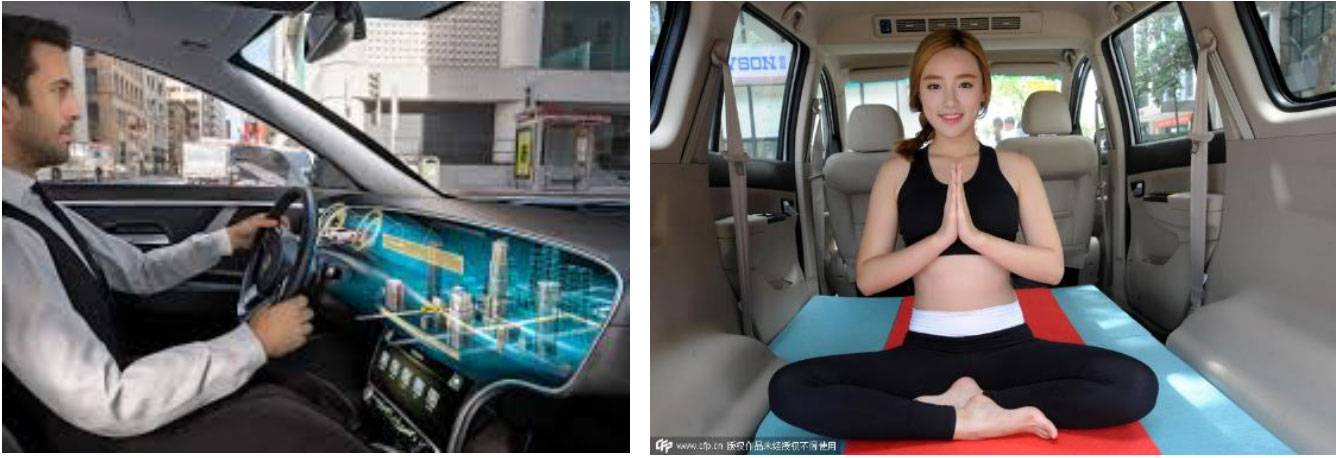
DVN-I has covered IAQ and hygiene in recent editions, and the absolute need of a continuous environment and protection level along everyone’s daily lifeline, from home to office, through transportation, shopping, and all the rest.
New levels of health concern amid the pandemic will push the industry to develop more human-centered, health-related features into cars for more demanding customers, and to help automakers bring forth USPs (unique selling propositions) to support a sales recovery and boost profit potential.
HMI, the human-machine interface, has always been important to secure proper interaction between the driver and car. In traditional driving, the focus was more on how the driver commands and operates the car—a one-way flow of intent and action. With today’s assistance systems, communication is in both directionss (with car feedback, through text, images, lights, sounds, vibrations, etc). The future will have more car-to-driver communication, for the car will in certain scenarios be the driver.
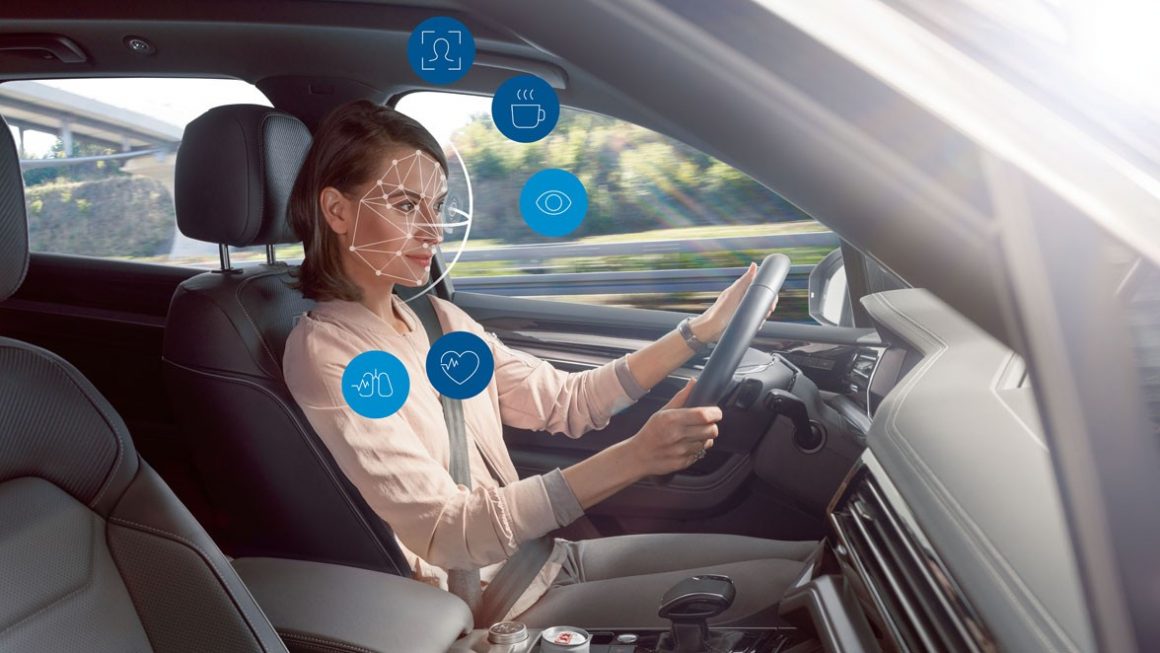
A combination of this automated driving advancement and present health concerns, will lead to many more interior innovations in term of HMI, which can achieve both targets, while providing an overall improved safety level.
DMS (Driver Monitoring System) will watch over the driver. DMS is pivotal to improve safety, for will be necessary for easy handoffs between human and autonomous driving required in L3 vehicles. DMS could also offer many other benefits in managing fatigue, drowsiness, cognitive load, personalization, and keeping track of health and wellbeing.
Contoured displays: Why do traditional buttons and switches fall so easily to hand? Because you can locate them purely by touch. A number of tier-1 suppliers are currently working on shaped touchscreens with features such as ridges and dimples to replicate this ability.
Finnish technology company Canatu has been working with Faurecia on stretchable and 3D formable touch surfaces for automotive interior applications. These use Canatu’s proprietary Carbon NanoBud (CNB) material, which is a hybrid of single-wall carbon nanotubes and fullerenes, designed to combine high electrical conductivity, favorable optical qualities and impressive formability.
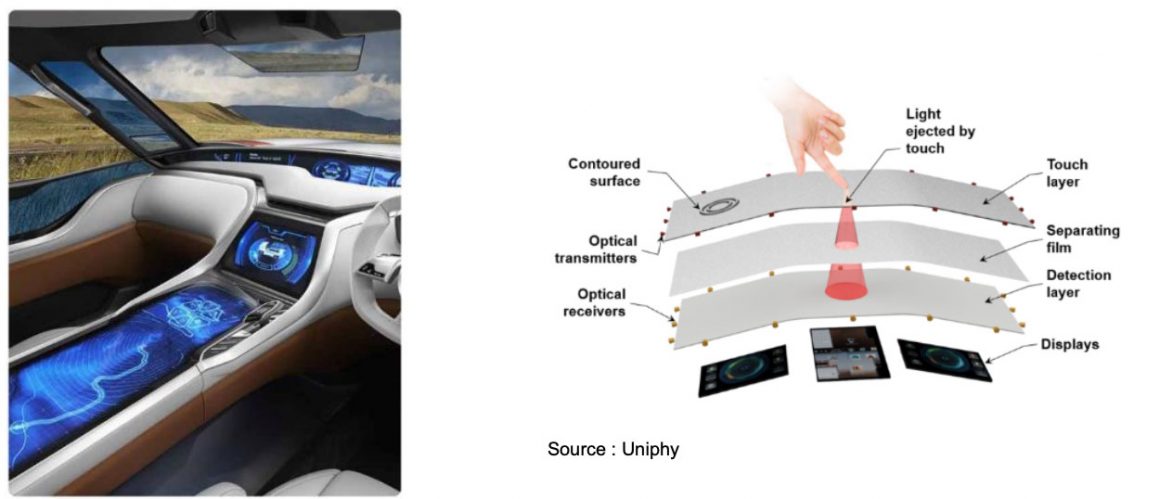
Uniphy’s “beyond touch” technology, combines design elegance and flexibility as well as ensuring safe operation by combining latest curved and contoured touch surface technologies, on-display buttons and integrated mechanical control dials.
The driver gets to operate the graphics display without the need for visual interaction.
Haptic feedback: Haptic displays take the sensation of touch one step further by mounting the screen on an actuator. By modulating the force feedback as the user moves their finger over the screen it’s possible to create the sensation of bumps, rides and textures on a completely smooth display.
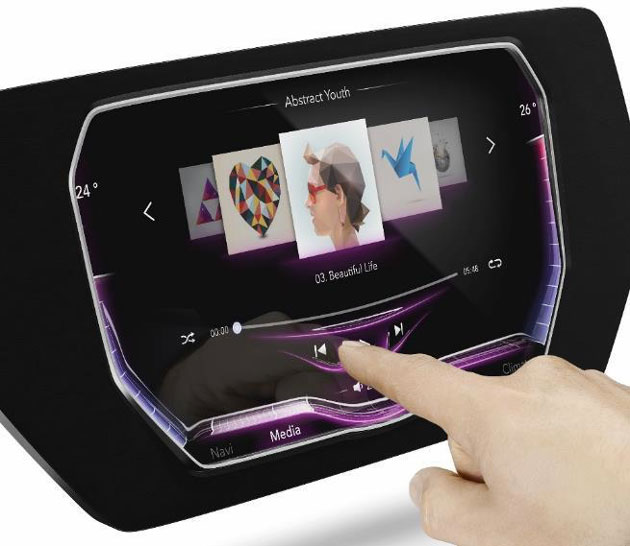
Continental was one of the pioneers of this concept with their Haptic Feedback Display, mounted on a series of electromagnetic actuators.
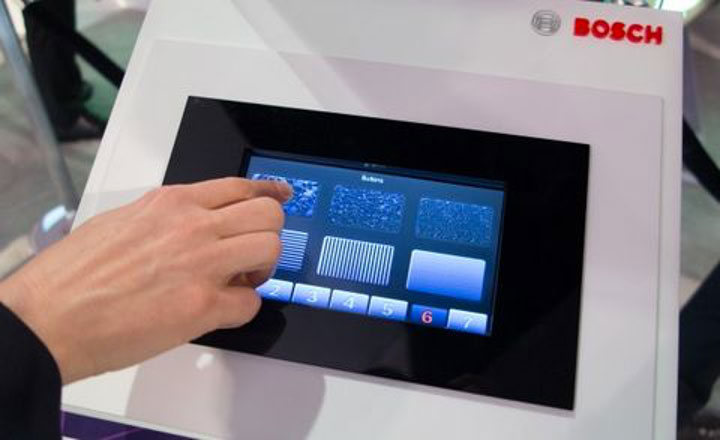
Bosch soon followed with their NeoSense interface. This monitors the pressure applied to the screen, so the user can gently swipe over the virtual buttons or press harder to activate them. Varying the pressure also allows the user to control other functions, such as the speed at which the system scrolls through its menus.
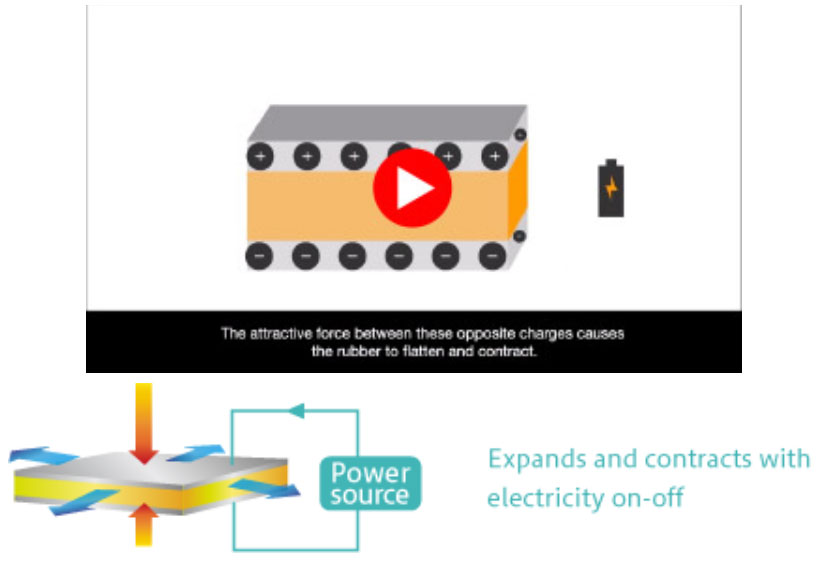
Toyoda Gosei’s e-Rubber is a novel rubber material that can function either as an actuator in response to electrical stimuli, or as a sensor in response to mechanical force. Its basic structure is a thin dielectric elastomer film sandwiched between two electrodes. This is a haptic technology that simulates various tactile sensations using these vibrations.
Simplify
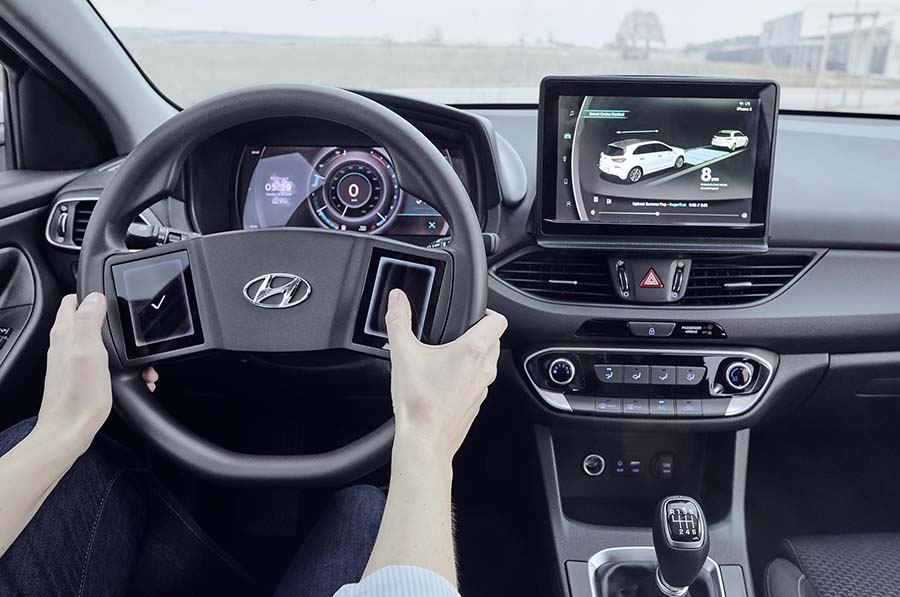
Hyundai’s Cockpit of The Future aims to clean up the human machine interface (HMI) around the steering wheel. Rather than many physical buttons, two miniature haptic display panels, one within reach of each thumb when your hands are placed on the wheel. “Currently we tend to see around 10 to 20 buttons on the steering wheel depending on the manufacturer,” explains Regina Kaiser, senior HMI engineer at Hyundai Motor Europe Technical Center. “In psychology, people talk about the Magic Number – seven plus or minus two – which is the number of tasks that people can typically hold in their short-term memory. We wanted to reduce the number of buttons on the steering wheel down to that level so they could operate them with muscle memory alone.”
3D Imaging: Challenge here is to improve driver information and reduce distraction. Therefore, use of 3D graphics will develop. It can bring important information to the foreground, while retaining less critical information behind. It enables focus and context, helps to effectively alerts the driver, and improves comprehension and readability.
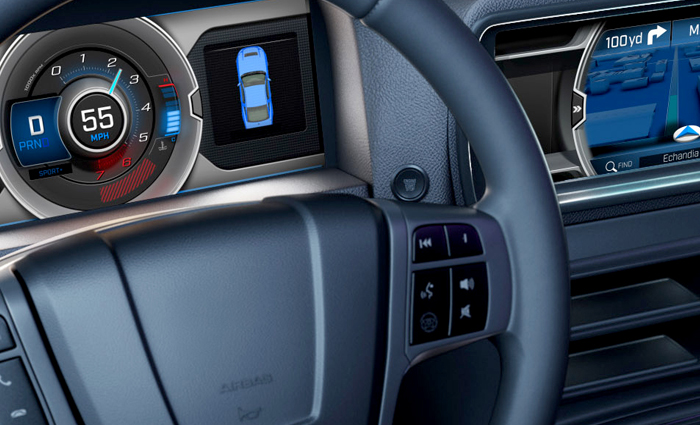
Aptiv’s (formerly Delphi Automotive) MLD (Multi-Layer Display) technology uses two LCD displays separated by a gap of 6 mm. This creates a seamless perception of depth without the need for special glasses or headtracking cameras.
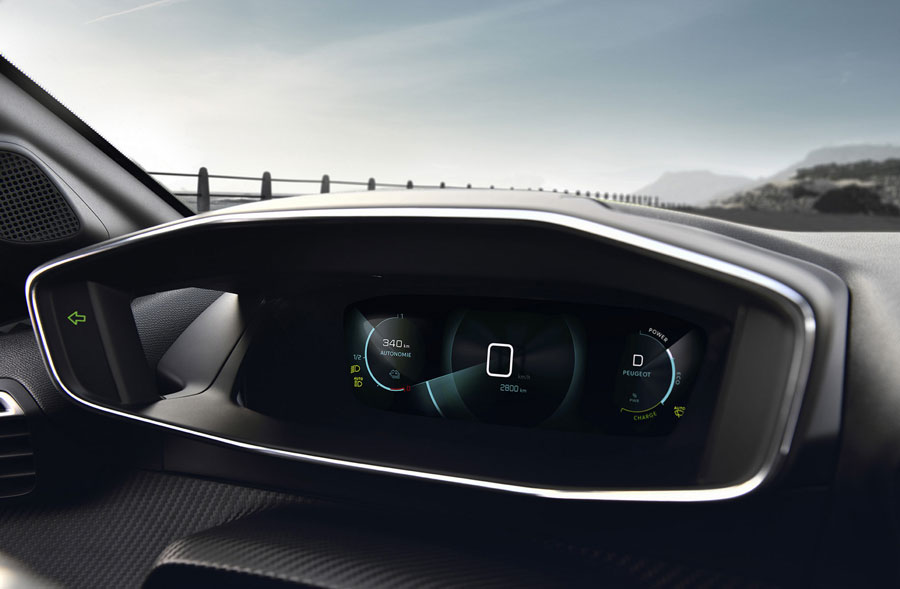
Visteon has applied a similar principle with their 3D Blade concept, which is used for the instrument cluster on the new Peugeot 208. It features a high-definition 10.25-inch ‘background’ TFT display and a 7-inch ‘foreground’ TFT display that’s projected onto a semi-reflective blade. The leading-edge display creates a 3D projection of approximately 15 mm between the front and rear images.
We’ve previously covered Marelli’s Glass-Free 3D Display technology, where 3D depth perception will take the guesswork out of when and where to turn, by virtually immersing the driver in the surrounding environment.
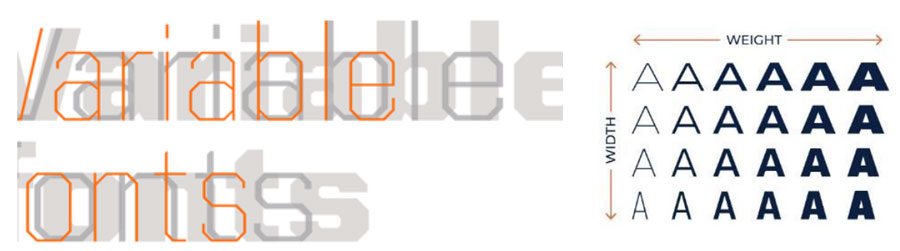
Variable fonts Monotype (Monotype Imaging Inc.) develops variable font technology which can creates variation on typographic message pending context (alert, light condition, language length). While improving readability, it saves computing capacity as many different variations of a typeface to be incorporated into a single file, rather than having a separate font file for every width, weight, or style.
In the next installment of this series, we’ll review many other HMI developments in other important domains, such as Driver Monitoring System, Voice and Gesture interaction, Mood Monitoring, and more. Overall it shows how these increasingly sophisticated HMI systems can simplify our interactions with our cars, even as the list of available features and capabilities is larger and more diverse than ever, and still growing.


