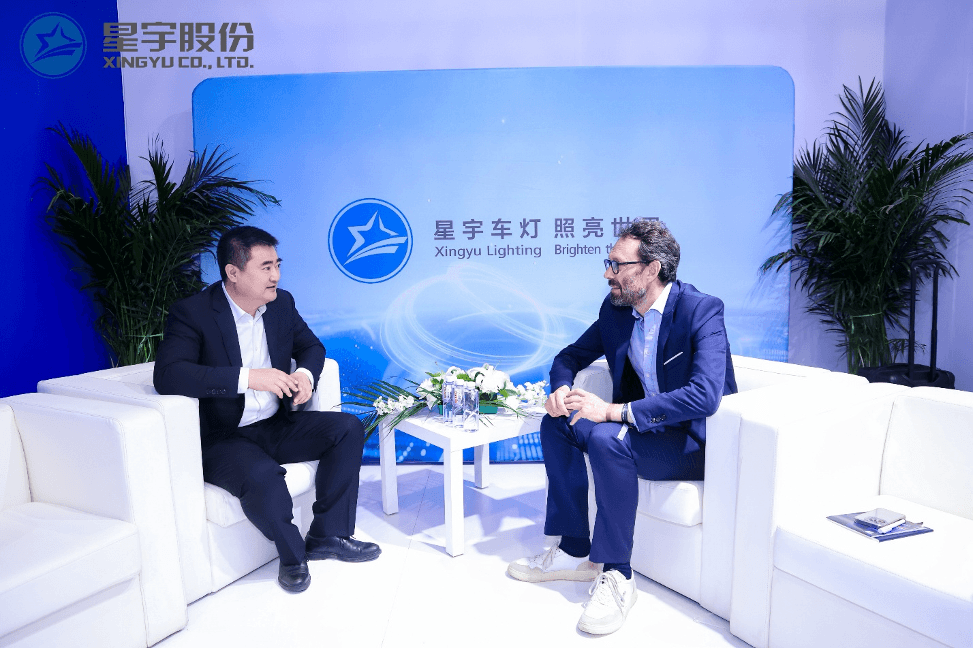
Paul-Henri Matha: Thank you Lin Shudong for this interview. Xingyu is showcasing static and dynamic projection lighting (including MLA and DLP technology). We know that SRP (signalling Road Projection) is permitted in China. Has Xingyu already equipped certain vehicle models with such turn signal or reversing projection modules? Which technology is currently predominant in the market?
Lin Shudong: Yes, we have previously mass-produced and supplied film technology and MLA technology projection welcome lights, as well as film technology turn signal projection modules for models such as Volkswagen and Chery. At the same time, Xingyu has completed the R&D reserve for cutting-edge technologies such as MEMS, DLP, and LFS (Laser fiber source), enabling colorful, dynamic, and editable intelligent experiences, which are also showcased at the Beijing Auto Show.

PHM: Xingyu also exhibits multiple MiniLED and RGB display products. Currently, it is indeed rare to see new vehicles equipped with such display technologies, as costs remain relatively high and the technology is not yet fully mature. When can costs truly decrease? What pixel pitch is the optimal (best compromise) choice?
LS: Currently, Mini LED/RGB ISD is indeed relatively expensive, and maturity is still improving. We estimate that within the next 2–3 years, as chips become localized and yields increase, once scale is achieved, costs will significantly decrease.
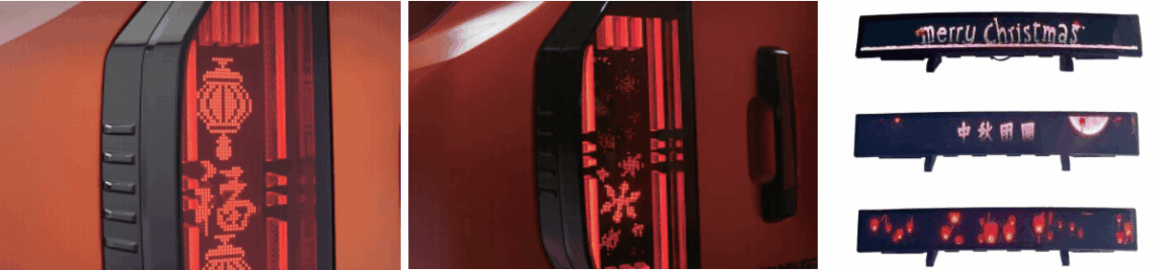
The optimal pixel pitch mainly depends on the application scenario. We are committed to providing customized optimal solutions for vehicles at different price points, different application scenarios, and different pixel pitches.
In this regard, Xingyu has unique advantages. We have formed strategic partnerships with leading domestic light source and chip suppliers to jointly develop cost-effective products for users.
PHM: What about headlight controllers, ADAS product controllers, and zonal controllers? How do you view the development trends in China regarding Software-Defined Vehicles (SDV), zonal controllers, and High-Performance Computing Units (HPC)?
LS: From an industry perspective, the advancement of three key areas—Software-Defined Vehicles (SDV), zonal controllers (ZCU), and High-Performance Computing Units (HPC)—is reshaping the technological landscape of the global automotive electronics industry.
Software-Defined Vehicles (SDV) represent the top-level design driving this transformation, and the market has already entered a phase of explosive growth. The core driver of this growth is the comprehensive shift in the electrical/electronic (E/E) architecture from the traditional “distributed” model to the “central computing + zonal control” architecture.
ZCU, as the “nerve center” of the new architecture, has entered the mass production stage and is now being adopted in mainstream consumer vehicles priced as low as the 150,000 RMB range.
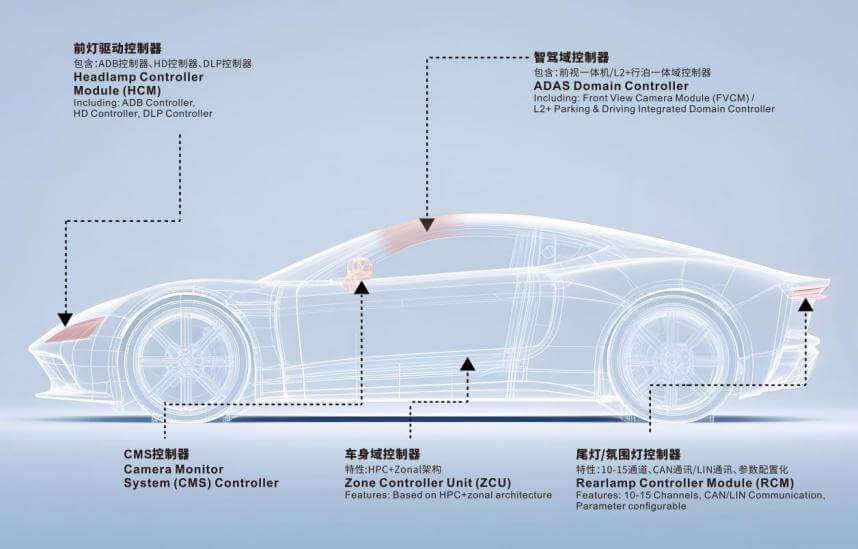
HPC, serving as the “central brain” of the new architecture, relies on breakthroughs in chip technology as the physical foundation for enabling all intelligent features. The competition in high-performance, high-computing-power chips is fierce, and the challenges are significant. The localization rate of high-end chips remains relatively low, especially in areas like the “central domain controller” chips, which are still heavily dependent on international giants such as Infineon and NXP.
PHM: Will the headlight ECU be retained, or will it be integrated into the zonal controller or HPC?
LS: Regarding the future of the headlight ECU, the answer is clear: traditional distributed headlight ECUs will be phased out on a large scale, and their core functions will be integrated into the zonal controller or the central HPC. This is determined by the combined demands of cost, efficiency, and the core requirements of the Software-Defined Vehicle.
Although integration is inevitable, before fully transitioning to the zonal + central architecture, the Lighting Domain Controller (LDC) will serve as an important “transitional form” and will be widely adopted for a period of time.
PHM: Do you think Ethernet will be applied to headlights in combination with RCP (Reconfigurable Communication Platform)?
LS: The integration of Ethernet and RCP (Reconfigurable Communication Platform) will be commonly applied to automotive headlights. This has become the mainstream technological path under the trends of Software-Defined Vehicles (SDV) and zonal architecture. Currently, leading industry players such as ON Semiconductor and Microchip have launched mature Ethernet+RCP solutions for headlight applications, some of which have already entered the mass production validation stage.
PHM: Regarding strategy, can you talk about vertical integration that is something I really see as a trend in China?
LS: Mr. Lin: The full-chain layout from atomic root technologies to the vehicle scenario is primarily driven by the following considerations:
First, to address industry transformation. Automotive lighting has evolved from traditional illumination to software-defined intelligent interaction units. Without mastering underlying technologies like chips, materials, and algorithms, it is impossible to develop truly intelligent automotive lighting.
Second, to achieve autonomy and controllability. Key light sources, chips, and materials have long been dependent on overseas suppliers. By focusing on root technologies, we aim to take control of our technological destiny and ensure supply chain security.
Third, to build long-term competitiveness. Vertical integration allows for better cost control, improved R&D efficiency, and rapid responses to the new architectural needs of OEMs. This strengthens our confidence in competing in the high-end and global markets.
PHM: So, can you give us some examples of vertical integration and/or collaboration?
LS: We emphasize the deep integration of scenarios, technology, and chips, with the core focus on building an industrial ecosystem led by automakers, driven by Xingyu, and deeply collaborated with upstream and downstream partners. On one hand, we engage with OEMs early to define intelligent lighting scenarios. On the other hand, we collaborate with chip, material, and optical enterprises for joint R&D, achieving end-to-end synergy from demand to technology and manufacturing.
In terms of source control, we collaborate with chip companies on joint R&D and problem-solving, adopting forward chip definition to ensure chips are better tailored to automotive lighting scenarios. In materials, we also partner with suppliers to develop specialized automotive-grade materials based on industry pain points, cost considerations, and quality requirements, ensuring quality control from the source.
PHM: Xingyu’s R&D investment over the past three years has exceeded 20 billion RMB, and the company possesses multiple high-level R&D platforms, including a National-Level Enterprise Technology Center and a National-Level Industrial Design Center. With the rapid transformation of automotive lighting from traditional functions to intelligent visual systems, how does Xingyu’s R&D system and talent system support the technological leap from lighting components to intelligent interactive systems?
LS: We have indeed invested significantly in R&D. In terms of the R&D system, with the National-Level Enterprise Technology Center and National-Level Industrial Design Center as core platforms, we have established a full-chain R&D system covering optics, structure, hardware, electronics, software, algorithms, and system integration. We have also set up over 10 R&D centers both in China and abroad, forming a complete closed loop from fundamental technology research and product development to mass production validation.
In terms of talent, we have a large interdisciplinary R&D team. Through university-enterprise collaborations, high-end talent recruitment, and internal training, we continuously strengthen our talent pipeline. We have also established a sound innovation incentive mechanism, generating a substantial number of patents and new technologies annually. This provides solid support for the transition from traditional lighting to intelligent interactive systems.
PHM: Then I understand you cover the full HW and SW skills to develop new lamp intelligent system. Having everybody on the same roof, how does it increase the development speed, from initial concept to mass production?
LS: The greatest advantage of full internal chain integration is that insight, R&D, process, and manufacturing can advance simultaneously. This enables faster prototype development, higher efficiency, and quicker internal problem resolution. Moreover, with a complete technology stack, we can deeply integrate with real-world vehicle application scenarios, allowing us to more precisely define next-generation intelligent headlight products. It is precisely this systematic advantage that empowers us to lead the industry in both technological direction and market demand.
PHM: Lighting is not only a styling component. With intelligent lighting, Software is depending on computing platforms. ADAS/AD is requesting more lights for its perception sensor and software. How are you connecting with these worlds?
LS: Our core concept is to upgrade automotive lighting from an execution terminal to an intelligent entity that combines styling aesthetics with perception, computing, and interaction capabilities. This is mainly reflected in the following three aspects:
First, we are building full-stack in-house capabilities integrating “perception, illumination, display, projection, and control.” We are no longer limited to light source and optical design but have deeply engaged in perception algorithms, dedicated chips, and control systems. For example, our “Perception-Fusion Headlight Control System” integrates high-pixel visual sensing and real-time processing capabilities, enabling the headlights to “see” road conditions and make dynamic beam adjustments. More importantly, upstream in the industry chain, we have achieved key breakthroughs through collaboration with ecosystem partners. For instance, in the “iVISION Smart Eye Headlight” launched in 2025, we were the first in the world to integrate an automotive lighting‑dedicated AI computing chip provided by Ouye Semiconductor and a domestically produced silicon‑based Micro LED light source provided by Lattice Power. This marks our ability to define products in the most critical areas of “computing power” and “pixel light sources.” Additionally, Xingyu’s full‑stack in‑house HD intelligent headlights have already achieved mass production in the Nio ES8 and ES9, with new designated models at Geely, Hongqi, Volkswagen, and others.
Second, we are engaging in deep “ecosystem integration” with leading intelligent driving companies to achieve joint innovation. Since entering into a strategic partnership with Huawei in 2022, we have developed into a top‑level strategic partner in Huawei’s intelligent automotive lighting field. This cooperation is no longer a simple supplier relationship but involves full‑chain collaboration from product definition and technology R&D to mass‑production delivery. A typical case is the AITO M9, where our pixel headlight system is deeply integrated with Huawei’s million‑pixel smart projection module. This not only delivers ultimate adaptive driving beam (ADB) glare‑free functionality but also extends to innovative scenarios such as lane‑level light carpet navigation and outdoor large‑screen projection, jointly defining a new standard for “smart lighting.” Similar deep collaborations have also been implemented in high‑end models such as the Stelato S9, Zeekr 9X, Luxeed V9, Xpeng GX, Hongqi Guoya, and models under the Qijing and Yijing series.
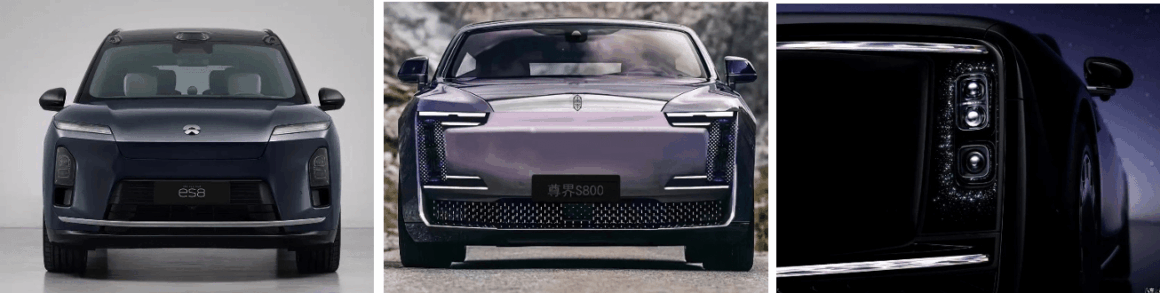
Third, we are driving the value leap of intelligent automotive lighting from “function” to “interaction” through forward‑looking products. Our implementation cases clearly demonstrate this path. For example, in the Li Auto i6, our starlight ring light is not only a design symbol—its internal architecture is already prepared for future OTA upgrades to enable autonomous driving status prompts linked with LiDAR. In the NIO ES9, the “interactive smart light carpet” we created provides safer interaction for users during night driving, where the lighting has become an emotionally warm interactive partner.
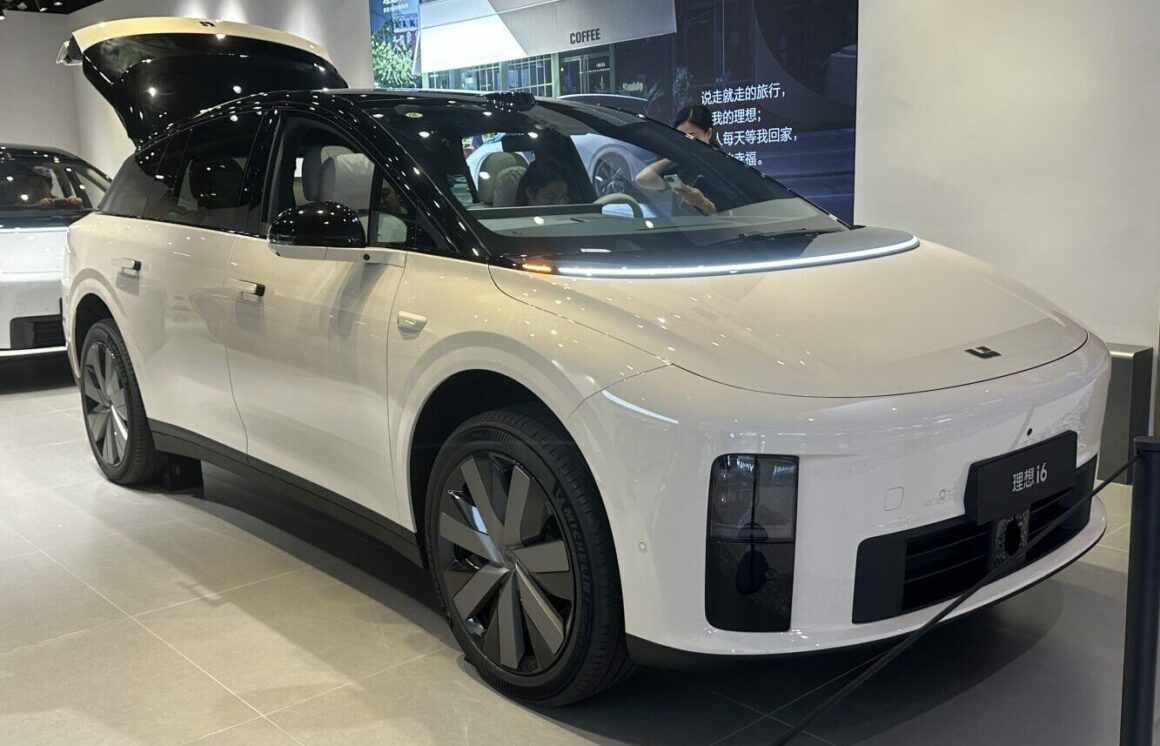
In summary, Xingyu’s strategy is systematic: in insight, we accurately grasp industry and user needs; in optics, we continuously iterate optical systems; in hardware, we break through core chips and light sources; in software and systems, we develop algorithms in‑house and integrate into ecosystems like HarmonyOS; in manufacturing, we have built high‑standard digital factories. Currently, our intelligent automotive lighting solutions have gained wide market recognition, with a leading domestic market share, and we are engaged in full‑cycle collaboration with multiple mainstream automakers, from pre‑research to mass production.
We believe that the headlights of the future will be the “eyes of the intelligent vehicle”—they must not only see clearly and understand, but also express and communicate.
PHM: Lighting technology is changing really fast. During vehicle life cycle, OEM are willing new features, that are sometimes possible with OTA. From a manufacturing side, how do you adapt?
LS: Xingyu possesses end‑to‑end vertical capabilities that span R&D, process, equipment, mold, electronic SMT, and manufacturing. Through digitalization efforts over the past three years, the company has achieved Level‑4 Intelligent Manufacturing Maturity certification.This enables Xingyu to maintain the economic efficiency of large‑scale production—delivering billions of RMB worth of automotive lighting annually—while also developing the flexible capability to respond swiftly to technological iterations.
PHM: Software new possibilities is changing the classical business and relationship between OEM, tier1 and tier2. OEM are sometimes struggling to transform a design sketch into a lighting video sequence (I still see some excel files with thousands of columns and rows). What are your views about that?
LS: Xingyu possesses full‑stack R&D capabilities for intelligent automotive lighting system software, offering flexible support for the architectural requirements of different automakers. To address the image and video presentation needs of intelligent lighting, Xingyu has developed a series of toolchains that can translate customer requirements into real‑world visual presentations in seconds. Using AI to recognize customer needs, the system can automatically generate videos or patterns, which are then directly converted into binary data via professional tools and transmitted to the lighting controller for display.
These software capabilities allow Xingyu to provide customers with system‑level solutions alongside the delivery of intelligent lighting hardware. A core demand in the intelligent lighting market is the rapid iteration of scenarios and quick refresh of visual presentations. Xingyu’s full‑stack software R&D capabilities provide strong competitiveness in this area.
PHM: What about regulation? How is Xingyu involved in regulation making in China? For example, I know took the lead in formulating the ISO/TS 5385:2022 standard, which is the first ISO standard approved for China’s automotive lighting industry
LS: This standard is the first ISO standard in China’s automotive lighting industry. It mainly focuses on the anti‑fog coating of automotive lamps, specifying the relevant technical requirements, test methods, and evaluation criteria, thus filling an international gap in this field.
Regarding standardization for intelligent automotive lighting, we will focus on areas such as interaction rules, performance evaluation, functional safety, communication protocols, and system‑level testing and verification. As the leading unit of the industry standards working group, we will continue to participate in and promote the development of relevant standards to help the industry develop in a more standardized and healthy manner.


