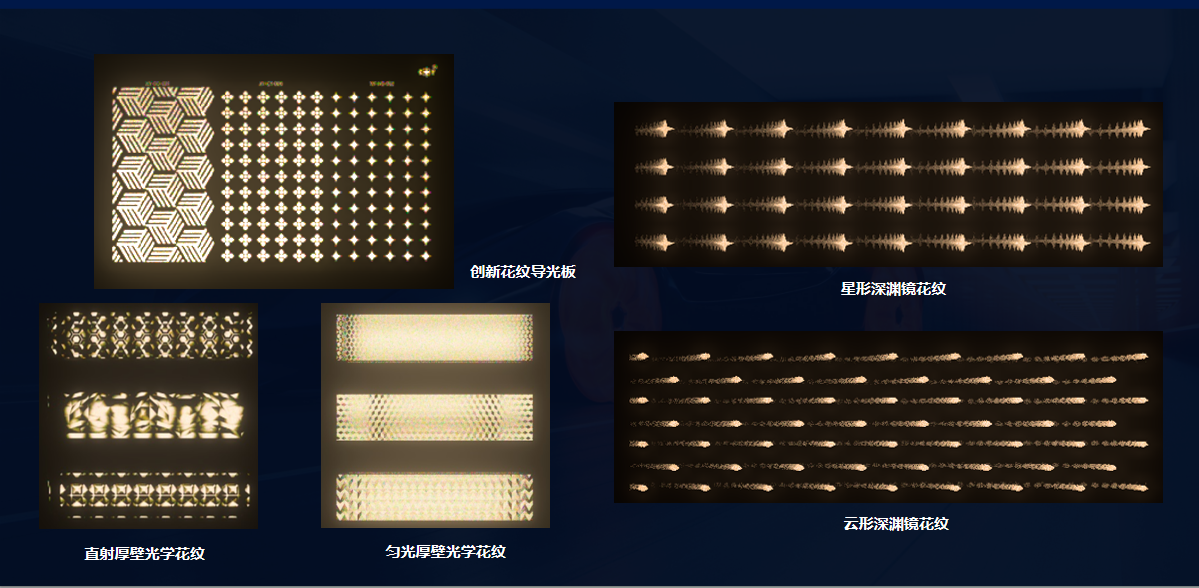
At the ALE conference, Xingyu showcased their innovative optical pattern technology. By integrating new materials, advanced processes, and precision machining techniques, it creates distinctive optical textures and lighting effects on automotive lamp surfaces, significantly enhancing visual appeal and optical performance. It extends the functional boundaries of textures into the realm of multimodal interaction.
The core of the technology is Xingyu’s independently developed composite process of 3D laser engraving and electroforming. Through ultrahigh-precision multidimensional texture carving with an accuracy of 0.01 to 0.05 millimetres on transparent substrates such as PC or PMMA, Xingyu achieve unparalleled levels of detail in light and shadow. When illuminated, these intricate textures produce a variety of stunning visual effects: sparkling starry patterns, gradient ripples, and dynamic light interplay. In the unlit state, the lens retains a crystal-clear quality.
Xingyu also presented CMF Surface Light Source technology.
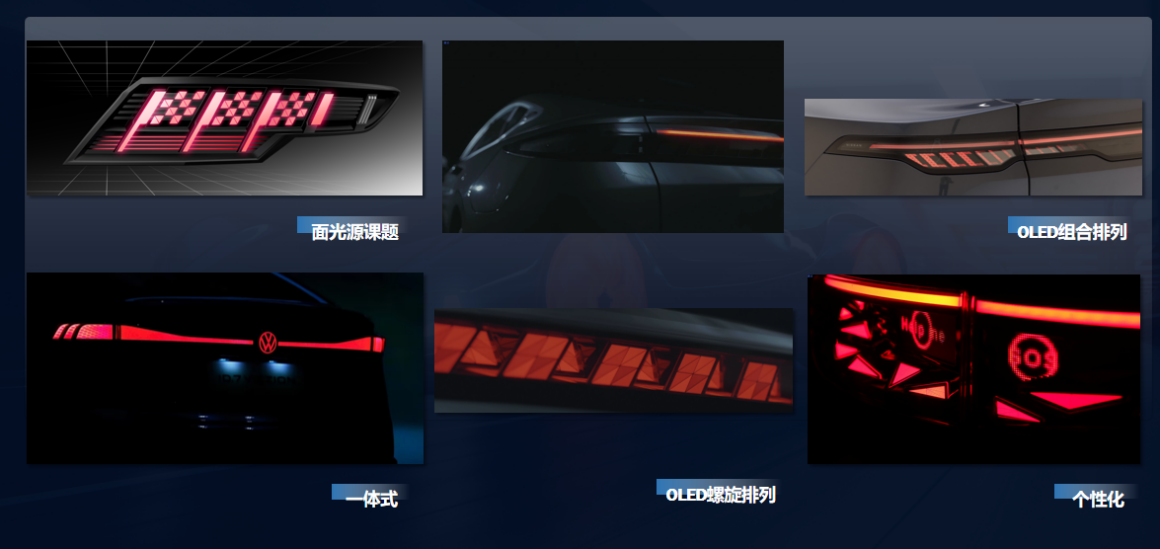
It features a micron-level pyramid array combined with an exponential distribution compensation microstructure. With proprietary algorithms, the technology precisely controls the height, angle, and distribution density of tens of thousands of microprisms. This dynamically compensates for light transmission attenuation within the light guide, ensuring the luminance difference between the centre and edges of the illuminated surface is maintained within 5 per cent, completely eliminating uneven streaks.
Compared to traditional etching processes, this technology achieves a 40-per-cent improvement in optical efficiency and reduces power consumption by 30 per cent at the same brightness level. A breakthrough innovation lies in the integration of dual-colour co-extrusion and in-mould microstructure synchronous forming technology, which combines transparent light-guiding substrates with dark light-blocking baffles in a single injection molding process. This achieves a precise boundary resolution of 0.1 mm, effectively preventing light leakage and stray light.
The light guide plate thickness is reduced to 2.5 mm, enabling compatibility with complex forms such as curved and ultralong continuous designs. This meets the streamlined design demands of new vehicles, achieving the integrated effect of invisibility when off, pure and seamless light when on.
Xingyu’s surface light source technology integrates texture, colour, and CMF effects – matte, glossy, and smoked finishes – and supports dynamic lighting, zoned control, and brand logo light projections. This elevates vehicle lighting from a functional component to the core of a brand’s visual identity.
The third innovation they presented was the ‘floating effect’:

Xingyu’s floating structure employs a multilayer transparent optical layering architecture, featuring a nested design of dual- or triple-layer independent light guides combined with a dark background base. Each light-guiding layer independently manages the luminous area, texture, and lighting effect, while a precise 0.3 – 1 mm air gap is maintained between layers to create a physical depth differential. By using localized illumination and microstructure offsetting, Xingyu’s floating technology breaks away from traditional uniform full-surface lighting, delivering a visual perception of ‘floating depth’ that appears to hover in space.
The floating structure adopts an ultrathin light guide design, keeping the overall thickness at or below 3 mm. It is compatible with curved, full-width, and hidden lamp forms, achieving a seamless black-surface appearance when off for perfect integration with vehicle body trim, while instantly revealing a floating light pattern upon illumination. Through microstructure optical compensation and total-internal-reflection light recovery, the luminous uniformity exceeds 92 per cent. This eliminates uneven bright-dark streaks. The multilayer structure, combined with light-absorbing backgrounds, suppresses over 95 per cent of stray light for clean, sharp, translucent floating visuals that exude a premium aesthetic.
The technology supports a variety of surface finishes, including smoked, matte, high-gloss, semi-transparent, and coloured textures. It can be customized with floating motifs such as stardust, galaxy patterns, rings, lines, or brand-specific graphics, paired with monochrome, dual-colour, or RGB light sources to create unique light signatures and visual brand ID.


