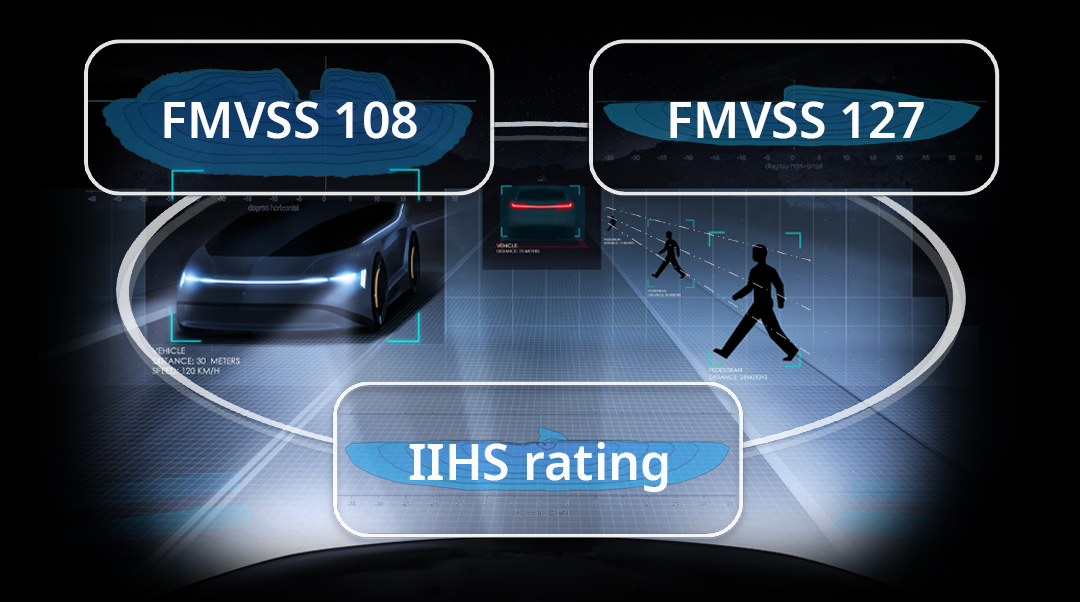
In the United States, all new vehicles must be equipped with AEB (automatic emergency braking) systems compliant with FMVSS 127 by September 2029. As of now, the night scenarios with pedestrian detection by low beam light only is still a pain in the neck.
The specified pedestrian dummy is designed as explained by Colby Childress from Marelli in his speech. The blue trousers have high reflectance for blue wavelengths, maybe an advantage for LED headlamps.

With an ordinary VOR low beam, 50 per cent of a pedestrian will not be visible; mainly just the trousers will be visible.
Colby wondered whether the low beam pattern can be optimized to improve camera detection. Good question! In FMVSS 108, there are limitations in maximum light above the cutoff.
The 50-metre-distant/right-side pedestrian in the FMVSS 127 test, with a lamp mounting height of 85 cm, may be covered by a new beam pattern with 1,200 cd at head level (for example) or 1,500 cd at waist level.

A modified beam pattern, fulfilling FMVSS 108 and compatible with IIHS criteria (to avoid glare demerits) may be able to put light on head and waist, as shown below.

One additional difficulty would be to make this low beam compatible with ADB, where glare limits above the cutoff are more stringent. Instead of putting 1,250 cd on the pedestrian head at 50 metres, it would put only 790 cd, Colby explained.

Then, Colby proposed a beam pattern compliant with FMVSS 108 low beam + ADB, and also capable of getting an IIHS “good” grade, with a VOR cutoff.

Which beam would be enough for camera detection? is the criteria 1,250 cd at 1.1 degree up / 1,600 cd at 0.2 degree up a good requirement?
Also, the higher the lamp is, the better the detection is (if we consider same lamp aiming). Pedestrian detection is clearly easier with higher lamp mounting height, as on trucks.
Will the glare be acceptable? A lot of people are complaining that U.S. low beams are already too glaring.
Will it be enough for the front camera to detection the pedestrian? That answer needs to come from camera suppliers – and all of them are invited to answer!
In the last part of the presentation, Colby investigated the issue with aiming tolerances. He mentioned that a lamp misaimed 0.2 degree down would badly degrade the pedestrian detection. Aiming accuracy would then become even more important versus IIHS. We’ve written about headlamp aim in North America before (once, twice); it’s a longstanding and ongoing problem – getting worse as lamps evolve in ways that make them more sensitive to misaim in terms of seeing performance and glare output.
Nevertheless, if this idea works, implementation may be easy with Marelli’s K-light standard module, as an example. One additional LED could be activated in low beam (and off in ADB). With HD lamps like microLED, would even make it easier to activate / deactivate some pixels in some scenarios.
An alternative may be to add an IR 850-nm LED, not human-visible but camera-visible. That could add the needed light without adding more glare.
As a conclusion, it seems headlamps can support front camera performance pursuant to meeting FMVSS 127. To get there from here, we’ll need close collaboration between lighting & ADAS teams.


