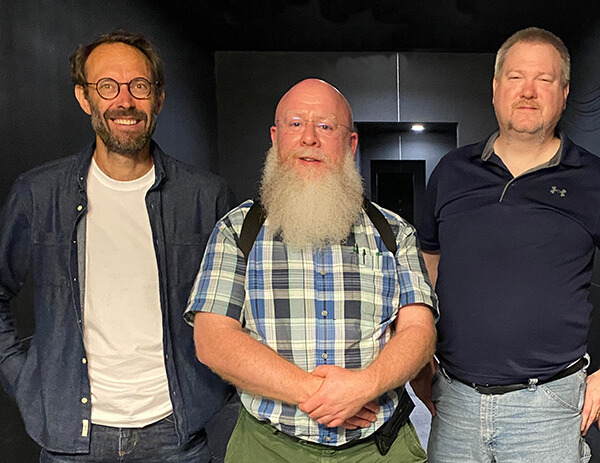
By Daniel Stern, DVN Chief Editor
For years, Calcoast – ITL has been a widely trusted laboratory for all kinds of tests on all kinds of vehicle lighting equipment. Detailed examples of their work can be seen, for example, as all eight test reports in the attachments section of NHTSA docket 2021-0061. Mark Evans ran the lab for quite a while, and he and test engineer Douglas Cummins have been frequent participants and contributors in the SAE Lighting Systems Group. Now, Evans has sold the business to Cummins, who gave us a tour of the lab’s comprehensive test facilities in California and shared his thoughts with us.
DVN: Douglas, will you tell us about yourself and your background?
Douglas Cummins: I graduated from the University of California at Berkeley in 1993 with a BS in Mechanical and Nuclear Engineering. I can’t say that I was a remarkable student in college, but I took comfort from one of my early professors, who stated – when quite a large number of us didn’t perform well on a midterm exam – that we should recognize that since we were accepted to such a difficult school, we were all likely geniuses, so an average performance in his class just meant that we were average geniuses.
DVN: What’s the backstory on how Calcoast-ITL got started, and evolved to its present position?
D.C.: The origin of Calcoast – ITL starts in the 1950s, when UC Berkeley was contracted by the state of California and California Highway Patrol to perform research on retroreflective road markings and lighting (or so I have been told). They were located in Building 180 at UC Berkeley’s Richmond Field Station. When the research was complete and no longer funded, the professor in charge, Dennis Finch, bought the test equipment and set up an independent lab, in a Berkeley warehouse, called Industrial Testing Laboratory (ITL). In the 1980s, ITL was purchased by another lab that specialized in analytical chemistry, called Calcoast Analytical. The labs merged and became Calcoast Analytical – ITL. Later, Mark Evans was hired to be the test engineer in charge of lighting testing. In 2001 he purchased the lighting lab and the two labs split into Calcoast Analytical and Calcoast – ITL. For some time, the two labs shared facility space in Emeryville, California, but in 2013 Calcoast – ITL moved to its current location in San Leandro, California. I just purchased the lab from Mark at the beginning of 2026.
DVN: How and when did you come to work at Calcoast-ITL?
D.C.: I started at Calcoast – ITL in 1994, a year after graduating from college. I was poring through listings at the university’s job center and stumbled across an advert for a lighting test engineer. I applied and apparently impressed enough to get hired.
DVN: What’s the scope of Calcoast-ITL’s services and activities? How about prospects for expansion?
D.C.: Calcoast – ITL is an ISO 17025-accredited independent product compliance test lab specializing in automotive lighting and roadway visual safety products. We test just about every kind of lamp that is found on an automobile – primarily for the North American market, although we have a partnership with DEKRA in the Netherlands so we can also perform UNECE testing. Another large industry we serve is testing reflective sheeting where we’re pretty well-known. I am active in SAE with developing and maintaining standards, and I am starting to do the same with ASTM.
I’m still finding my feet as a business owner, so thoughts of expansion are still off in the future. My focus right now is improving our current test program and making sure our current clients are satisfied.
DVN: What kinds of customers do you serve? What other kinds would you like to serve?
D.C.: We serve just about everyone. We have government / regulatory customers, large and small OEMs, aftermarket manufacturers, distributors, and the occasional legal consulting.
DVN: Of course, paying work is paying work. But what are your favourite kinds of work to do, and what makes them so?
D.C.: It’s always interesting to see new lamps coming through for testing and how they work, and see what the manufacturer wants to focus on for the vehicle. I’ve always liked performing reflex work so that’s probably my favorite kind of testing.
DVN: Now you’re in charge of Calcoast-ITL, are you planning changes? Upgrades?
D.C.: I don’t know about changes. Everybody has a different work style and focus, and mine are definitely different from Mark’s, but both of us want to make sure that our customers are best served not only with accurate test data, but also with guidance and advice on any questions or concerns they may have.
Obviously, upgrades are in the future – they always are. Every company has to implement them to accommodate new technology.
DVN: What are some difficulties and irritations you face in doing your work? Do you think some of them could be reduced or eliminated with changes to external factors like technical standards or regulations?
D.C.: This is probably a leading question as I’m sure anybody in the automotive industry can attest when dealing with the USDOT/NHTSA. Of course, NHTSA standards could be (much) better when dealing with today’s technology, but even the UN’s new simplified regulations could be better. I think a lot of difficulties could be reduced or eliminated not only with changes to the regulations and standards, but the participation of the regulatory agencies to address questions and concerns from designers, manufacturers, and test labs. My primary annoyance is when I have customers ask if something is possible or may cause an issue with a regulatory agency and I have no good answer other than “maybe”.
DVN: Imagine you have a magic wand and can use it to change three things about vehicle lighting. Could be anything at all; what are your three wishes?
D.C.: Well, first and foremost, we’re supposed to be an unbiased and independent test lab, so my primary job is to test submitted samples to the given regulation, industry standard, or customer’s own requirements. I have been asked numerous times if a product is good and my reply is always that I don’t determine if products are “good” or “bad” – only if they are compliant or non-compliant to the specified standard.
That said, the biggest thing I’d want to change are headlamps – neither the US nor the UN headlamps seem to have requirements that have a reasonable basis for road performance. The UN has made some improvements, but the US requirements are still essentially based around sealed beam headlamps from the 1970s. The aim cutoffs for both markets still leave a lot to be desired whether it’s the cutoff aim at 1 per cent below the horizontal (0.57°) for UN headlamps or the cutoff aim at the horizontal (0°) for the US VOR headlamps. Neither is ideal – either there isn’t enough light going down the road with the UN cutoff or there’s too much light causing glare with the VOR cutoff. My opinion would be to split the difference and put the cutoff 0.25° below the horizontal to get the best balance between road light and glare light. Also, limit the headlamp mounting height to around one metre, so the cutoff would be below the majority of cars’ mirrors to prevent headlamps blinding drivers.
The next thing I’d like to change is the current trend of making small, thin lamps. In the past, lamps were a minimum size because they required an incandescent bulb, a reflector, and/or an optical lens to meet requirements. But today with LEDs one can make a very tiny lamp that meets all the current requirements – but is probably not the greatest for conspicuity or glare. In the past, conspicuity was a given so there was no need to have detailed requirements, but today I think it’s an unrecognized or at least potential problem. One example is backup (reversing) lamps – while the driver has the advantage of numerous safety systems including backup cameras and sensors, pedestrians should still have some ability to recognize that a car is about to back up toward them because their backup lights are on. I have noticed that for some cars, their backup lamps are so small that you may not notice them illuminated when it’s a bright, sunny day.
The last thing is rather minor, but I think the minimum intensity for tail (rear position) lamps should be increased. The current minimum [2 cd in MVSS 108; 4 cd in UNECE] is fine when the weather is good, but I’ve noticed a number of cars’ tail light is very difficult to see in fog, rain, or similar inclement conditions. I think that the minimum requirement for the tail function should be 10 per cent of the stop function’s minimum. Technically, a car manufacturer can add a fog tail (rear fog) lamp, but it is little more than another stop lamp that is steady-burning, which most drivers would either never turn on or leave on all the time.
DVN: Thanks, Douglas! Congratulations and best of success to you as new owner of Calcoast – ITL.


