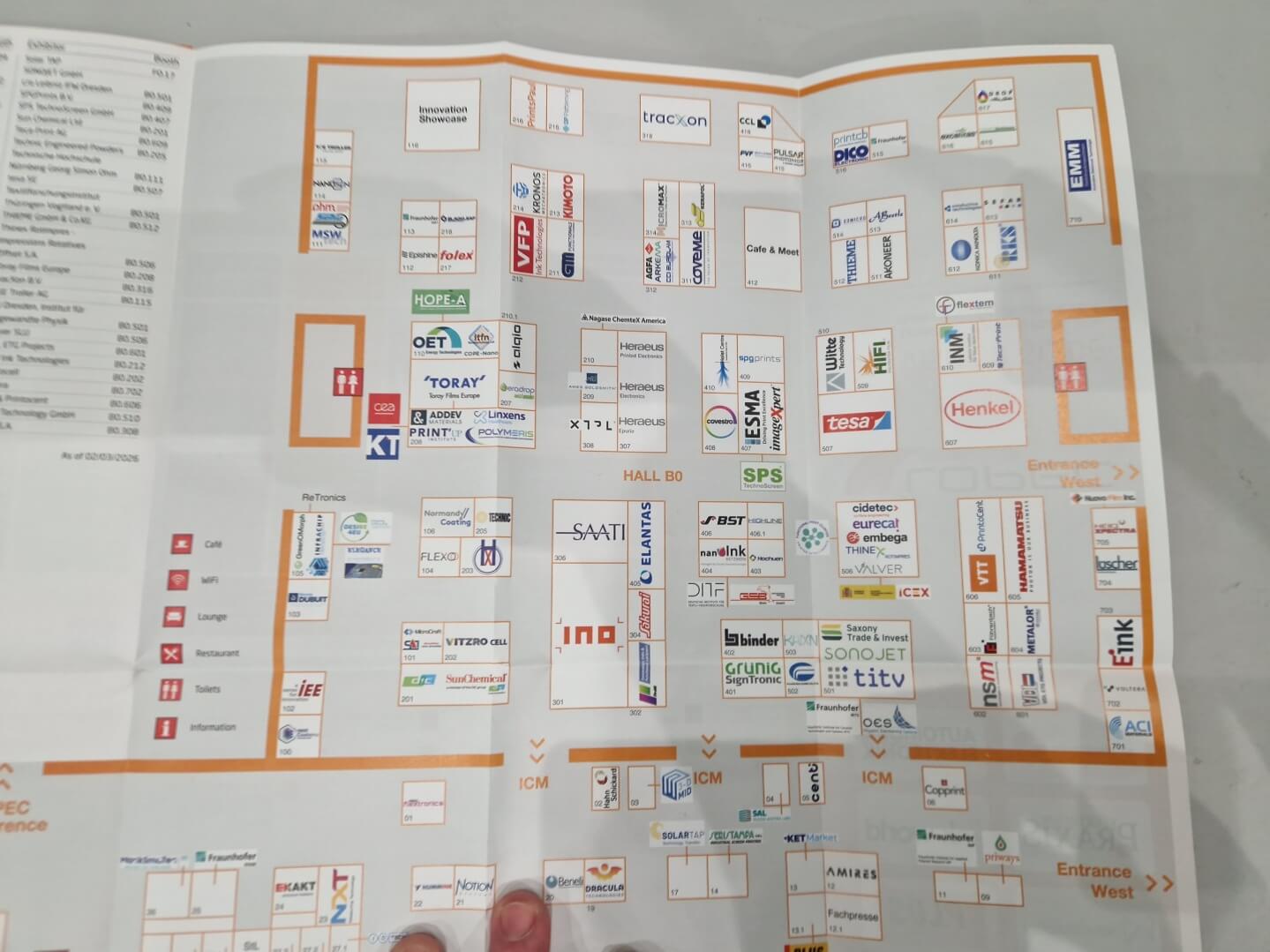
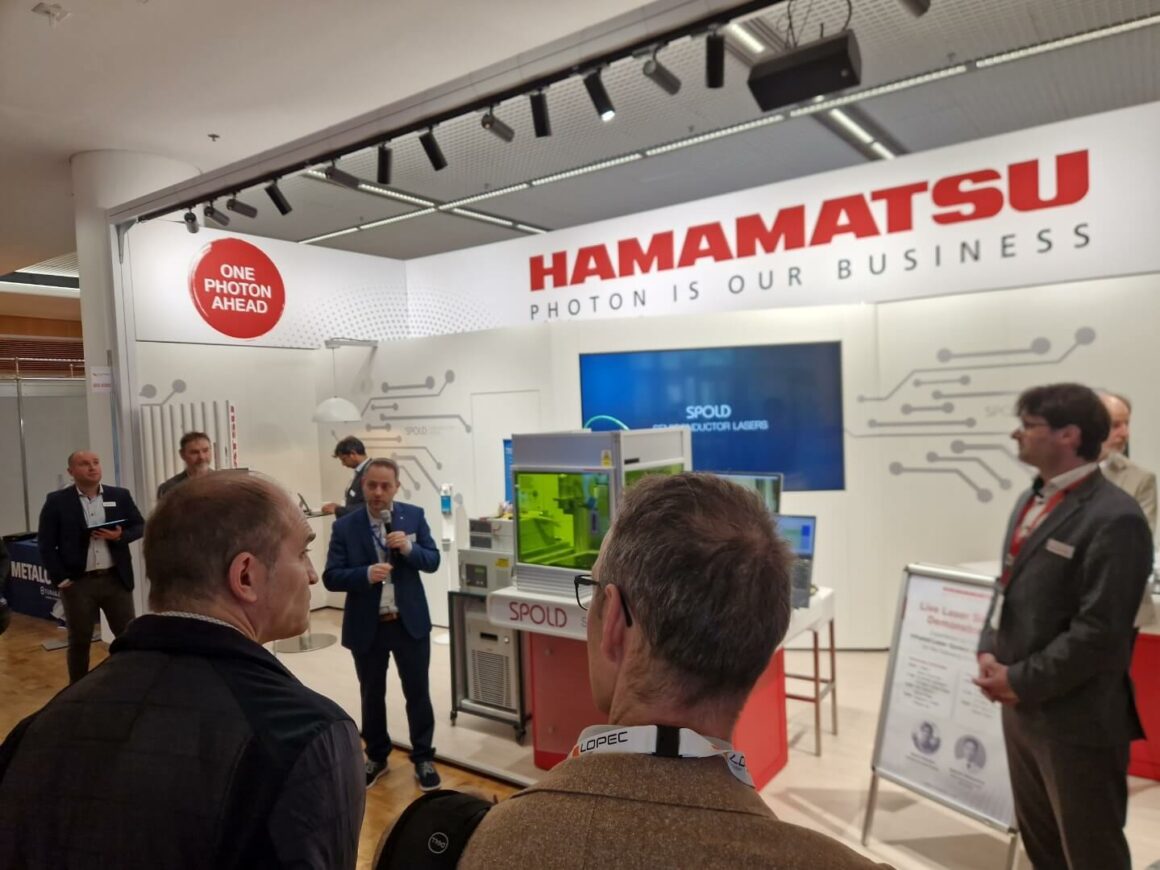
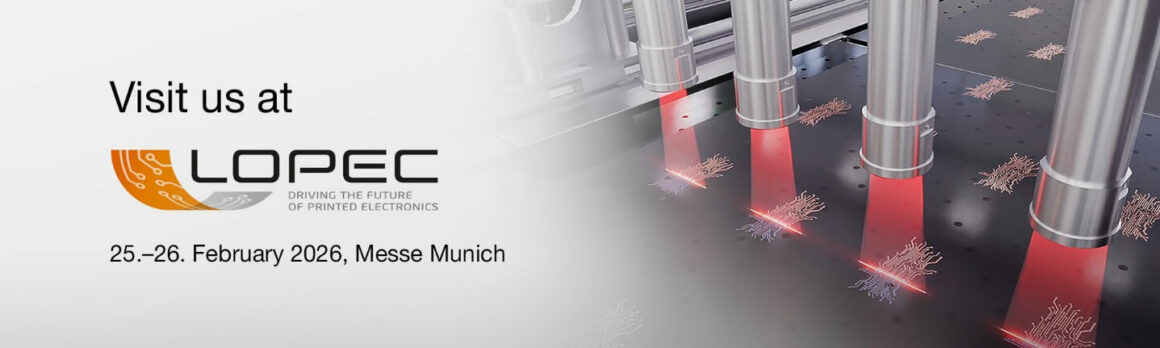
Hamamatsu’s was an impressive booth to discover high-speed laser processing systems for printed electronic applications. Functional inks can be sintered very fast, without thermal impact on sensitive substrates such as PET, PI, and glass. Take a look at this video.
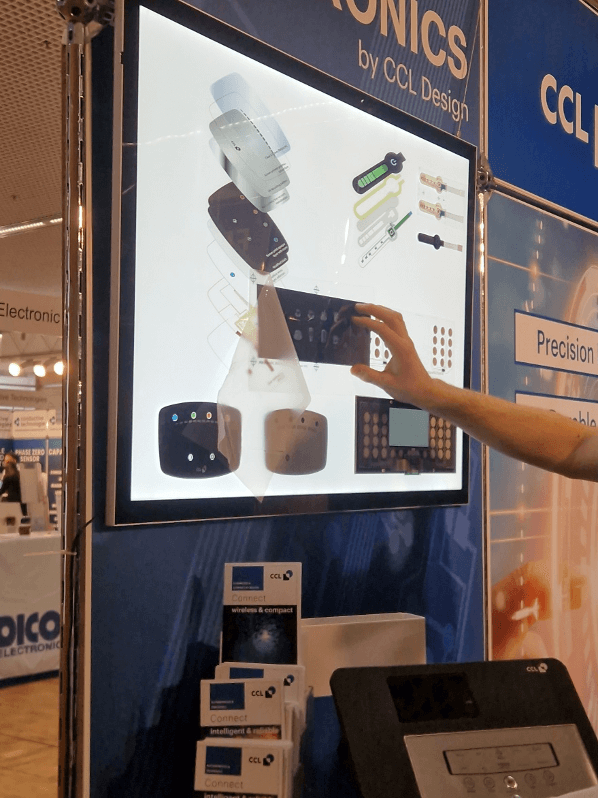
LOPEC 2026 made one thing clear: the center of gravity for printed electronics remains the cabin, where plastic trim becomes an interface: decoration + HMI + functions (heating, sensing, connectivity) embedded into film/ink/coating.
The substrate: dimensional stability decides your registration
A film is not a neutral carrier. It requires when you combine printing, curing and thermoforming. where Coveme sits: heat-stabilized, surface-treated PET films designed to remain dimensionally stable across process cycles. In automotive, this is decisive: a small dimensional drift in a multilayer pattern is enough to break registration between decoration and function, and repeatability collapses. The key competence is stable film that bonds reliably: surface treatment must match ink chemistry, otherwise delamination appears after aging.
Functional layers: conductors, dielectrics, heaters and after forming
On top of the film, inks must perform after deformation and under stress. Elantas and Heraeus Electronics address the core of the stack: silver conductive inks, dielectric/insulating inks, and PTF material systems, with clear relevance to heater functions (including PTC heater inks at Heraeus).
Post-forming sheet resistance stability, micro-crack control in conductors, pinhole control in dielectrics (ESD robustness depends on it), and compatibility with overmolding resins are the real gateways to PPAP-level maturity.

Elantas’ propose on pad-printed silver paste: it is a process option when screen printing reaches limits in resolution, access or repeatability.

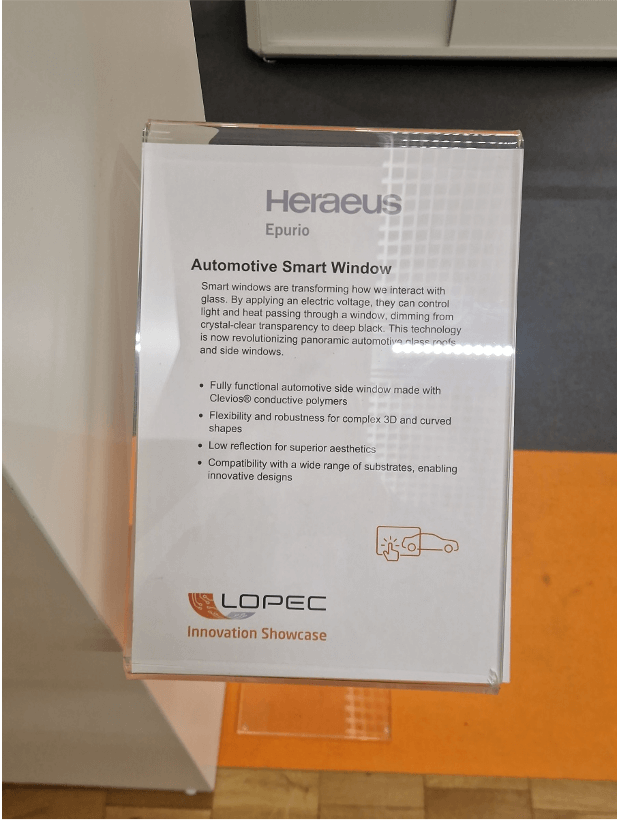
Heraeus’ “material system” approach is pragmatic for hybrid assemblies, reducing layer-to-layer incompatibilities that otherwise tend to surface after environmental aging.
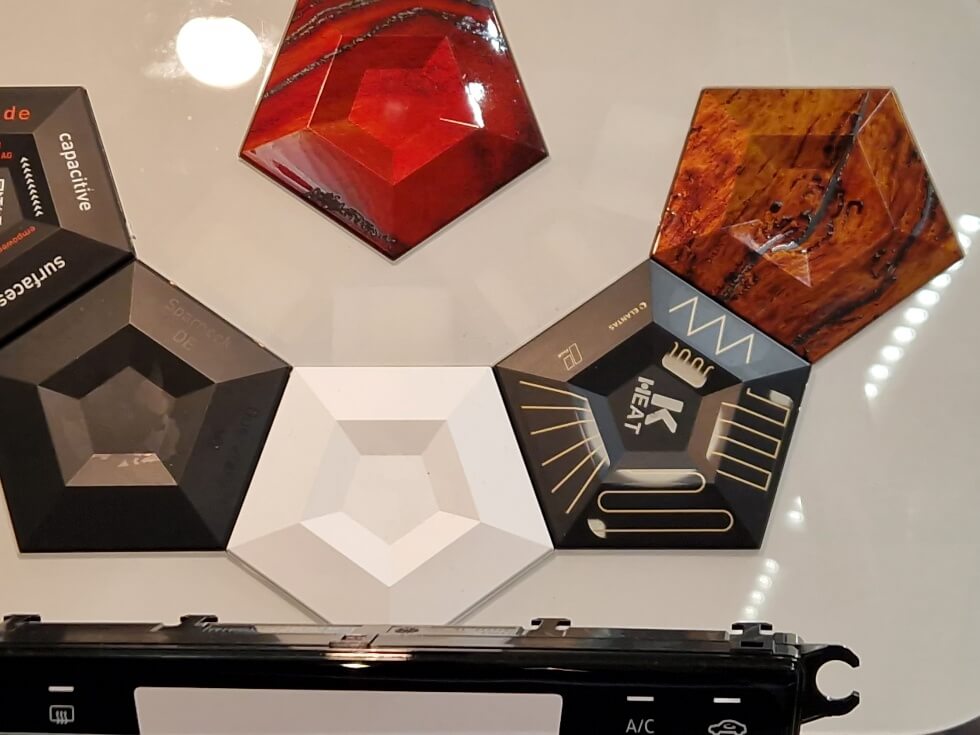
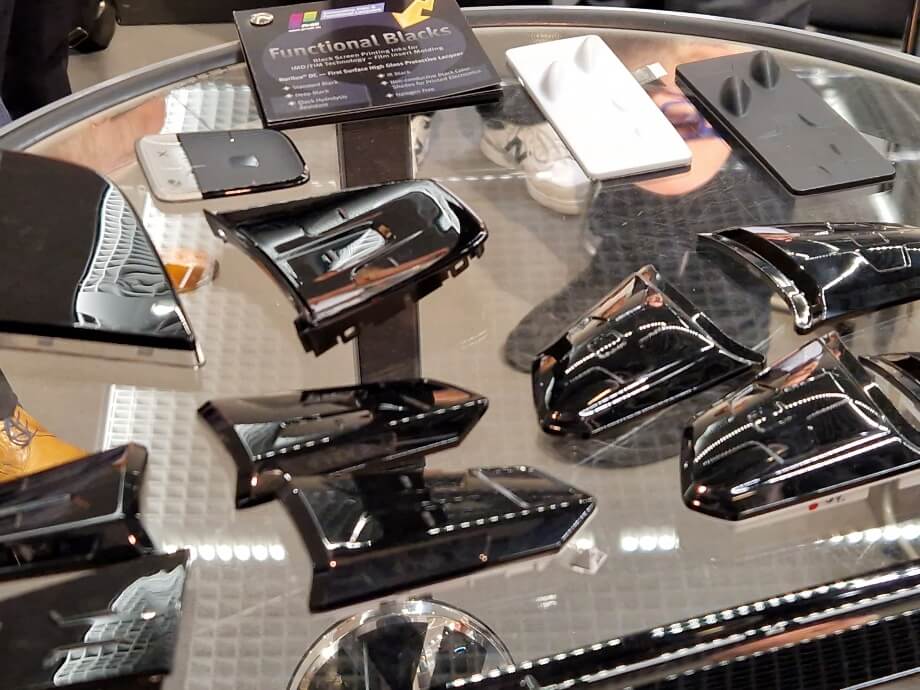
Protection and aesthetics: the topcoat is a functional component.
In the cabin, the most abused layer is often the one most underestimated: surface protection. Proell stands out at the decoration durability boundary, with IMD/FIM decorative inks designed for forming/overmolding and with protective lacquers/hardcoats targeting abrasion, chemicals and optical constraints (haze, gloss, uniformity).
The technical value is balance: protecting without harming optics, without weakening adhesion.

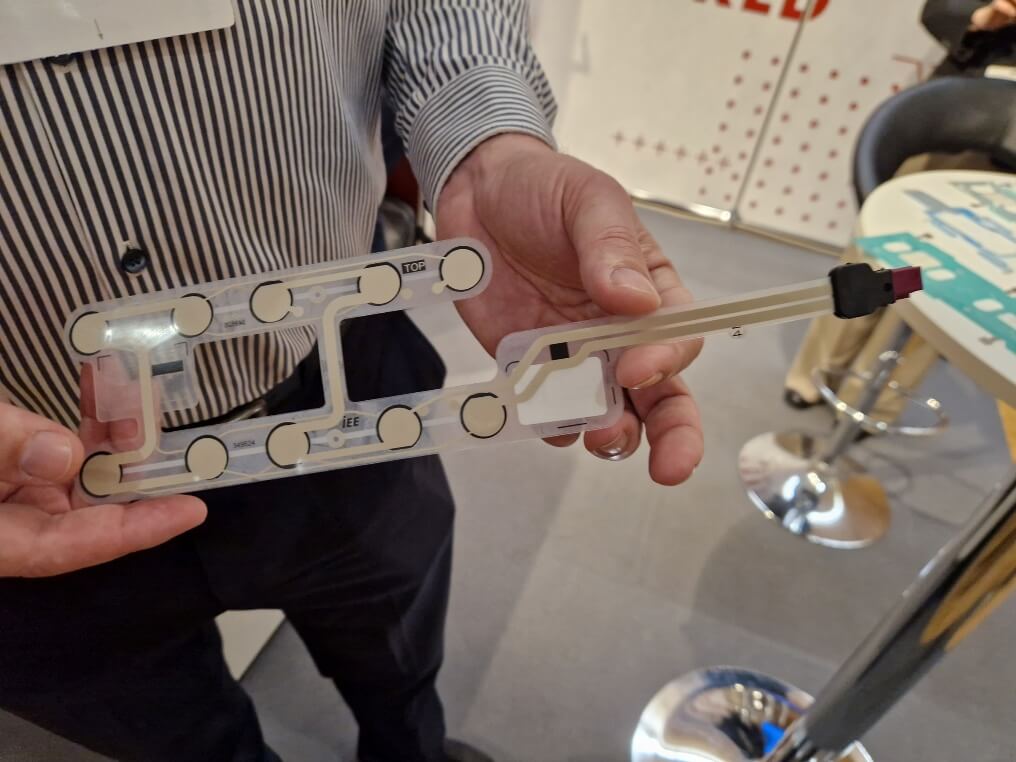
With IEE Smart Sensing Solutions, we clearly see a system-level approach: flexible sensing for occupant detection/classification, with signal processing, diagnostics and calibration. The printed pattern alone is not the proof; production robustness is. Sensor dispersion, compensation strategies, EMC/ESD immunity, stability under thermo-hygro cycles and mechanical fatigue (seat foam dynamics) are the true competence.

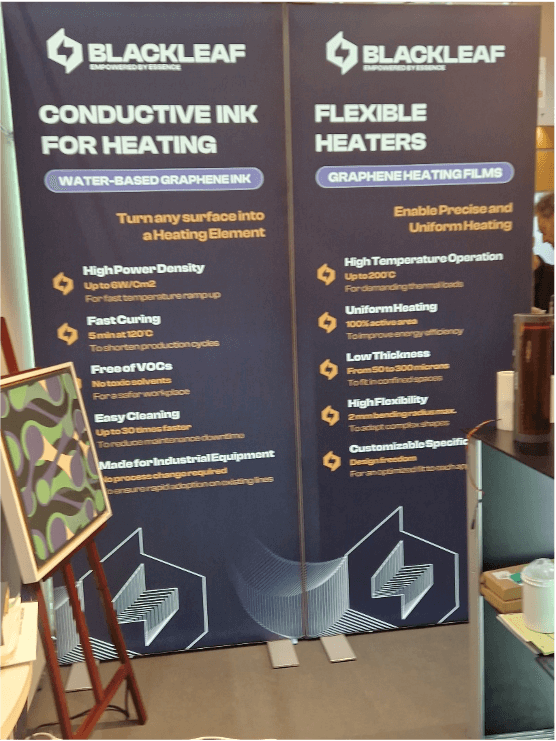
Today had a remarkable demonstration of a heating surface up to 120° (a bit too much for our automotive applications) but we will soon have a 3D version for our seats, our supports and other surfaces to bring us a reassuring well-being!
The LOPEC 2026 takeaway is straightforward: the technology is mature enough to widespread series deployment.
Over the next 12 to 24 months, the most structuring locks will be:
- Interface robustness under strain: adhesion and layer integrity after thermoforming and after aging—3D forming remains a defect amplifier.
- Dielectric integrity and ESD/EMC behavior
- Heater uniformity and aging
- integration of connectors and transition zones:
- process and in-line inspection: repeatability, traceability, and defect detection (optical/electrical) at line rate.
- Design for industrialization and end-of-life: disciplined hybridization, material compatibility, disassembly/recyclability trade-offs.


