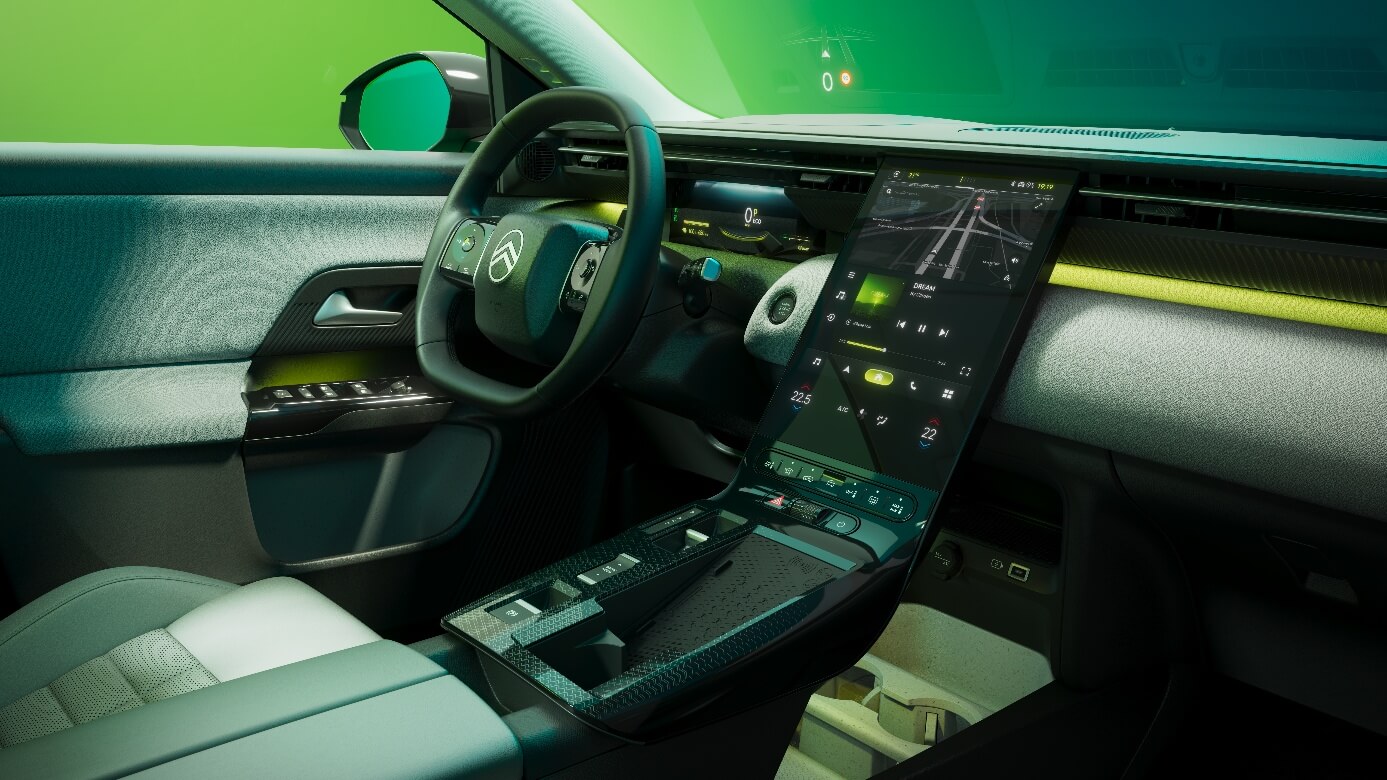
Following previous meetings between Pierre Leclercq and Paul Henri Matha, DVN had the opportunity to meet the interior design team responsible for the new Citroën C5 Aircross. The aim was to understand how to turn a ‘rolling lounge’ design brief into a credible, manufacturable interior that remains typically Citroën.

Four pillars of the Citroën project and the DVN-Interior team, in an interview driven by Laurent Sérézat, accompanied by Paul Henri Matha and Sébastien Adam discussed the cockpit from the perspectives of design, UX and CMF:
Florent Adeline, head of design communication at Citroën,
Jérémy Lebonnois, interior designer, 2012 graduate of Ecole Strate, began his career at Forvia. At Citroën for just over nine years, he’s worked on phase advances and concept cars: the first C5 Aircross in Shanghai, followed by CXperience in 2019 and phase advances on the C4 X, C3 and C5 X projects. The C5 Aircross is his first production model.
Johanna Vray: colour, materials and finish designer, graduate of Ensi Design Textile. She started her career at Sunbrella, a supplier of textiles for interior design. The automotive industry came into her life somewhat by chance: “When I arrived, I had no knowledge of the codes or references of this environment. However, I had an eye for interior design and furniture. I think it was this sensitivity that led me to work on colours and materials for Citroën and the new C5 Aircross”.
Loïc Phelipeau: Head of UX Design for the Citroën brand: “I have a degree in physical measurement. I started my career in a service synthesis department. This allowed me to really focus on customer satisfaction in my daily work. Gradually, I worked with the design teams until I became involved in UX design thanks to my specialisation in embedded electronics. Today, I am responsible for UX activities for Citroën design”.
Citroën DNA seen from the inside: comfort, simplicity…understated poetry.

When asked what really sets a Citroën interior apart, Johanna Vray says, “The signature of a Citroën interior is really that immediate feeling of comfort and serenity as soon as you get in. The textures, materials and colours are there to create an atmosphere that is both warm and soothing”.

Jérémy Lebonnois adds: “clean lines, no excessive design, handy features rather than scattered gadgets. The idea is clear: let the architecture breathe, don’t clutter the interior with totally useless technology, and respond to the user’s real needs”.
Loïc Phelipeau applies this philosophy to the screen: “We need to have the right information in the right place, with a little extra touch that brings a certain Citroën comfort. A dashboard is generally an extremely boring piece of equipment. On the C5 Aircross, we’ve managed to give it a certain poetry”.

This poetry takes the form of an instrument panel background depicting the sky at the end of the afternoon, with small animated clouds that shift to a starry sky at night. Nothing ostentatious, but a gentle narrative in an object that is usually purely technological.
Florent Adeline describes repositioning the brand within the group: Citroën remains popular, but rejects the label of Stellantis’ low-cost brand: “While Citroën is indeed a popular brand, it can rely on its identity. Citroën models retain their core features, including comfort, interior space and bold design. Heritage is also an asset; the brand will soon be celebrating its 110th anniversary”.
The scene is set: a rolling lounge, but under industrial control, and with a real heritage as a backdrop.

On the new C5 Aircross, the ‘lounge’ motif is not just a metaphor in a press release. From the very first sketch, the aim was to envelop the occupant from door to door, with the lower part of the cabin treated as a continuous sofa, over which floats a high-tech upper layer. Jérémy Lebonnois says:
“From the very first sketch, we wanted to convey the feeling of having a living room in the cockpit. We brought comfort to the dashboard, truly enveloping the user in a cloud of comfort that extends from the driver’s door to the passenger door. All of this is enhanced by ambient lighting between the two”.
The top of the board, with its vertical ‘turrets’ incorporating tweeters and lighting, becomes a key element: a technical piece, highly designed, which contrasts with the generosity of the lower sofa, but remains in line with the exterior design. For an interior designer, this is the kind of piece they often dream of, but which is rarely produced in series with this level of precision.
The Advanced Comfort seats, with their ‘chocolate square’ patterns (a nod to the CX) and their upper backrests treated like a scarf that ‘cuddles the user’, play the same tune: unapologetic comfort that remains accessible and non-intimidating, despite the integration of support and adjustment technologies.
As to the UX,the distribution of information and functions is designed to avoid the ‘Christmas tree’ cockpit effect. Loïc Phelipeau emphasizes this layered approach: a high zone in the central screen for frequently viewed, reconfigurable information, an organisation that aims to simplify the task of driving rather than stacking widgets.
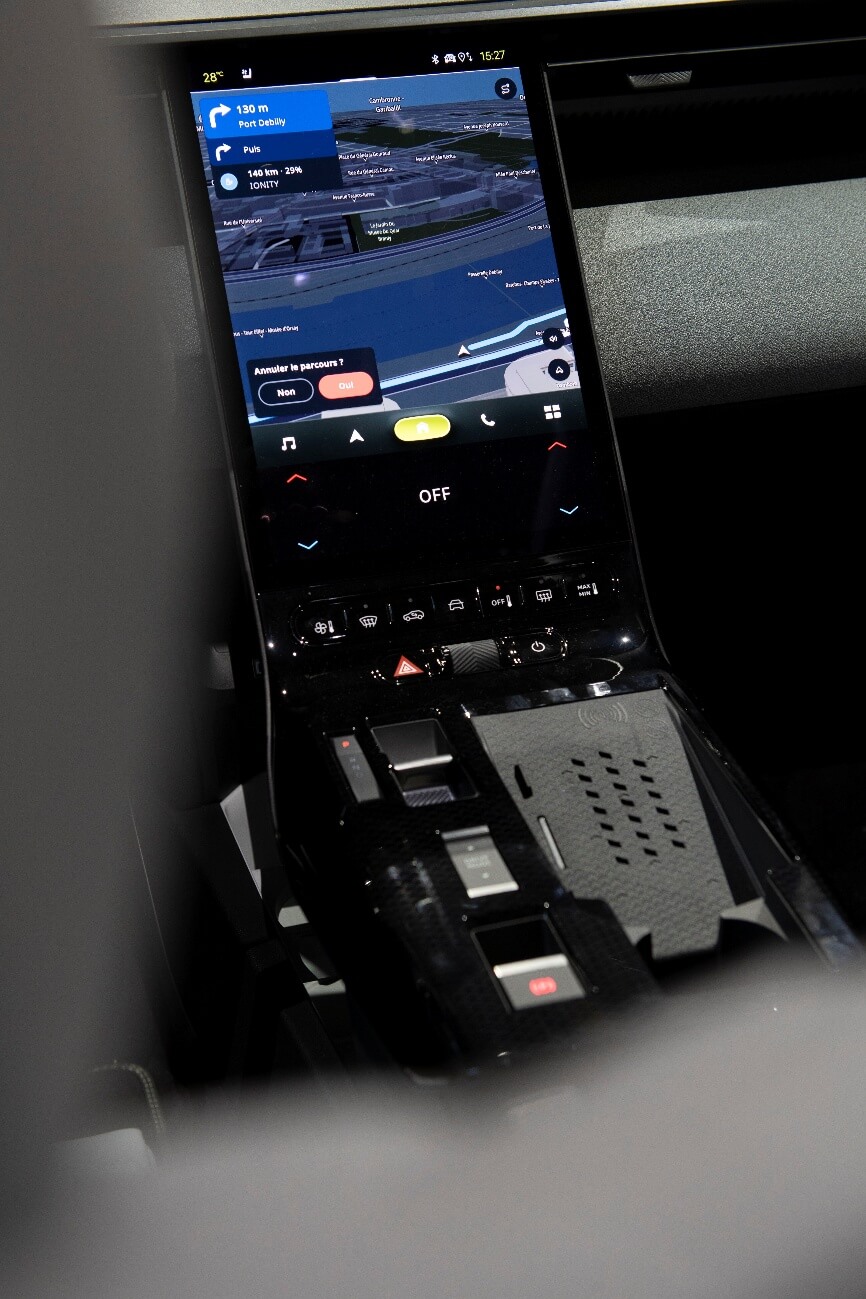
Navigation is based on TomTom, with CarPlay/Android Auto compatibility. An interesting feature for HMI experts is the ability to mirror CarPlay/Android Auto in the cluster, which allows for greater consistency between the instrument panel and central screen in modern use cases.
On the extended display, Jérémy and Loïc describe a true diptych/triptych: combined for driving, extended HUD as an optional and reconfigurable synthesis, central screen for everything else. The head-up display allows you to ‘split’ part of the cluster and streamline it where you want, depending on the driver’s profile.
And then there’s AI. Loïc: “The integration of ChatGPT opens up many possibilities in terms of multimodality. As a UX designer, I don’t want to talk about screens, I want to talk about information retrieval. You can ask it to turn up the air conditioning, turn down the volume…there are lots of interactions that become very natural”.
In a world where everyone is talking about XXL screens, this shift towards information retrieval and natural voice control is an interesting signal for automotive UX: Citroën is seeking to make voice control a real pillar of comfort, rather than just a gadget.
However, the brand is not giving in to the ‘100% touchscreen’ reflex. User tests have shown a strong demand for physical buttons, particularly for volume and certain primary controls. Hence the MUX front panel, treated as a single skin with real mechanical clicks behind it, and a steering wheel with a single control plate incorporating 6 to 7 functions with no visible cutouts. Technically delicate, but very consistent.
And what about Amazon? Florent Adeline clarifies: “Stellantis is working with several partners to develop a virtual cockpit. The group continues to work with Amazon on other initiatives”.
CMF: a responsible home with thoughtful details
When Johanna Vray talks about the C5 Aircross, the word ‘lounge’ quickly comes up. She describes the clarity and visual comfort immediately noticeable when you get in, and the strong intention to make you feel at home. The lounge is not just storytelling: it translates into textiles inspired by furnishings, soft surfaces and lighting designed to create a homelike atmosphere.
The link between exterior and interior is also conveyed through a signature color called ‘Rouge André’.
Vray describes it: “This color has always been associated with Citroën, appearing on the logo and also on the latest Oli concept car. It’s a strong, bold, saturated color. It really acts as a signature, both outside and inside”. This red colour features on the dashboard, creates colour accents on the seats and contrasts with the mineral grey or Gallium upholstery.
Its application varies depending on the version, but its role remains the same: to establish a common thread between the bodywork, the HMI and the interior fittings.
When it comes to materials, the discourse is not cosmetic. Starting in 2021, the team explored bio-based, recycled and natural materials, ultimately deciding against certain exotic materials that were too far-flung in favour of more local, better-controlled solutions: textiles knitted and woven in Italy and northern France, recycled but also recyclable materials, end-of-life considerations and logistics integrated into the specifications.

And then there are vine shoots. Rather than oyster shells, as Volvo usess, Citroën has chosen this French wine-growing waste product, which until now has been burned, and has been working on it since 2018 to turn it into a robust material.
The result: up to 20 per cent vine shoots in the plastics used in storage bins and cup holders. Johanna Vray describes the visible aspect of this material: “We’re not talking about a flaw. It’s a natural material. That’s what makes it so vibrant. It will be different from one vehicle to another.”
On the supplier side, Aunde, Sage, and Tesca are involved, with sites in France, Italy, and Spain, but development is led from France – and conscious choices have been made to limit the logistical footprint by ruling out certain materials that are too far away, despite their appealing storytelling.
The laser chevrons on the console and the easter egg of the silhouettes of models produced at La Janais (BX, GS, Dyane, C5) extend this approach: making CMF details a means of expression for the brand, with a second meaning reserved for curious eyes.
Standards, constraints, and catalyzed creativity
An interesting point for the design and engineering teams: Jérémy Lebonnois’ talk on standards does not fall into the sterile opposition of artists versus modules. With regard to Advanced Comfort seats, he explains how integrating technology into a calm and legible architecture is only possible through close collaboration with project teams and developers. The goal is always the same: to preserve the essence of the original creative intention, while accepting compromises. Some even lead to technical solutions that neither engineering nor design could have imagined on their own.
On the question of fixed modules, he goes further: “That’s precisely what catalyzes creation, because if we didn’t have all these constraints, we could become scattered, perhaps lose some of our focus and be too artistic and not industrial enough, not design-oriented enough. If we were on our own, it would remain a sheet of paper with ink on it”.
This is a far cry from the frustrated designer: the C5 Aircross appears to be a textbook example of what a team that accepts industrial safeguards as an integral part of the creative process can produce.


