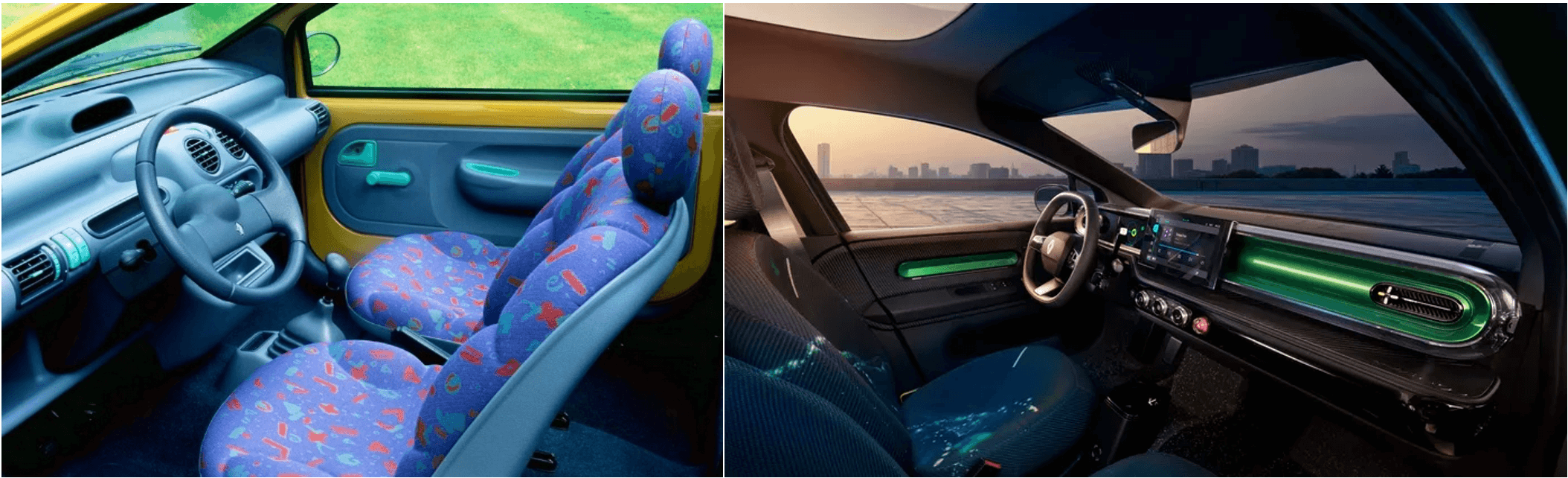
When I opened the original Twingo and the new Twingo E-Tech one after the other, I had this very strange feeling: on the one hand, the carefree spirit of the 1990s, and on the other, thirty years of technical and regulatory layers piled up in the same size.
In the old Twingo, the interior was almost a manifesto against constraints: a loose dashboard, a central cluster that looked like an electronic toy, bright colours (of the day, versus today’s grays) and a sliding bench seat that transformed the car into a mini-studio or a small van, depending on your mood. Regulations were relatively lax, and the interior architecture was built around a few mechanical hard points.
In contrast, the 2026 Twingo E-Tech has to accommodate a battery pack in the floor, two screens, an ADAS arsenal, and the entire GSR2 package – DMS, ISA, AEB, event recording – in a body that remains an A-segment car costing less than €20k.
The choice of a suspended cylindrical dashboard, leaving a continuous shelf underneath, is no ploy; it is an architect’s response to an interior that is closing in under the pressure of wiring, computers, and sensor installations.
At the same time, Euro NCAP and GSR2 are adding to the complexity of our dashboards and consoles: airbags all over the place, side reinforcements, presence sensors, DMS cameras in the roof lining, and more.
The old Twingo did just fine without a real center console, but we are now being pushed towards ‘backbones’ in the middle of the car, which provide structural support for safety, but sometimes at the expense of the feeling of space in row 1. This is the new equation for European EV interiors: battery pack + ADAS + standards = weight, thickness, scattered electronics.
And now, while we are fighting for every millimeter of overlap on our consoles, Brussels is preparing…the opposite. Under the banner of a ‘Small Affordable Cars Initiative’, the Commission is working with the industry on a new category of ‘e-cars’ inspired by Japanese kei cars: small, lightweight cars with limited size and performance, which could be exempt from some of the equipment requirements imposed on conventional M1s in order to return to a price range of €15k to €20k. Renault, Stellantis, and others are pushing hard in this direction, going so far as to propose a freeze on regulatory requirements for 10 to 15 years in this segment to allow time to optimize costs and architectures.
For us, as interior designers, this is not a theoretical debate. A European e-car, with regulated speeds and simplified regulations, could potentially bring back the freedom of the original Twingo: truly flat floors, slimmer seat backs, and storage space that is once again central to the product promise rather than being an adjustment variable in a regulatory package. Provided we collectively accept that we are not building mini motorway SUVs, but urban vehicles with a different safety/cost compromise.
Save the date and sign up now!
May we discuss this ‘European kei’ topic directly at our DVN Interiors workshop in Turin on 14–15 January 2026 at the Museo Nazionale dell’Automobile? Two days to look at how seats, cockpits, HMIs and materials will evolve.
Reserve your place now on the Driving Vision News website, or by sending me an e-mail.
Take care,