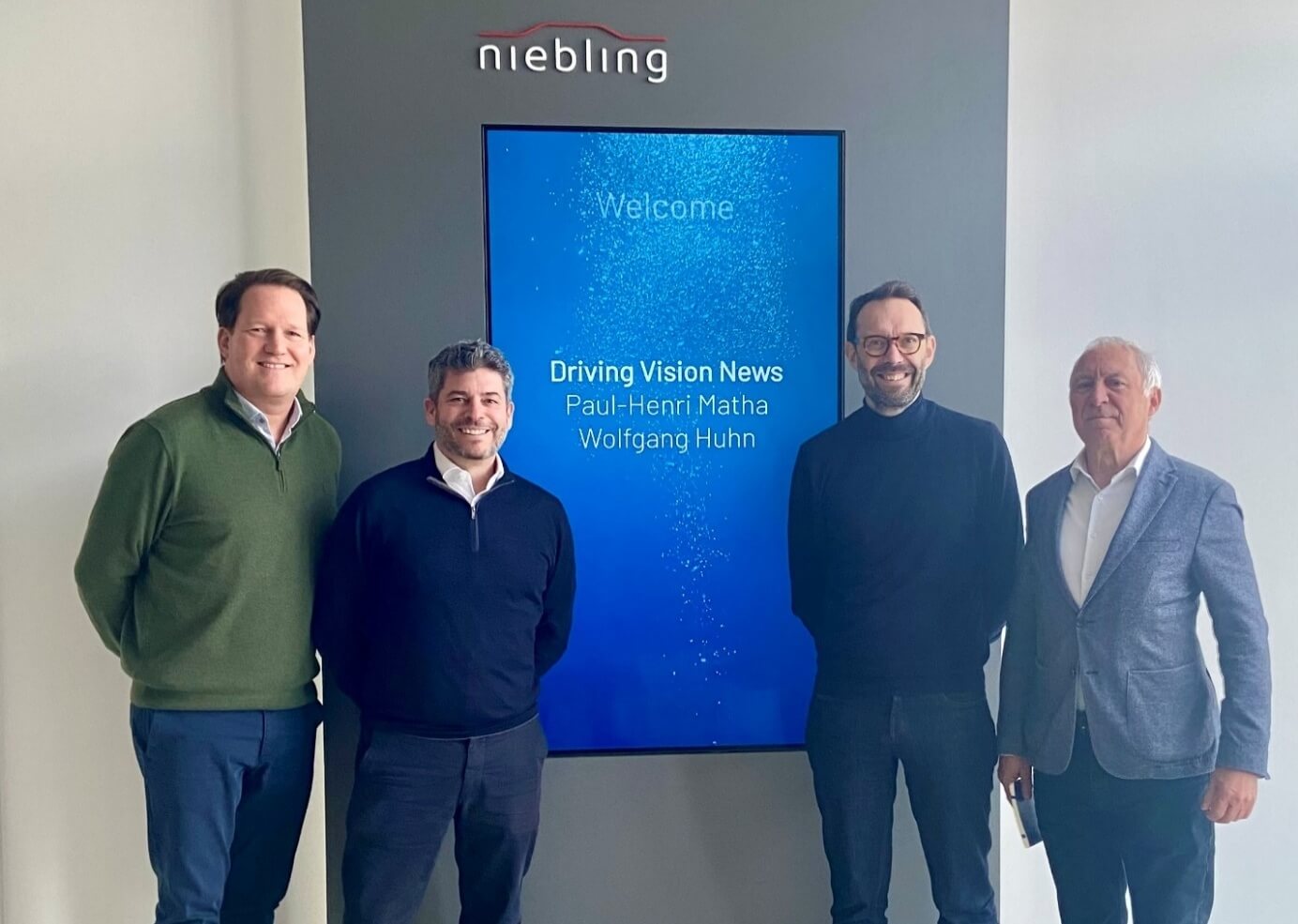
By Paul-Henri Matha
Niebling are a world-leading manufacturer of high-pressure forming (HPF) equipment and related forming and trimming tools. These are mainly used in the automotive supplier industry (~90 per cent) for the precise forming of functional and decorative films, primarily in film insert moulding (FIM) for surface decoration and in in-mould electronics (IME) for integrating electronic functionality into 3D-shaped components.
The company was founded by Mr. Niebling in 1984 and is still independently owned. They are located in Penzberg, about an hour south of Munich. We had the opportunity to visit the company and meet CEO and owner Christian Drexler. With 30 years’ experience in tooling, HPF, and FIM processes, Drexler has been leading the company since 2012 and continues to drive its technological roadmap.
Niebling’s business is divided into two main pillars: 70 per cent of turnover comes from HPF machines and automation modules, and 30 per cent from high precision forming tools, developed and manufactured in-house. This setup allows adaptation to specific customer needs.

Niebling works with many tier-1 to -3 suppliers in vehicle lighting. The following companies represent a selection of customers using Niebling equipment:

Many of these partnerships go far beyond traditional supplier relationships and involve joint development on materials (films, inks, conductive inks), process integration, and future-oriented concepts.

Niebling’s HPF systems operate at 50 to 90 bars while most competitors remain below 10 bars. This technical advantage allows geometrical tolerances less than 0.1 mm on formed part and positioning tolerances of ±0.5 mm with cycle times of around 45 seconds and forming areas up to 1.5 metres. The result: precise and repeatable forming of complex 3D film geometries with high optical and dimensional quality. Such precision is essential for demanding parts in automotive interiors, human-machine interfaces, and lighting applications.
Already back in 2002, Niebling developed processes to form complex 3D shapes with printed conductive inks, long before IME became a trend. Today, the company continue to push boundaries. For instance, Niebling have realized forming processes for sheet materials like polycarbonate up to 10 mm thick, enabling simplified production setups without injection tools. While such solutions may not fit all designs, they offer clear advantages in tool cost and lead time.

Niebling don’t just sell machines; they enable applications that redefine what’s possible in surface design.


