By Michael Hamm, Senior Advisor DVN and TU Darmstadt lecturer
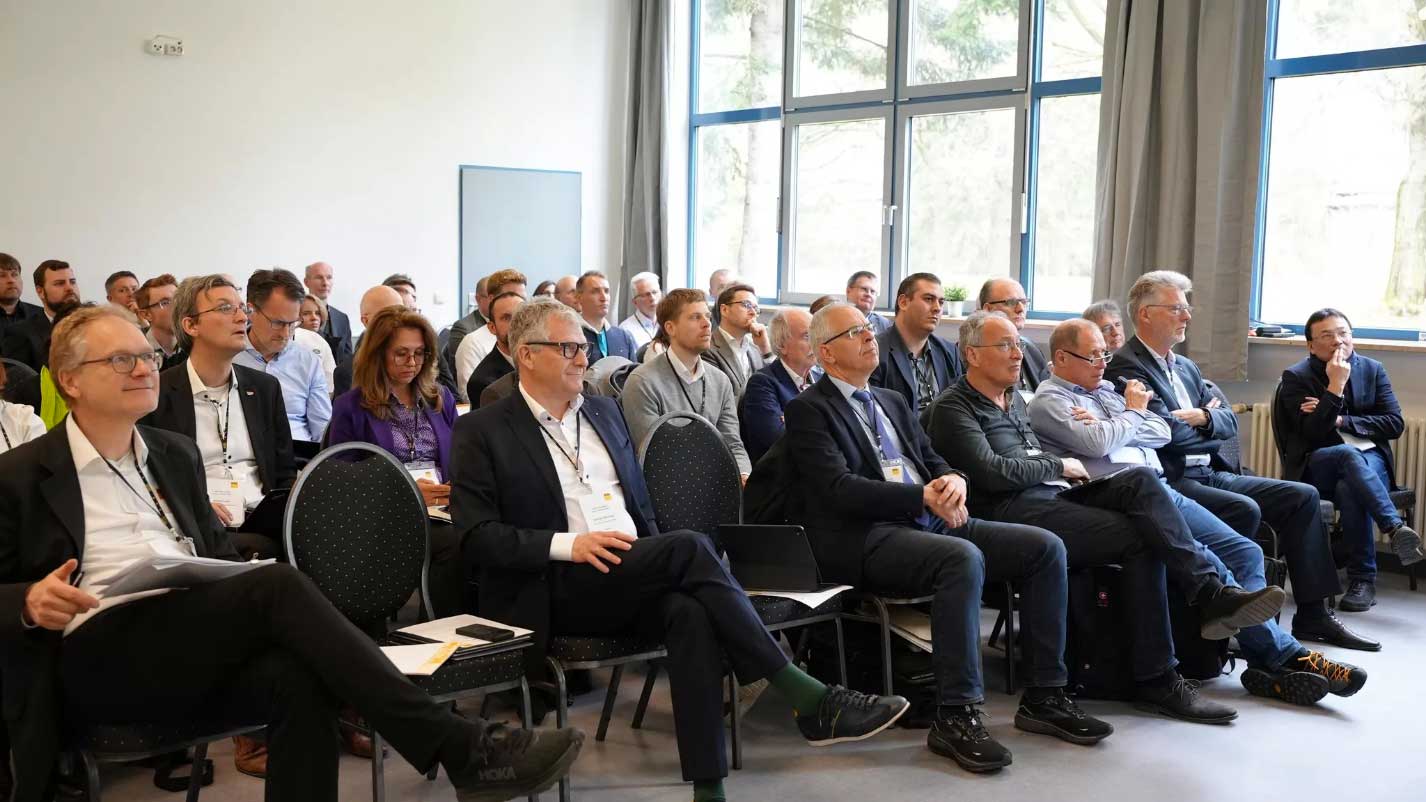
For two days about 60 participants attended the ADAC glare symposium in Landsberg/Lech, Germany. ADAC organized together with automobile clubs from UK, Netherlands, Austria, Switzerland and others a broad online survey on glare. The survey of motorists by questionnaire was conducted up to the end of 2023 to determine the extent to which they note they are affected by glare from light sources on vehicles and what restrictions they experience when driving. These results inspired ADAC to organize a symposium on glare with ophthalmologists, industry participants and researchers. The symposium could be considered as the extended version of the DVN Glare forum held in Munich the day before the DVN Munich workshop Feb. 2025 in Motorworld Munich.
The meeting started after welcome words from Prof. Khanh from Darmstadt University and Carsten Schulze, Technical President of ADAC. Burghard Böttcher reported from the ADAC survey. With 4.312 interviews extracted from a representative approach, 71 % of the respondents noted the glare unbearable or annoying. The Dutch automobile organization ANWB was presented by Herman Zeven. His organization did a member-based interview. More than 15.000 reactions were recorded. About 80% also mentioned glare as intolerable or annoying. Additional Bicycle lights and SUV were mentioned. Rod Dennis from the British RAC showed a more precise approach by asking when and how the glare was experienced. More drivers from limousine cars (e.g., lower driver’s eye height) reacted on glare issues. Henrik Liers, Managing Director at VUFO Traffic Accident Research Institute at TU Dresden (a company run by TU Dresden, Accident Research FAT, Federal Highway Research Institute BAST) reported on a data analysis on accidents. From their GIDAS database of 14.567 accidents investigated, about 105 were related to glare from other vehicles. Generally, direct glare was

Mr. Liers from TU Dresden displayed Data out of the GIDAS database of investigated accidents. Only 105 accidents could be traced to glare impact.
In the ophthalmologic session, four ophthalmologists presented their findings. Dr. Dirk Werdermann explained the eye function and referred to the glare sensitivity of elderly drivers. Prof. Schiefer from Eye-Research in Aalen showed restrictions for the definition of visual acuity. Not all letters for visus determination are recommended. With Landolt rings about 8 – 15% of humans have problems on left-right discrimination. He showed that after the age of 48 years the ability of accommodation deteriorates. With age, the visual contrast sensitivity shrinks by a factor of six. Prof. Dr. Michael Bach from the Medical Center of University Freiburg showed the importance of contrast vision. Tom van den Berg from the Royal Netherlands Academy showed the investigations on straylight generated in the human eye. It is possible to measure the amount of straylight in a human eye individually and reliably. Many patients complain of night blindness. They see a “halo” around a light source or feel dazzled by the headlights of oncoming vehicles The effect of increased straylight in the human eye can be compared to looking through a dirty windshield.
Research Institutes gave an overview on research about glare. Dr. Klaus Trampert from KIT Karlsruhe showed an experimental setup to determine the readaptation without the errors that might occur by pressing a button or verbally announcing Landolt ring orientation. Readaptation after a 500 ms glare pulse of 24 lux was measured. Christian Schwanengel from Techno Team showed his company’s ability to make luminance measurements with extreme small resolution. From the derived luminance values, he showed how the resulting illuminance at the eye could simply calculated.

ADAC Outdoor demonstration of different light sources in different situations to demonstrate discomfort glare and disability glare.
Mr. Böttcher from ADAC organized a lighting demo indoor and outdoor.
In an indoor demonstration ADAC had lined up cars with several types of illumination. Halogen, Xenon. LED and LED ADB cars were illuminating a wall. Later those cars were driven in an outdoor circuit. The idea was to show the different contributions to disability glare and discomfort glare.
The second day of the ADAC glare symposium was dedicated to research and regulation.
Prof. Stephan Völker from TU Berlin showed research findings about glare source luminance and spectrum. With proper aiming there were only small effects on glare source luminance or spectrum found. Nevertheless, they exist and could be quantified. Prof. Völker showed that the dominating parameter for glare is the illumination (measured in lux) at the driver’s eye.
Dr. Ernst-Olaf Rosenhahn from Marelli Lighting shared new glare analysis by measurements and new statistical evaluations. In morning and evening driving situations, the amount and type of glare in opposing situations was recorded. Dr. Rosenhahn shared the bitter results.


3.95% LB asymmetry, 2.49% misaim and about 3.29% road topography. Strong glare: about 0.5% asymmetry/misaim and 0.6% topography
About 10% of the opposing situations were related to glare. In a deeper analysis he could split the glare impressions to the root causes low beam asymmetry, misaim, and road topography.
Dr. Rosenhahn additionally gave an example of strong glare due to road topography. An oncoming car on a hill/bridge produces with 60 km/h about 1.5 seconds glare below cutoff for oncoming traffic. The glare peak is not rectangular, but more triangle shaped. Assuming 4.5 lux maximum at driver’s eye the result is 3.4 lx·s glare. From literature, it is known that such amount leads to strong glare.
He also calculated glare situations of an oncoming car in a curve. Trees and bushes aside the curve could obscure the headlights and only the luminance on embankments and trees would be visible. This situation was described by ADAC as dangerous because the high beam assist only reacts on direct headlight visibility and potentially high beam glare would exist. Looking to the naked data, Dr. Rosenhahn calculated in various curve radii about 0.6 – 1.1 lx which is equivalent to moderate glare. This is due to the fact that a high beam has its maximum roughly in the optical axis, while a car in a curve (bend radius 100 – 400m) does not hit the eyes of a driver with its optical axis. But in internet this was demonstrated as a big topic. There might be potentially a higher sensibility by the drivers because they might feel that the oncoming car could do something to avoid a potentially heavy glare situation.
Elisabeth Kemmler from the Lighting Lab of Darmstadt University showed findings of a laboratory experiment on light source size and luminance.
Markus Peier from the Lighting Lab of Darmstadt University showed findings of outdoor results on glare reduction by adaptively controlling the rear lights. Especially when standing behind a braking car there is potential to reduce the luminance of the front car’s rear lights.
Dr. Aniella Marie Johannsen from LLAB Lippstadt showed an indoor and outdoor test on the influence of small light emitting areas on headlamp glare. This experiment was organized together with Dr. Niedling from Forvia Hella. Looking into the results, there was no evidence found that on a real road discomfort glare increases by aperture or LED as new light source. All ratings are above admissible. But a misaligned system that thus produces higher illuminance at the driver’s eye is rated (2.4) in the DeBoer category between (3) disturbing and (1) unbearable.

Results of the LLab / Hella investigation on discomfort glare produced by different light sources and luminous aperture of the headlights.
Prof. Lamontain from Magdeburg Research showed the power of virtual assessment of wet road and glare.
Prof. Khanh from Lighting Lab of Darmstadt University presented findings on soiling of headlight outer lenses. He explained an experiment where salt and dirt were used as real dirt contributors on outer lenses. With increasing soiling, the glare contribution increased up to a factor six where the headlights range decreased for lower visibility and detection.
Dr. Michael Hamm from Lighting Lab of Darmstadt University collected the impact of various glare contributors in vehicle lighting systems. Especially the non-existing precision of headlight aim due to tolerances and load conditions, dynamic effects and topography was investigated and quantified.
One of the big topics seem to be the incorrect aim of the lamps. Several tolerances contribute to variations in aim. Additionally, a live experiment with 15 of the participants showed that nobody of the 15 participants was able to aim the test lamp identical to anybody else in the test group. A standard deviation of ±0.25° with a maximum of 0.6° was recorded. Dr. Hamm could show from literature that this is not surprising. Aiming with the eye is always loaded with additional tolerances. Additionally, he showed data from scientific reports that a test with 10 garages showed that not a single garage was able to aim correctly. Some did just nothing or made things worse. His recommendation was to put priority in technical equipment (e.g. digital aimers) via PTI to have at least one point in car life where aiming was done with minimal tolerances.
Dr. Hamm showed that due to dynamics about 2.5 – 5% of all times the vehicle’s cutoff is above the horizon and thus potentially creating glare. Due to topography, about 3 – 5% of all times the vehicle‘s cutoff is above the horizon and thus potentially creating glare. Only few countermeasures are already in force. Especially the coming static automatic load correction could be a positive glare reducing contributor.

Another effect was that outdoor investigations are creating different results, because the test persons must fulfil driving tasks. A difference of 2 DeBoer rating steps was recorded if the results of indoor and outdoor findings were compared.
In the last session glare and reduction in the field of regulation was covered. Tomasz Targosinski explained the process of interaction in the way a new regulation is created.
Dr. Rainer Neumann gave an overview of regulation activities on glare. Dr. Rainer Neumann chairs the research WG SVP in GTB, is Co-chair of the WG Strategy and belongs to the international Automotive Lighting and light– Signalling Expert Group (GTB). He reported on the VEDILIS Research project in 1995 that was initiated before the introduction of Xenon Light. The study for this research on spectrum and aperture influence by the Dutch research team of TNO did reveal only small influence of about 0.1 DeBoer Points. In a big outdoor study in the year 2014, GTB made experiments demonstrating the influence of load in the vehicle’s trunk. 25 different vehicles with 3 different load conditions were used to investigate the impact on discomfort glare.

Results of the investigation on discomfort glare induced by trunk load in the outdoor event conducted 2014 by GTB in Klettwitz/Germany
The introduction of static automatic levelling that corrects the vehicle’s headlight aim on the load in the trunk will possibly reduce glare events in the future. The GTB has passed that proposal, but as Rainer Neumann showed, there is some additional contribution by GRE and UNECE necessary to bring such proposal in the status of “in force”.


