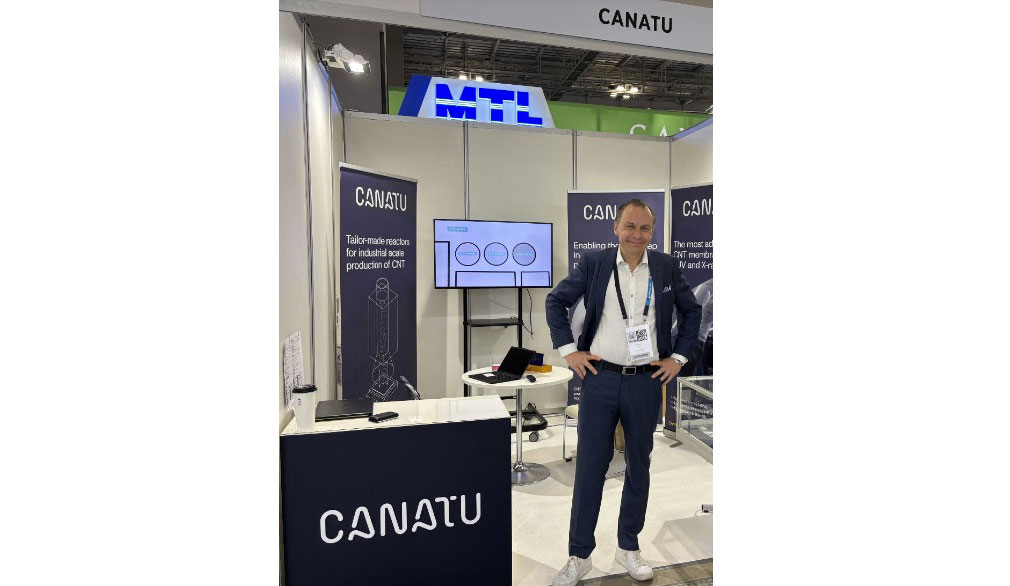
At SEMICON in Japan last month, we spent time talking and listening with Samuli Kohonen, Canatu’s sales VP, about their new partnership with Denso.
DVN: What can you tell us about Canatu’s new pact with Denso? It’s a memorandum of understanding at this point, yes?
Samuli Kohonen: We are a technology company and a leader in advanced carbon nanomaterial. We develop the most advanced carbon nanotubes (CNT) for semiconductor, automotive, and medical diagnostics industries. Denso is one of Canatu’s largest shareholders and Canatu and Denso already started joint development based on previous a licence agreement and contract. The key areas in the MOU signed on 4 December 2024 for CNT are research and development, mass production technologies, and global supply chain development.
That is, specifically, we develop new applications for transparent heaters with Canatu CNT. Canatu film heaters have high transmittance and heat an entire surface with wire-free. The film heater can be integrated into a plastic lens (like PC) by laminating or insert moulding. One application will be for sensors and cameras. As autonomous driving technology continues to evolve, vehicles must detect their surroundings accurately by cameras and sensors. It’s a problem that frost, ice, and condensation obstruct visibility, degrading accuracy and acting against correct detection. Canatu CNT can be a solution to prevent these problems.
DVN: How about lidar? It must work in all weather; the lens must always be clear of fog, ice, snow, and condensation.
S.K.: CMT holds great promise for a wide range of applications. Lidar could be one of them. There is no date [yet] for implementation. The program with Denso is currently in the R&D coöperation and exploratory stage.
DVN: How about headlamp lenses?
S.K.: Film heaters can be a potential solution for headlamp problems related to weather, but the target at present is for sensors and cameras.


