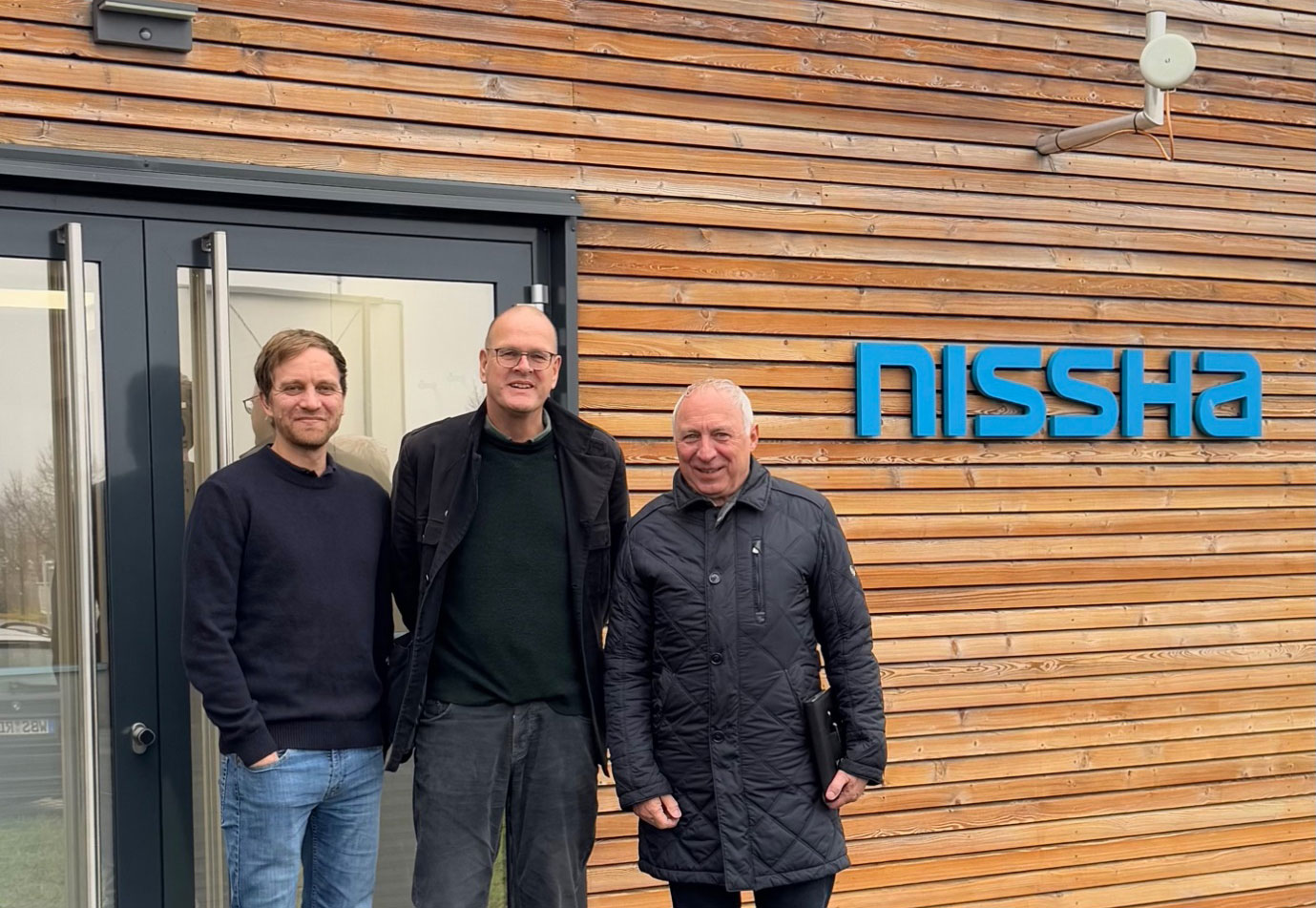
By Wolfgang Huhn, DVN Senior Adviser
Nissha’s name is a combination of the Japanese words for Japan and Printing. The company was founded in Kyoto in 1929 as a specialist in high-end art printing. Today, Nissha are a global player in printing, coating, laminating, moulding, patterning, and metal processing. In the interior lighting business, Nissha are involved in decorative and adhesive foils, in-mould labelling technology, and IMD as well as decorative and functional lighting. Another important area is touch films for consumer communication applications.
Sales of around €1bn are generated by nearly 6,000 employees, with 41 per cent coming from industrial materials (films, mouldings, metallized paper, etc.), 33 per cent from film-based touch sensors, 22 per cent from medical technologies, and 4 per cent from other businesses. Nissha have a global presence with 48 bases around the world. The European Innovation Centre and a factory are located in Thuringia, Germany, mainly supplying interior products to the automotive industry as a tier-2 supplier.
Due to the widespread use of large displays in new car interiors, the decorative IML film business is shrinking; Nissha are responding to this trend with innovation. Promising new business is being generated in car exteriors, such as films with integrated heaters and integrated sensors in the front end, films in the outer lenses of headlights to differentiate car lines, and others not yet revealed to the public.
FIM (film insert moulding) technology can be used for dynamic lighting applications. Evenly-distributed light scattering in film material and light-scattering in printed layers with precise control are very interesting for creating new æsthetic designs and functions. In sensors, Nissha are working on integrated touch-, force-, and temperature sensors, as well as transparent heating foils with embedded wires.

Nissha’s new films are highly efficient and can help reduce LED power consumption by improving the optical efficiency of the entire lighting system, both interior and exterior. This seems to be a valuable approach when considering the several thousand LEDs in the interior of a luxury car. Exterior communication displays (ISD, as reported in our 2024 DVN study) will also need more optical efficiency in the future.
From what I saw during my visit, Nissha are a thriving tier-2 supplier with a portfolio of products and innovations with the potential to create highly visible innovations for the world’s OEMs in terms of æsthetics, design, function, and sustainability. To be honest, I was really surprised by what I saw in the innovation centre and in the factory; it was way beyond my expectations.


