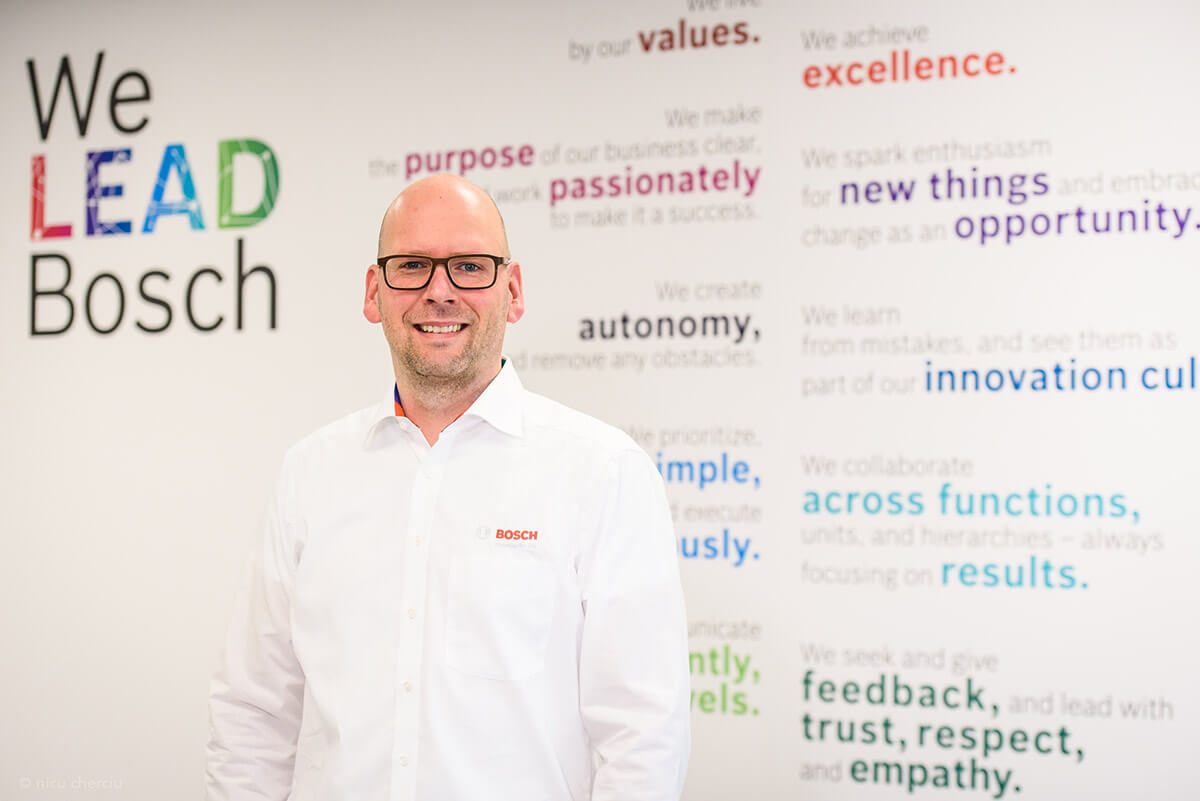
DVN’s Juergen Dickmann met with Dennis Raabe, Senior Vice President of the ADAS Components business unit within Bosch’s Cross-Domain Computing Solutions division.
Since January of 2024, Raab has led the development and growth of Bosch’s ADAS component business. The portfolio includes high-quality sensors with embedded software for decentralized vehicle architectures, and hardware-only sensors to support the trend towards centralized architectures.
Note: At DVN, we aim to keep the ADAS/AV community informed about sensing, architecture and applications. On 17–18 November, our DVN conference will take place in Stuttgart and for the first time, host special sessions on Dual-Use and on “The Road to Type Approval: Mastering End-to-End AI Systems”.
In the runup to the DVN conference, we are presenting Key ADAS/AV players , and sharing their results, perspectives in this field. The first in this series was our report on a preview drive with Wayve’s latest vehicle; now comes the Bosch interview, and further instalments will follow every fortnight until the conference begins.
DVN: Hi, Dennis. Let’s jump right in: serious challenges are presented by the fragmentation of previous global business models and supply chains, and the localization of markets. How do you see it? How do you cope?
Dennis Raabe: I find it fascinating to see how sensing is developing at the moment – especially under the massive price pressure coming from China, which has increased significantly again since our last conversation. At the same time, I ask myself how robust these highly cost-optimized sensors really are in practice. In clearly defined NCAP scenarios, you can demonstrate quite a lot, but for me the decisive factor is the many corner cases in real everyday use. That is exactly where a system has to be robust enough that, as a father, you would feel entirely comfortable driving with your family in it.
What can also be observed in China is a different level of social acceptance towards new technologies and their initial shortcomings. On top of that, there is a strong status element: a full ADAS package is a visible part of a vehicle’s value there. In this environment, our vertical integration in radar is a real advantage. With our own SoC, we have a deep understanding of what a radar sensor can do, where its limits are, and how to translate that into genuine customer value. Topics such as interference robustness are exactly where top-level sensing proves itself in everyday use. In the short term, we are developing very strongly local for local in order to remain competitive in terms of China speed and local performance requirements. In the long term, we are confident that, with a well-established Chinese organization and the sustainable, high-quality, high-performance solutions we stand for at Bosch, we will be able to convince OEMs.
Another advantage we have is our end-to-end system competence and experience, and on that basis we can also develop the right sensor solutions.
DVN: Chinese people frequently tell me status matters more than safety. And, in line with that narrative, they also accept that new technologies make many mistakes.
D.Raabe: Yes, you can definitely see that in China. When lidar and L2++ started to become a topic, some people even put empty lidar housings on their cars as accessories simply because it looked high-tech. That shows very clearly the symbolic value ADAS sometimes has there. But I believe that, in the medium term, quality will also prevail in driving comfort, and that is where we offer the right sustainable sensor solutions. After all, cars should still be able to provide their driver-assistance functions five years down the line. The used-car market also benefits from sustainably developed solutions.
DVN: How are you localizing for China?
D. Raabe: For me, the decisive differentiation lies initially in the separation between sensors and software. In the past, turnkey solutions were often purchased. Today, many customers source software and sensors separately – either because they already have a software partner, or because they develop the stack themselves. That is exactly what we have adapted to with two ADAS business units: one for software and systems, and one for hardware and sensing. Customers are responding well to this because our software stack also works with other sensing solutions – and, conversely, our sensors also work with other software stacks.
Alongside that, we clearly see a split between China and the rest of the world. In the classic rest-of-world business, you scale through platforms with high volumes and many overlapping requirements. In China, it is different: shorter cycles, much higher speed, sometimes only six months from sourcing to SOP. That is why we have built local solutions there, for example in radar, a light version for particularly cost-sensitive applications – developed locally, but with the global experience we bring as Bosch.
DVN: Do you co-develop with Chinese partners?
D. Raabe: Yes, it really is set up local for local. Depending on the sensor, we do a great deal in-house there and in some cases also with local partners. In radar, a lot happens directly in China, and our rest-of-world colleagues are deliberately not in the lead in those projects. That is exactly how we ensure the required local content.
DVN: Coöperation between OEMs and software-stack companies is increasingly addressing the L4 fleet market, touching off a displacement battle. How do you position Bosch in the L4 market?
D. Raabe: I think the approach of using reference lists and reference sensor setups is exactly the right one. You have to define very clearly what a sensor must deliver and what a software model is designed for. If those requirements are transparent and a small amount of retraining is possible, then in the end the customer can consciously decide which sensor to use in that setup – exactly as platform providers are already doing today. We are already part of such reference lists and want to remain on board with our next-generation in the next system updates. And we want to expand that further.
This is exactly where our Bosch competence comes into play, because we bring the system perspective. We can see very clearly that the L4 area is scaling: there are high levels of investment, new rollout announcements, and a shift from technical feasibility to economic viability. In the early phase, sensor costs were not yet the top priority. As fleets grow, that changes. And that is where a market opens up for our sensor solutions. Operators now have to optimise their sensor sets from a cost perspective and ask what is really necessary at system level. With high-performance radar and camera solutions, different interface levels are possible, from object or target interfaces through to spectrum, depending on what the respective software stack requires. For high-performance vehicles with a lot of computing power, the trend is clearly moving towards spectrum. In cost-sensitive entry-level solutions, more intelligence remains on the sensor.
DVN: A software stack can work only with what the sensors provide. Error or MPI rates can also be interpreted as an annoyance rates from the customer’s view, no?
D. Raabe: That is exactly why this direct comparison is so interesting for us. We have a major customer where our software stack does not necessarily have to run with our Bosch sensor. Of course, at first glance that is a pity, because I am convinced our sensor is operating on a different level. But that is precisely where the opportunity lies: if the system performance is identical in the end, that is a clear data point for us. If, on the other hand, we see differences in annoying rate, robustness or overall performance, it further validates the path we are taking. Then we can trace very precisely what contribution the sensing actually makes at system level.
DVN: There are now a number of young OEMs who adopt Tesla’s vision-only model. Are they right?
D. Raabe: I find vision-only a very exciting approach to begin with, but not a sufficient one. For me, it is simply a question of physics. A camera-based system remains an optical system, and that means it has clear limitations in glare, dazzling sunlight or certain visual illusions. That is exactly why only the combination of different sensing modalities, such as vision plus radar, really convinces me. A radar sensor will still detect an object where a purely optical system may misinterpret it.
You can see that in well-known examples too: painted scenes, marketing graphics on lorries or other image patterns can put vision-only systems into critical situations. In combination with radar, that does not happen in the same way. So our position is clear: vision-only can work well under stable conditions, but for the robustness and safety we expect, it is not enough on its own.
DVN: Do your Chinese customers see it that way as well? Or do they consider vision-only adequate?
D. Raabe: Yes, that view is changing in China as well. There are L2 regulations there, and many of the required scenarios can only be handled properly with radar. In front radar, the discussion there is now more about 8×8 approaches than about what was standard in the rest of the world for a long time. That shows very clearly that China, too, is moving towards a combination of several sensing modalities.
DVN: AI software suppliers use raw-data interfaces for sensor integration. Infineon favour MMICs/chips as ‘dumb’ sensor heads for radar, with Ethernet CPU link. What’s your view?
D. Raabe: That is precisely where we see our advantage: we can offer high-performance solutions with different interface levels, from object and target interfaces through to spectrum, depending on what the software stack really needs. In the high-performance segment, the trend does indeed move towards spectrum interfaces, because a great deal of computing power is available on the central unit. In entry-level solutions, which are highly cost-sensitive, more intelligence remains on the sensor.
Of course, fusing as close as possible to the raw data on a central control unit has advantages. But for that I also need the corresponding computing power, and, in the end, it is always a TCO question. How much do I save on the sensor head if I move very far towards raw data? What does the more powerful SoC cost me in return? Is passive cooling still enough, or do I need active cooling or even water cooling? And above all: what functional added value do I actually achieve? That is why we see very different OEM strategies in the market, from rather conservative to very progressive.
DVN: Your competitors probably all have the same basic idea. What distinguishes your approach?
D. Raabe: Of course, others have the same basic idea. But the difference will not come from price alone. In a pure price competition, I do not see any winners in the end. The only ones who will prevail are those who deliver genuine added value to the end user. That is where we see ourselves as well positioned with our system competence: we can discuss with the customer what a particular software stack means for the hardware, what added value a sensor brings at system level, and what that means for ODD, robustness and the customer experience. For me, this combination of hardware and software understanding is decisive.
Of course, we could always make sensors cheaper. But simply bolting on the cheapest possible sensor head without talking about the system effect is, in my view, the wrong direction. In China, we see extremely short cycles – in some cases, sourcing decisions are made and SOP is reached in the same year. I find that impressive, but it also raises questions: how sound are the data campaigns, validation and safeguarding? We could also do many things faster if we stripped away the requirements and quality mechanisms that have been built up over decades. But the real question is: would you then sit in that vehicle with your own family with complete peace of mind? For me, that is not just an SOP question, but a question of trust.
There is also the lifecycle dimension. An ADAS system must not only work at SOP, but also after five, seven, ten years – especially with used-car markets in Europe in mind. With cameras, it is about intrinsic calibration, temperature drift and long-term stability. I can build a cheaper camera head, but if performance drifts over the lifetime and traffic-sign recognition, lanekeeping, or parking functions later no longer work robustly, then that is not a Bosch solution. In my view, that is also one of the strengths of traditional OEMs and established suppliers: technology has to work over the entire life cycle. We can still learn from China, especially in terms of speed. In the west, we have built up too much process burden over the years. The right way will probably be a middle course – faster and more pragmatic, but without sacrificing safety and long-term quality.
DVN: Can you keep up at China speed with your own chip fab and still remain innovative? How do you secure global parts availability here?
D. Raabe: The radar SoC and the generation-7 ultrasonic ASICs are in principle available on the external market. I know there are discussions around that, but for compliance reasons I cannot go into any detail. That is where one of Bosch’s strengths becomes visible: we bring full system competence, [and] we are open in our business model. Some initially see us only as an integrated supplier. But more and more partners understand that we can also collaborate openly at component level. When it comes to parts availability, we act on a geographically market-specific basis.
DVN: Where do you see your field in five to 10 years?
D. Raabe: Internally, we have set ourselves the ambition of ‘sense the world’. That is what our ADAS sensor business is about. We want to sense the vehicle’s surroundings ever better and hand that information over to the respective software stacks in high quality. When I look at our current generations in radars, ultrasonics, and camera, and at what we are planning for the next generations, our objective is clear: greater perception quality, more safety, and ultimately more comfort.
At the same time, I believe that in the coming years we will move more strongly into a phase in which platform solutions gain acceptance because of cost pressure. By fusing, for example, radar and camera, it is often possible to offer very good overall compromises. From my point of view, it will therefore become increasingly important not just to offer the technically maximum solution, but the solution that makes the most sense both economically and functionally.
In the end, the decisive question is this: what does an additional SoC or a highly customer-specific system solution really cost? And that is where it gets interesting. We are often not talking about small amounts, but about a much larger delta that arises solely from individual requirements. Then you have to ask very honestly where the actual added value lies at system level compared with a platform solution. In many cases, I do not see that extra value to the extent that it is priced in.
That is why we now often proceed very transparently and make two offers: one for a customer-specific solution and one based on our platform. That shows that, for many customers, around 80 per cent of the requirements can already be covered very well with a platform. And it also becomes clear very quickly that certain special requests sometimes really come from only a single customer.
DVN: Thank you so much for this fascinating insight into your Bosch world. I hope we will be able to welcome your colleagues to our DVN Conference on 17 – 18 November and continue the discussion!


