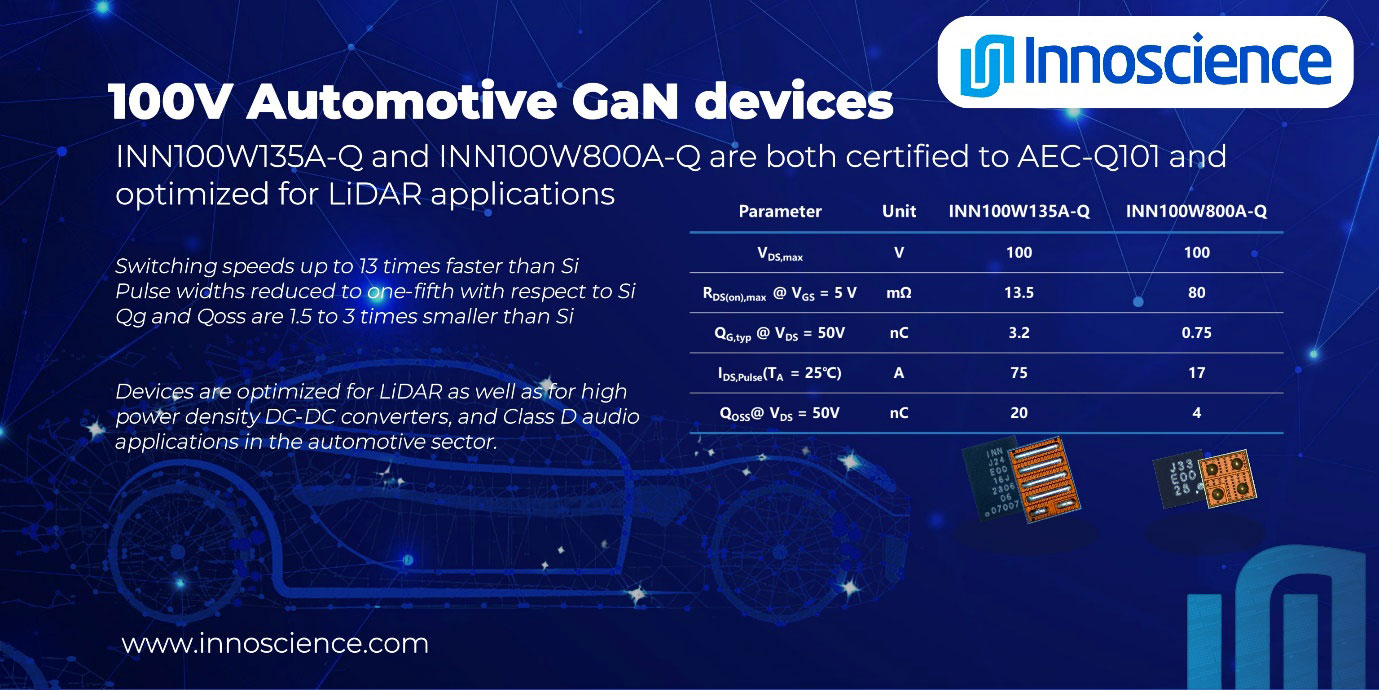
Innoscience Technology has two new 100V automotive-grade GaN devices: the INN100W135A-Q (RDS(on),max = 13.5 mΩ) and the compact INN100W800A-Q (RDS(on),max = 80 mΩ). Both have received AEC-Q101 certification, and are optimized for automotive applications such as lidar, DC-DC converters, and Class-D audio systems.
These devices, featuring WLCSP packages measuring 2.13 × 1.63 mm and 0.9 × 0.9 mm respectively, provide significant advantages in terms of size and power efficiency. They support L2+ and L3 drive-assist systems with switching rates up to 13 times faster and reduced pulsewidths compared to traditional silicon solutions. These and other advancements improve identification capabilities in the 200- to 300-meter range.
Innoscience says these GaN devices address the growing market demand for efficiency and precision in driver assistance and autonomous driving technologies, effectively replacing conventional silicon in critical automotive applications. Currently available in mass production, comprehensive specifications and simulation models can be accessed on the Innoscience website, where clients may also request samples.
DVN comment
Most lidar systems use time-of-flight (ToF) depth sensing. For better detection, higher emission peak power extends range, and shorter pulsewidth improves accuracy. Autonomous vehicle lidar systems need a detection range over 200 m with less than 5 cm measurement error in short-range areas. The laser’s peak power should exceed 100 W, with an ideal pulsewidth of a few nanoseconds, determined by the laser drive circuit. Designing a high-power, narrow-pulsewidth laser drive circuit is essential. Additionally, ensuring the laser pulse is safe for human eyes is crucial.


