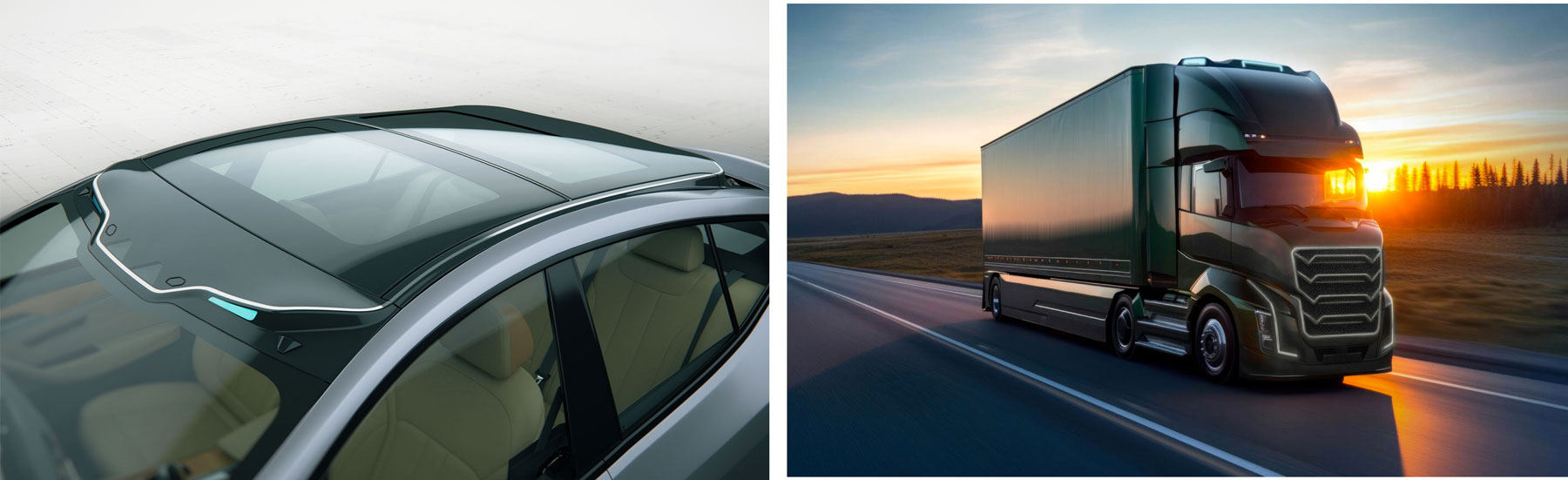
Venerable roof system supplier Webasto flourished into the autonomous driving space with their Roof Sensor Module (RSM) for passenger cars. Now, they are expanding their RSM range to include robotaxis and autonomous trucks.
Webasto integrates individual static and extendable lidar modules into cars, and also develops comprehensive roof modules equipped with various sensor technologies like cameras, radar, and lidar. The company has secured a customer project to supply the RSM for a robotaxi maker in the USA.
Webasto combines innovative automated cleaning and thermal management systems with sensor solutions to achieve this. Features for cleaning, de-icing, defogging, and cooling sensors maintain their availability under various weather conditions. Depending on customer needs, different sensors are combined in the RSM to create visually appealing solutions.
Since 2021, Webasto has collaborated with Canatu to integrate a fixed-film heater into the RSM. This module provides automakers with options to incorporate ADAS sensors and functions related to sensor availability into the vehicle’s roof—such as cleaning, cooling, de-icing, and anti-fogging. The roof is prime real estate for sensors, as it allows optimal detection due to the all-around view and elevated position. Including Canatu’s de-icing and anti-fogging system in the RSM ensures reliable ADAS sensor performance even in severe weather. The same Canatu film heaters can also be used for camera systems.
Automakers all over the world are heavily investing in developing lidar sensor systems to advance L3 and L4 driving —with the increasingly questionable exception of Tesla, whose owner Elon Musk doggedly insists he is right and everyone else is wrong. Still, adverse weather conditions pose a significant challenge for lidar technology’s full adoption. In wintry or humid environments, lidar sensors often become obscured with ice, fog, and snow, compromising their ability to detect objects and measure distances reliably. The Canatu film heater resolves this by keeping the sensor cover clean, ensuring dependable lidar sensor functionality and supporting autonomous driving in challenging weather.
Webasto’s Thomas Schütt says, “The next major advancement will be in autonomous trucks. The requirements for sensor integration—concerning vibration, environmental detection, and runtime—are more stringent, allowing us to leverage our expertise from the passenger car sector effectively. For example, Webasto’s compact sensor strip, which integrates various sensors and sensor availability functions, reliably transmits signals and crucial environmental information to the vehicle’s control unit. For Webasto, this technical development signifies a strategic extension of our product portfolio, now including sensor modules for passenger cars, robot taxis, people movers, and autonomous trucks”.
DVN comment
The Canatu film heater is lidar-transparent and entirely wireless, offering fast, uniform, energy-efficient heating across its surface without optical distortion. It is manufactured on a polycarbonate foil and integrated into the RSM cover via film insert moulding (FIM) in mass production.


