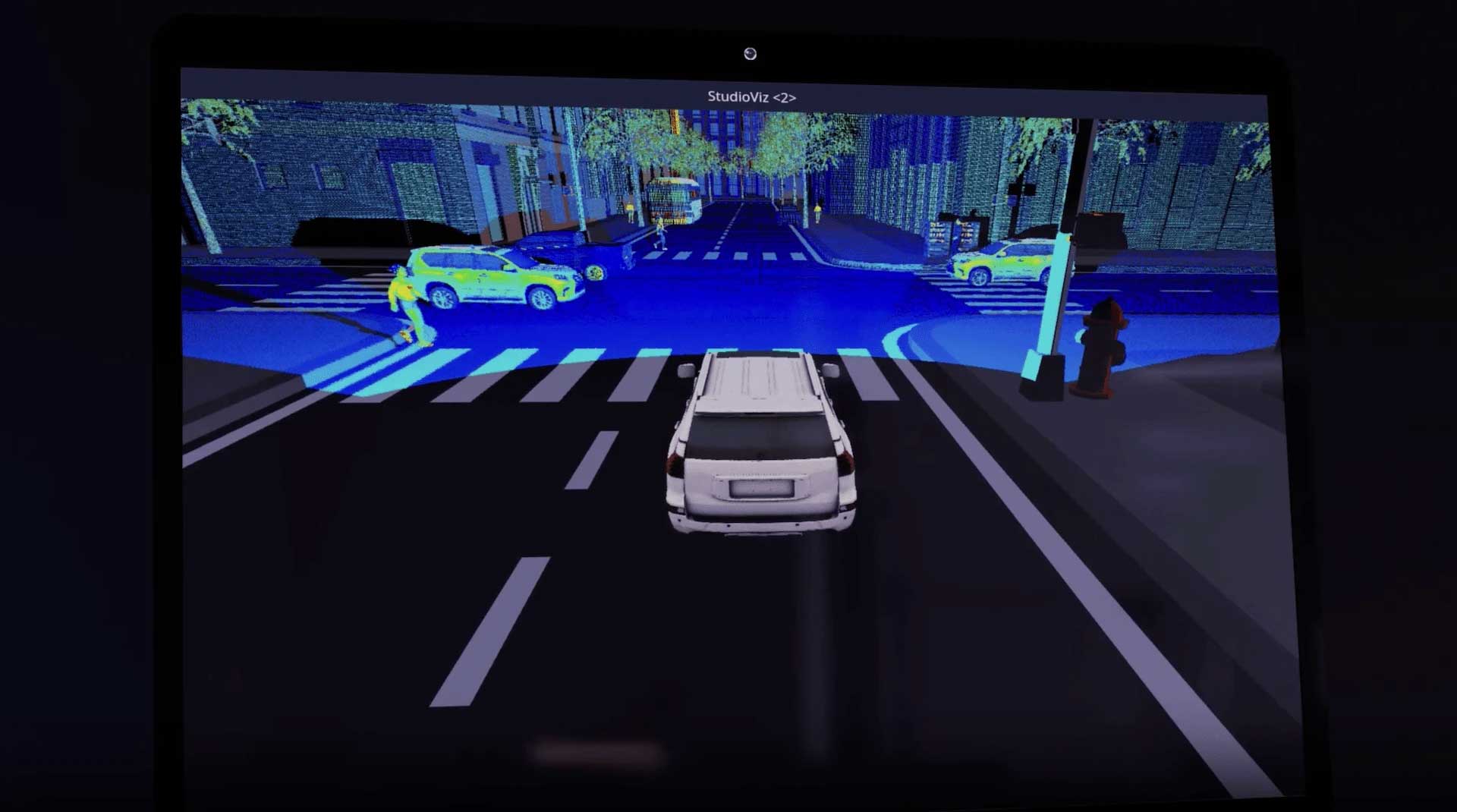
Cepton has launched their StudioViz advanced lidar simulation platform, intended to hasten the development and deployment of ADAS and AVs by offering significant cost efficiencies for automotive customers. Cepton says StudioViz simulation offers significant advantages, including:
- Easy lidar integration—StudioViz helps the automotive industry adopt lidar technology quickly and affordably by reducing installation costs and speeding up development.
- Sophisticated simulation features: the platform lets users build virtual scenarios, fine-tune sensor location, and combine simulated lidar data with other sensor kinds to evaluate system functionality.
- Productive R&D tool: StudioViz is a vital tool for advanced research, allowing data creation for perception solution development without requiring a lot of physical infrastructure.
With StudioViz, Cepton’s wide range of lidar sensors (including the long-range Ultra and medium-range Vista-X series) are used to create realistic 3D point clouds that simulate real-world scenarios. This allows automotive OEMs to evaluate different sensor positions and perception algorithms in a virtual environment, significantly reducing the need for expensive physical prototypes.
The platform also offers powerful simulation tools for sensor fusion evaluation and perception solution development. Users can produce detailed lidar data that is labeled with ground truth information for accurate vehicle and pedestrian detection and tracking. This helps in improving algorithms for lane and curb detection, path planning, and ego-motion estimation.
Cepton Product Owner Christian Nickolaou says, “StudioViz speeds up the testing, development, and deployment of Cepton’s lidar technology by offering an efficient and cost-conscious solution…[it] lowers financial investment in data creation and collection for the development of perception solutions”.
DVN comment
Generally, simulation can provide benefits such as reduced costs, speedy development, the ability to test complex scenarios, and reduced risk. It allows designers and engineers to test and evaluate systems in a virtual environment before deploying them in the real world. Sensor-to-environment simulation is a key point element in the AD simulation loop. In the particular case of scanning lidars, raytracing methods are a realistic approach that can dramatically accelerate matters.


