Partial driving automation is a convenience meant to make long drives easier, but humans are terrible at passively paying attention as required by these more-or-less L2 systems. There’s no evidence they make driving safer, and they can create new risks by setting up the perfect conditions for the driver’s attention to wander. That’s why it is essential that all partial driving automation systems incorporate robust safeguards.
But many of them don’t, and so the U.S. Insurance Institute for Highway Safety has launched a new rating program to evaluate the safeguards built into partial driving automation systems. They evaluate driver monitoring, attention reminders, emergency procedures, and other aspects of system design. A system may be assigned a rating of Good, Acceptable, Marginal, or Poor for its safeguards.
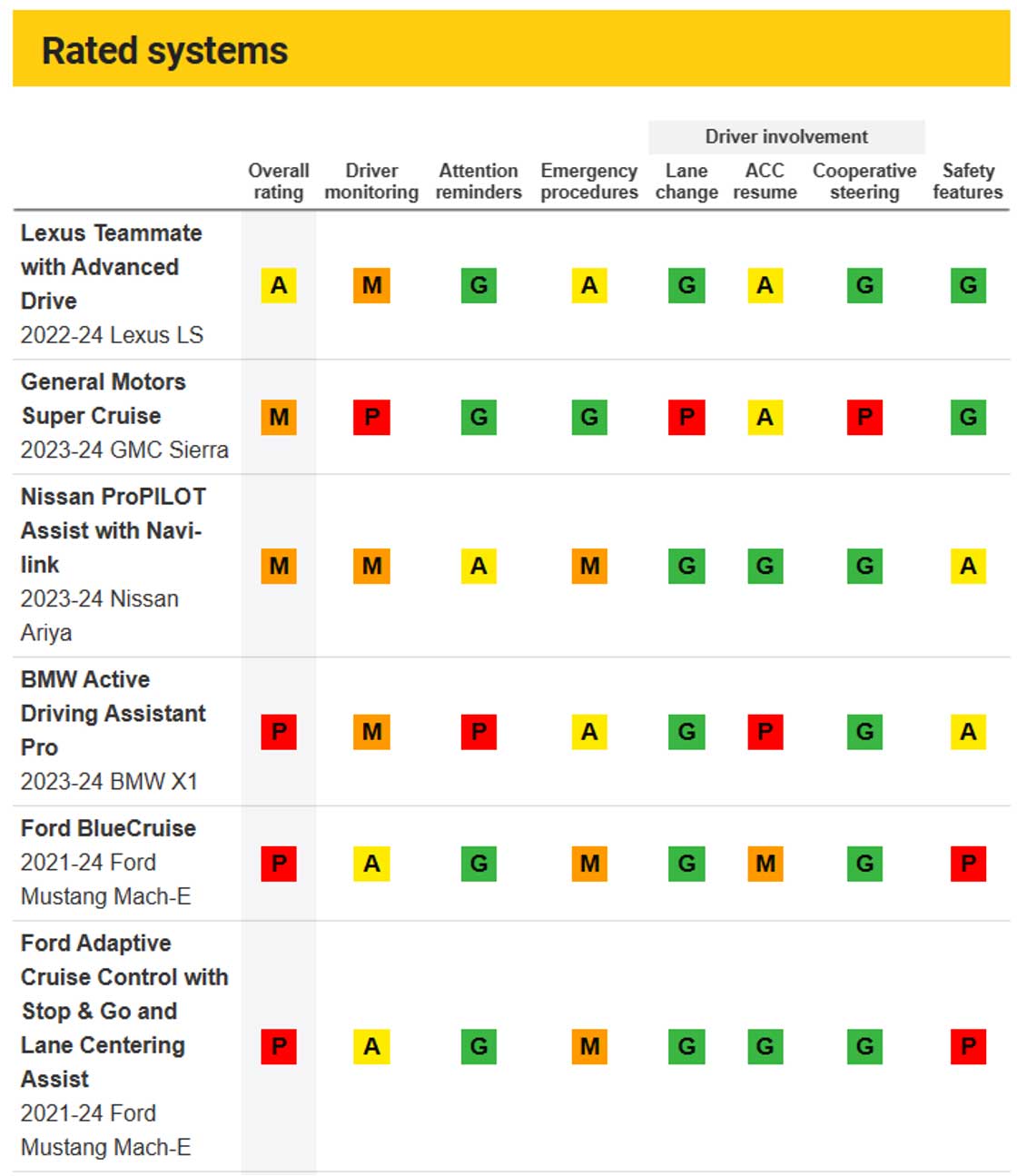
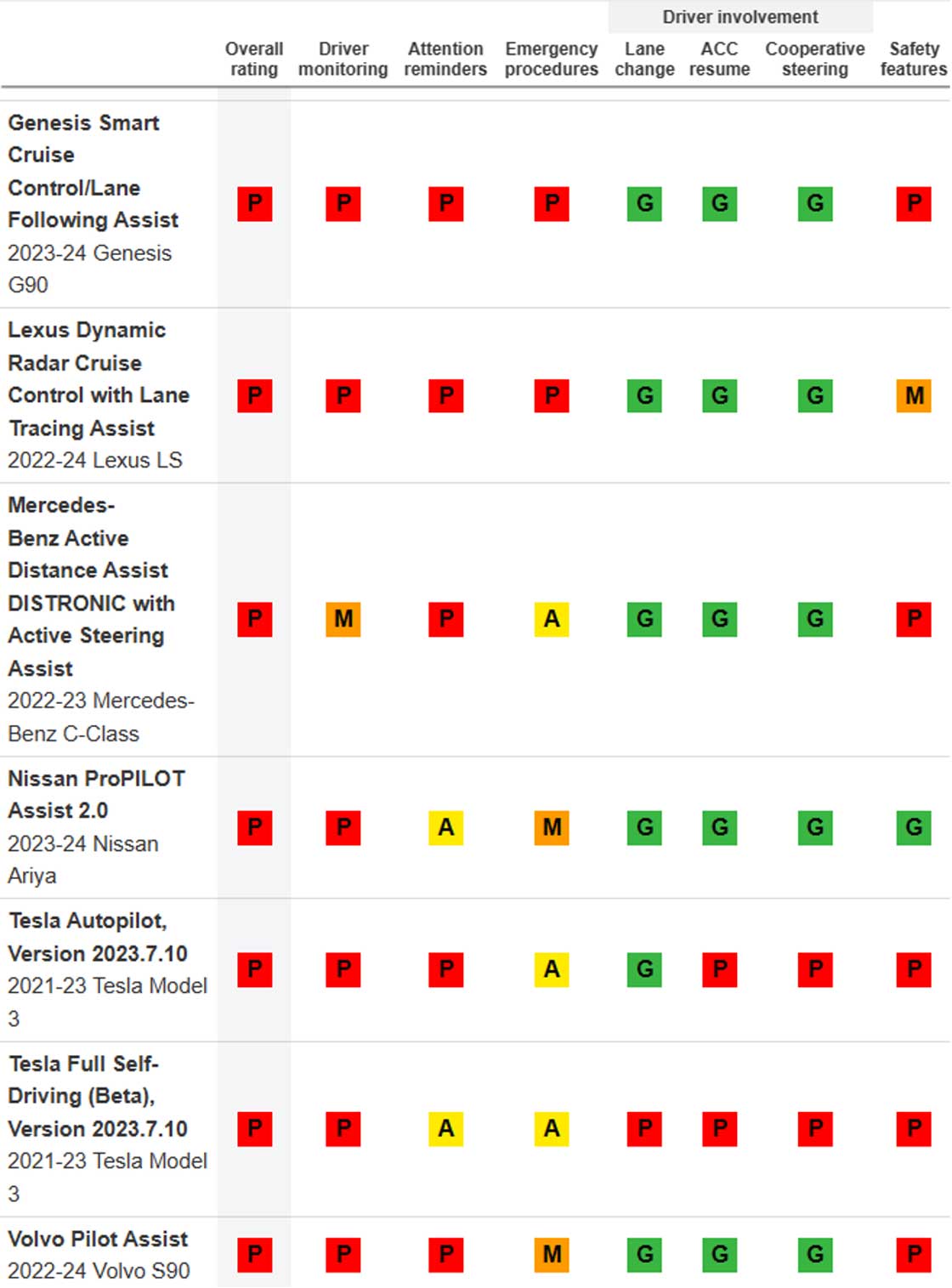
There are still a lot of issues with driver monitoring, emergency procedures, and safety features. Of the first 14 systems tested—from BMW, Ford, General Motors, Genesis, Lexus, Mercedes-Benz, Nissan, Tesla and Volvo—11 earned a Poor rating. Two were found Marginal, and only one earned an Acceptable grade.
Whether whole systems like Tesla’s so-called ‘Autopilot’ and ‘Full Self Driving’; GM’s Super Cruise, and Ford’s Blue Cruise, or feature bundles providing similar capabilities, today’s partial driving-automation technology uses cameras, radar, or other sensors to “see” the roadway and other vehicles. The setups in question include adaptive cruise control, lane centering, and various other driver-assist features. Adaptive cruise maintains a driver-selected speed, but will automatically slow to keep a set following distance from a slower vehicle ahead and then accelerate when the way is clear. Lane centering continuously adjusts the steering to help the driver keep the vehicle centered in the travel lane. Automated lane changing is also becoming more common. And driver monitoring is a crucial piece, to make sure the driver is always paying attention and ready to take control as soon as it’s needed.
Partial driving automation is a convenience feature that is meant to make long drives easier. There’s no evidence that it makes driving safer, and, in fact, it can create new risks by making it easier for the driver’s attention to wander. For this reason, it’s essential that all partial driving automation systems incorporate robust safeguards.
For our partial automation safeguard ratings, we evaluate driver monitoring, attention reminders, emergency procedures and other aspects of system design. A system may be assigned a rating of good, acceptable, marginal or poor for its safeguards.
Requirements for a good partial automation safeguard rating
Driver monitoring
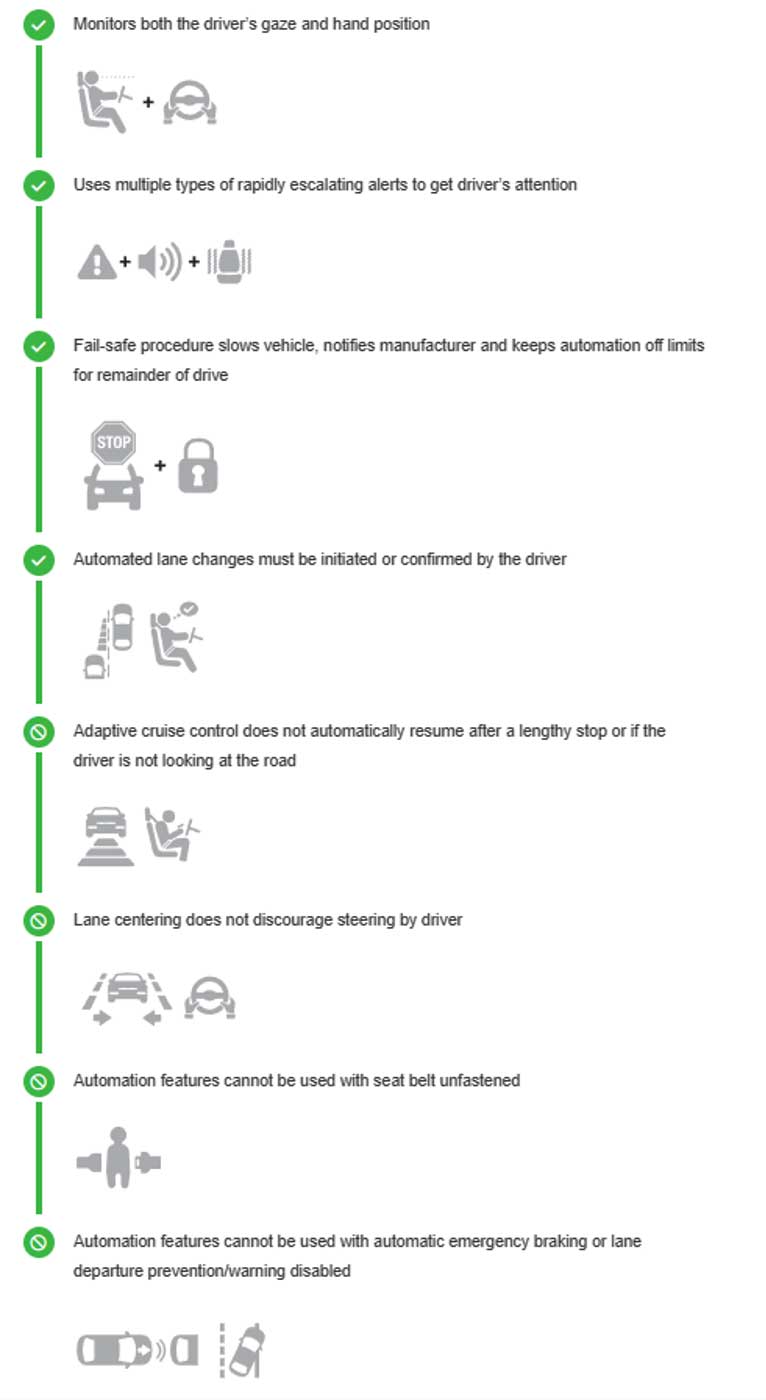
Effective driver monitoring is essential to making partial automation safe. Systems should be able to detect if the driver’s head or eyes are not directed at the road and whether the driver’s hands are on the steering wheel or ready to grab it if necessary.
To evaluate this, IIHS engineers record what happens in the following cases: the driver monitoring camera lens is blocked, the driver’s face is obscured, the driver is looking down, and the driver’s hands are not on the steering wheel. For systems that allow hands-free driving, the engineers also record what happens when the driver’s hands are holding a foam block the approximate size of a mobile phone. Systems should not activate under these conditions, and if they’re already switched on, they should issue an alert.
None of the 14 tested systems met all these requirements, though the Ford systems came very close. Ford’s BlueCruise and Adaptive Cruise Control with Stop & Go and Lane Centering Assist immediately issued alerts when the driver’s face or the camera lens was covered, for example, but failed to detect when the driver’s hands were occupied with another task. The BMW system didn’t react when the camera lens or driver’s face was covered, and the Mercedes-Benz system lacks a driver-monitoring camera altogether, though both vehicles were able to detect when the driver’s hands were not on the steering wheel.
Attention reminders
Timely and persistent attention reminders are also key. When a partial automation system detects that the driver’s eyes aren’t directed at the road or their hands aren’t ready to take over the steering, it should begin a dual-mode alert within 10 seconds, such as an audiovisual warning. Before the 20-second mark, it should add a third mode of alert or begin an emergency procedure to slow the vehicle.
Lexus Teammate, both Ford systems, and GM Super Cruise meet all these requirements. For example, when the test driver deliberately looked away from the road and held the foam block in both hands, Teammate began audiovisual alerts after four seconds, and began an emergency slowdown procedure after 16 seconds.
Both the hands-on Nissan Propilot Assist with Navi-link and the hands-free Propilot Assist 2.0 systems and Tesla ‘Full Self-Driving’ performed almost as well. The hands-on Nissan system, for example, provided audible and visual alerts about six seconds after driver disengagement, but didn’t provide a third type of alert until around 21 seconds had passed, when it pulsed the brakes. Seven other systems didn’t even provide dual-mode alerts within the first 15 seconds.
Emergency procedures
Partial automation systems need appropriate emergency escalation procedures to minimize the danger to occupants and other road users if the driver does not respond to those attention reminders. Regardless of how many different modes of alerts they issue, systems should begin a slowdown procedure within 35 seconds of driver disengagement. Drivers who ignore alerts for this long are either in distress or misusing the system. The system should send an SOS message to emergency responders or a 24-hour help center, and the driver should be prevented from restarting the automation for the remainder of the drive.
Of the 14 systems tested, only GM’s met all these requirements. Five systems include two of the three emergency procedures, and five include one of them. Lexus’ combination of Dynamic Radar Cruise Control with Lane Tracing Assist system and the two Genesis systems all fail to take any emergency action if the driver disengages from driving and does not respond to repeated warnings.
Driver involvement
Another group of requirements is aimed at ensuring drivers stay involved in decision-making. All lane changes should be initiated or confirmed by the driver. When traffic causes the adaptive cruise to bring the vehicle to a complete stop, it should not automatically resume unless the system can confirm the driver is looking at the road and no more than two minutes have passed. The lane-centering feature should not switch off automatically when the driver makes manual steering adjustments within the lane, as that can discourage drivers from being physically involved in the driving, and physical involvement can help prevent mental disengagement.
More systems performed well in these categories than any of the others. GM’s Super Cruise and Tesla’s ‘Full Self-Driving’ are the only ones that would make a lane change without any driver input. Super Cruise and both Tesla systems switched off lane centering when the driver does any manual steering.
Many systems allow ACC to resume automatically after a stop of more than two minutes or when the driver is not looking at the road. Both Tesla systems and BMW Active Driving Assist Pro will resume ACC in both scenarios, for example, while several others will restart in one of the two situations. Volvo Pilot Assist is one of seven systems that will not automatically resume in either scenario.
Safety features
There is little evidence that partial automation has any safety benefits, so it’s essential that these systems can only be used when proven safety features are engaged. These include seat belts, AEB, and lane departure prevention. For a good rating in this category, a partial automation system should not switch on if the driver is unbelted or AEB or lane departure prevention is not active. If already in operation and the driver unfastens their seat belt, the system should immediately begin its multi-mode, driver-disengagement attention reminders. Finally, it must be impossible to switch off AEB or lane departure prevention if the automation is engaged.
The hands-free Nissan Propilot Assist 2.0, Lexus Teammate, and GM Super Cruise systems are the only ones that meet all these requirements. The hands-on Nisson Propilot Assist with Navi-link and the BMW system come close, but they deactivate without issuing an alert when a key safety feature is disengaged. This is dangerous, because the driver may not be aware that they need to resume full control of the vehicle.
Most of the systems fail multiple safety feature requirements. Volvo Pilot Assist, for example, deactivates without an alert when the driver unbuckles, can be activated with lane departure prevention turned off, and also remains active if that feature is switched off mid-drive. The two Genesis systems fail all safety feature requirements.


