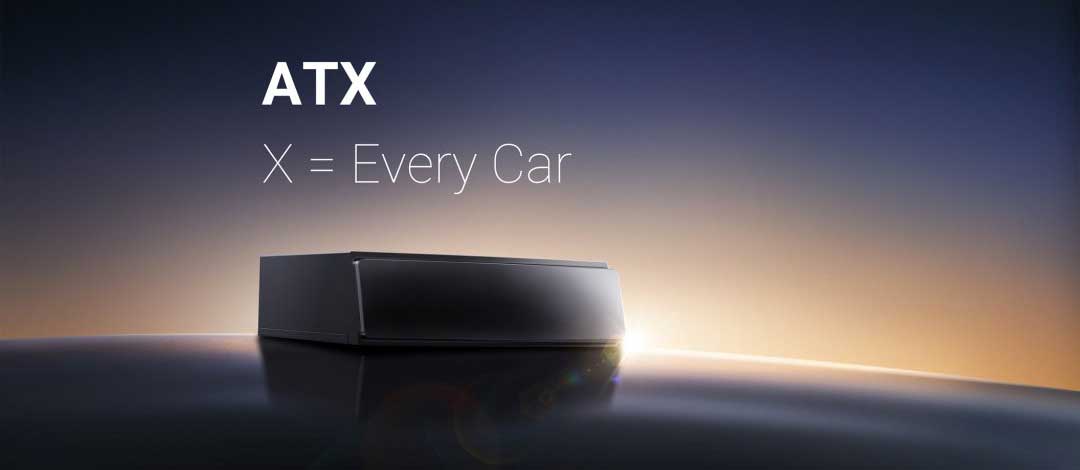
Hesai’s newest long-range, ultrawide-field lidar, the ATX, brings vehicles excellent 3D perception with big improvements in detection range, high resolution, and FoV width. It is smaller than the previous AT128, and uses Hesai’s 4th-generation technology platform with major upgrades to its laser transceiver module.
The ATX uses the market-validated transceiver architecture from Hesai’s AT series, greatly increasing module integration and simplifying the core optical scanning structure, while keeping a compact and lightweight form. Hesai has shipped over 300,000 AT128 units; the new ATX is 60 per cent smaller by volume, just over half the weight, features a surface window just 25 mm tall, and power consumption is a negligible 8W. That means it can easily be integrated into various positions on a vehicle: on the roof, behind the windshield, or inside the headlamps.
It boasts a 300-meter detection range and a 140° horizontal FoV, providing expansive visibility of complex road conditions such as surrounding vehicles or pedestrians. Its ultrawide FoV enables the provision of vehicle systems with comprehensive and accurate perception information. It can identify conditions such as rain, fog, exhaust fumes, and water droplets, and mark them in real-time at a pixel level, filtering over 99 per cent of environmental noise.
Hesai has already received design wins and nominations leading automakers, and large-scale mass production of ATX is expected to start in the first quarter of 2025.
DVN comment
Here again: better, smaller, more affordable, less power-hungry lidar. Every time a product like this is launched—which is quite often, nowadays—it further weakens Elon Musk’s already-lame arguments against automotive lidar.


