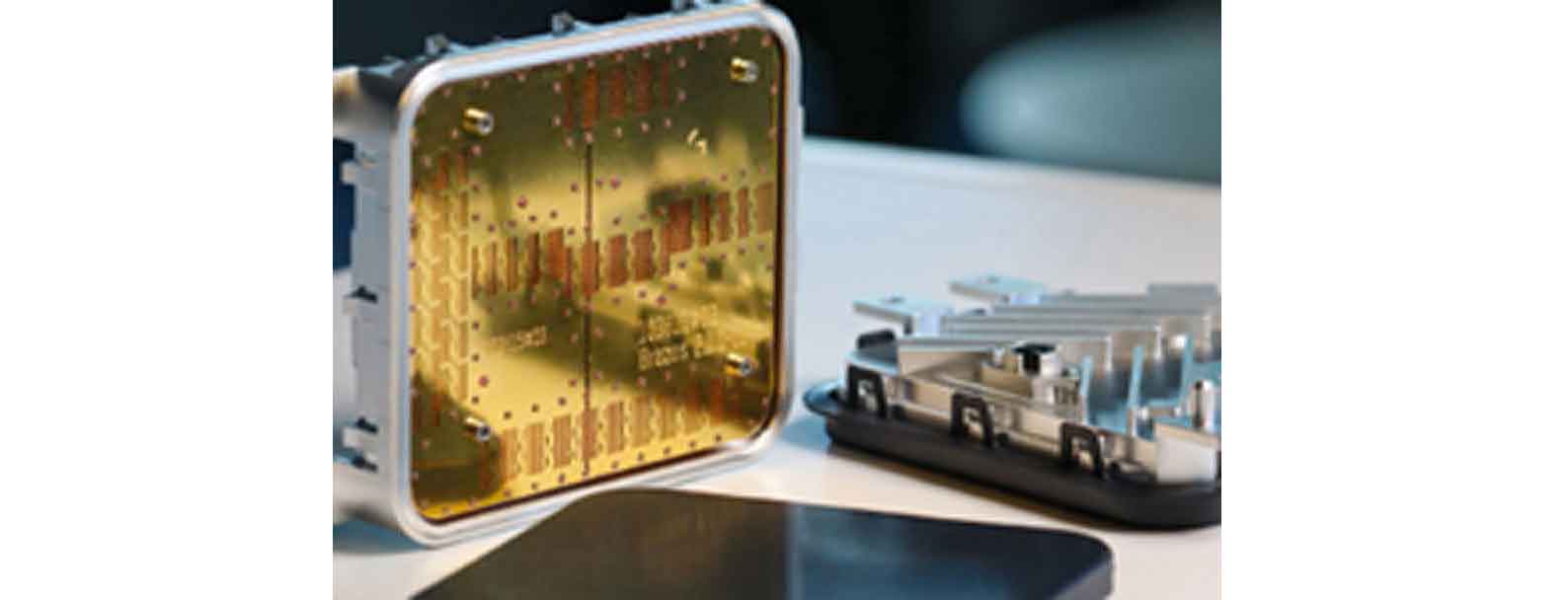
An undisclosed tier-1 customer, with whom a collaboration started in Q1 2023, has placed a first big new order with Gapwaves, with more to follow.
Planar solutions based on PCB technology are often used for RF distribution and radiation. They have been good enough for most applications at low cost with easy integration. This was also the case for automotive radar in the previous lower frequency bands and the first generations of the new 77-GHz band. However, at mmWave frequencies, problems such as low bandwidth, high losses and expensive RF substrates become significant, and the limitations of PCB create opportunities for other technologies.
Some of the other possible technologies include traditional waveguides, substrate integrated waveguides (SIW), low temperature co-fired ceramics (LTCC) and lens antennas. Automotive radars have switched to the 76- to 81-GHz band, which is now required by international rules. The main advantages are more accurate distance measurement because of the wider band and the easier integration of sensors on the car because of the smaller size. At the same time, the growing functions of advanced driver assistance systems (ADAS) and the emergence of autonomous driving (AD) require more capable and accurate sensors. Along with the other sensors on the car, such as cameras and lidars, radars are expected to keep playing a significant role because of their low-cost and all-weather operation. However, they must keep improving their performance while meeting the strict cost, size, thermal and reliability requirements. To achieve a precise and complete perception of the vehicle’s surroundings, different types of radar sensors exist In ADAS applications, one can differentiate between short-, mid- and long-range radars, depending on the distance and FoV needed for the functions, such as blind spot detection, lane change assist and forward collision warning, respectively. These sensors are specialized and increasingly common, with large volumes dominated by a few big tier-1 suppliers. They usually have between eight to 16 channels in a small form factor and cost is a key factor. The main performance challenge here is to achieve the desired range and FoV. On the other end of the spectrum are the more powerful and flexible high-resolution sensors, used for example in AD systems. They are also called imaging radars because they can provide camera/lidar-like perception through high resolution. These more advanced and premium sensors, with 30 to 100 channels, target a young market with many players and smaller volumes. The main performance challenges are to realize low loss routing and complex large antennas with a lot of channels. Clearly, the wide range of sensor types means a wide range of priorities and optimal solutions that need to be addressed.
There are three main benefits of RF performance: strong pattern control, wideband operation and high efficiency. Waveguide antennas can create both very broad and focused patterns, as well as customized ones, very well. A good option is vertically aligned resonant series-fed slotted waveguide antennas, because they are flexible, simple and low profile. They have naturally broad and stable radiation patterns in the horizontal E-plane, which are better than patch antennas, and they allow easy control in elevation by their length and number of slots. This is ideal for short-range radars where a large azimuth FoV is important and spacing down to half-lambda is often needed. For applications that need focusing on the azimuth plane, such as for maximum range in long-range radars, columns grouping or hard surfaces are used. Customized beams, such as in corner radar where the direction of the maximum range is at about 40 degrees, can be achieved by careful phase and amplitude control. In terms of operational bandwidth, unlike PCB patch solutions, waveguides can support the whole 76- to 81-GHz automotive band easily. This gives flexibility in frequency allocation and more precise distance measurement. For this purpose, both impedance and, more importantly, radiation patterns must be well-behaved, which is harder the narrower the beamwidth. High efficiency is the most famous advantage of the technology. At the antenna level, losses are the least significant even for high gain elements. When it comes to routing, typical losses at E- Band are around 0.01 to 0.02 dB/mm (0.25 to 0.5 dB/in.) depending on the design and material characteristics, much lower than typical microstrip solutions. This is especially beneficial for large and multi- layer sensors such as imaging radars, where the antenna size and layout may require routing lines that are tens of centimetres long, including crossovers. Of course, designing and manufacturing large sensors with several channels is a challenge.
DVN comment
Gapwaves’ waveguide technology gives automotive radars unmatched performance potential. Some of the main advantages are strong pattern control, full band support, minimal losses, and smaller, cooler, and shielded sensors. These benefits could help any new radar sensor to improve its performance and assist sensor makers to meet the requirements of L3 and L4 driver assist and autonomous systems.


