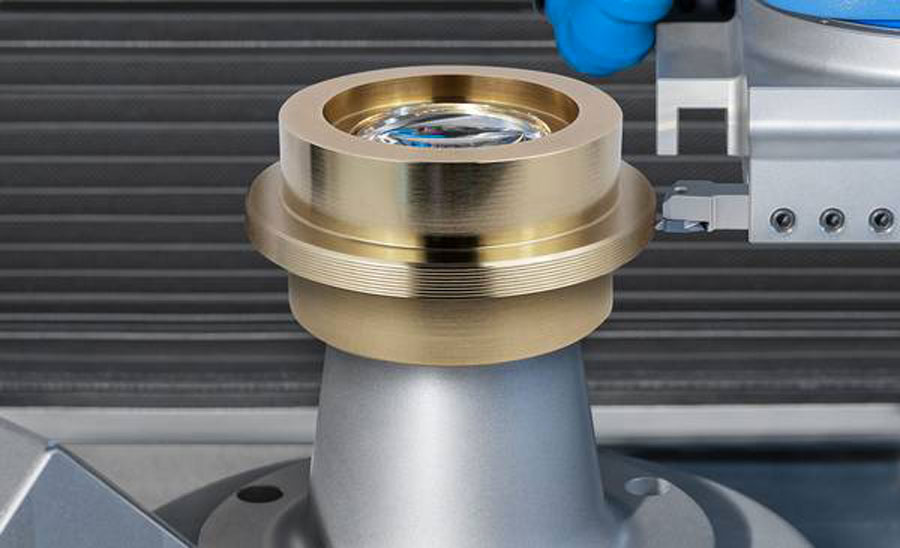
For high-precision lenses, while mounting single lenses in sub-cells and processing them using alignment turning, the edge of the mount and the flange surfaces of mounted lenses are produced such that the mount’s axis of symmetry coincides with the lens’ optical axis and all lenses have the correct air gaps between them. After being machined, the mounted lenses are inserted into a lens barrel, without any more alignment steps needed. Often, elements are secured in the lens barrel by clamp rings at both ends. O-rings are used if the inside of the lens must be sealed—for example because it is filled with gas.
The Trioptics ATS 100, 200, 200 UP, and 300 UP alignment turning stations now enable advanced processing of lens edges with threads and grooves. The thread or groove is cut directly on the lens mount, thus saving time by integrating this into a single work process along with the other steps of the mount-edge machining. The scope of functions on these alignment turning machines can be expanded with a software enhancement and added tools.
In addition to saving time, the combination of thread or groove cutting with an alignment turning machine offers further advantages due to the alignment of the chuck with the optical axis of the lens. The threads and grooves are centred to the optical axis of the lens, while the standardized flank angles of the threads and grooves are achieved in a uniformly and reproducible way because of the simple tool movement in only one direction.
Applying a thread to the lens mount enables a fixed position of this element itself, which eliminates the need for clamping rings or allows individual, critical elements to be easily fixed within the assembly. This offers benefits if the overall size of the lens must be reduced. Grooves allow secure positioning of the O-rings and thus ensure optimal sealing of the lens against leakage of the fill gas.
DVN comments
The interaction of the optics and sensor chip of the emitter and receiver unit of the lidar sensor must be precise and perfectly aligned. Perfect performance must be ensured from the first sample to the series product. Trioptics is one of the most important companies to support lidar companies in production chains.


