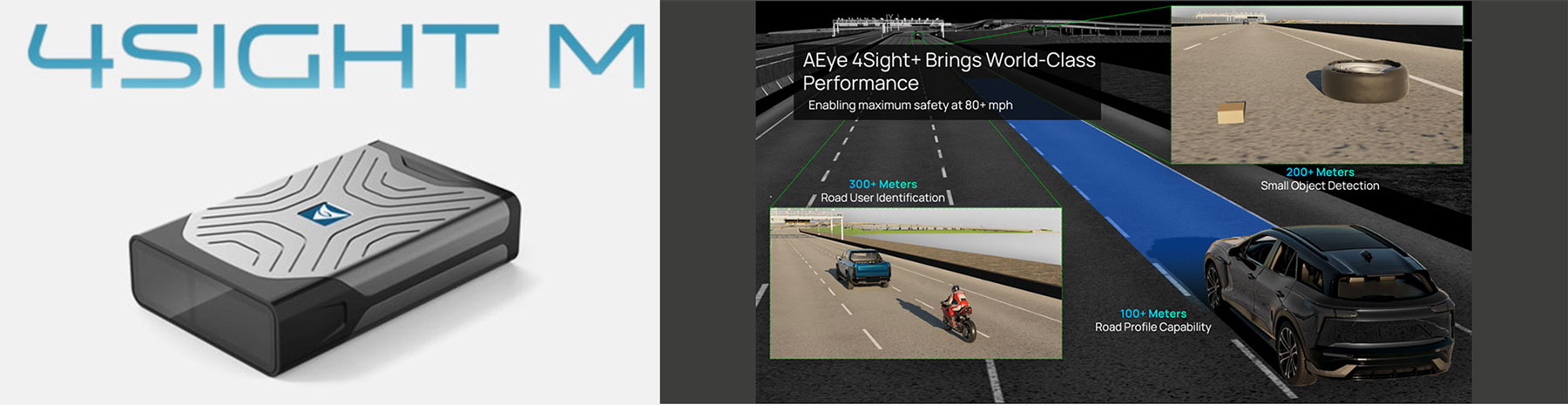
AEye has announced 4Sight+, the newest addition to their Intelligent Sensing product line, which delivers industry-leading path-planning, obstacle avoidance, and prediction capabilities. AEye applied their software-defined architecture to improve the sensor’s range by 20 per cent and spatial resolution by 400 per cent, extending its high-speed small obstacle detection capabilities, while enabling the same hardware to address hazardous vehicle cut-ins—providing an all-in-one solution for automakers.
The data fidelity and range upgrades in 4Sight+ bring an increased level of dependability, performance, and adaptability from AEye to help OEMs eliminate phantom braking, improve existing ADAS features, and safely enable hands-free driving at highway speeds.
4Sight+ takes advantage of the platform’s modular, bistatic system that can reconfigure lidar performance on-the-fly and add new capabilities over-the-air. Powered by a tiny MEMS device that allows for ultra-fast, yet robust movements, the 4Sight Intelligent Sensing Platform is inherently designed to be highly programmable to meet performance requirements for both urban and highway driving using a single platform.
4Sight+ improves prediction capabilities by tracking vulnerable road users, including pedestrians, cyclists, and other vehicles, at up to 300 meters. It improves vehicle ride quality and reaction time by detecting small objects, like bricks and tires, at up to 200 meters, and it helps with vehicle path planning by identifying road surfaces, such as cement and asphalt, at up to 100 meters, including in direct sunlight and low light environments. These advantages allow AEye to enable predictive safety systems for a smoother, more comfortable hands-free driving experience at 80+ mph, without requiring driver intervention.
The advantages of a software-defined sensor allow the same hardware to address close-up vehicle cut-ins, long-range views, and everything in between. Automakers can leverage AEye’s scanning agility to completely reconfigure the lidar’s performance instantaneously, using cues from other sensors in the vehicle, such as speed or GPS location to activate uniquely defined modes of operation for parking, urban, and highway environments.
By optimizing lidar performance based on driving conditions, the sensor continues to achieve high-performance, while operating at the lowest power required. This also allows for flexibility in form factors—an important consideration for seamless vehicle integration as automakers pursue electrification.
DVN comment
The 4Sight+ platform is highly programmable and can be reconfigured in real time to meet the demands of city and highway driving. The main evolution is the fact that it improves predictive capabilities by tracking vulnerable road users up to 300 meters away, and that it detects small objects up to 200 meters away and helps with vehicle path planning up to 100 meters away.


