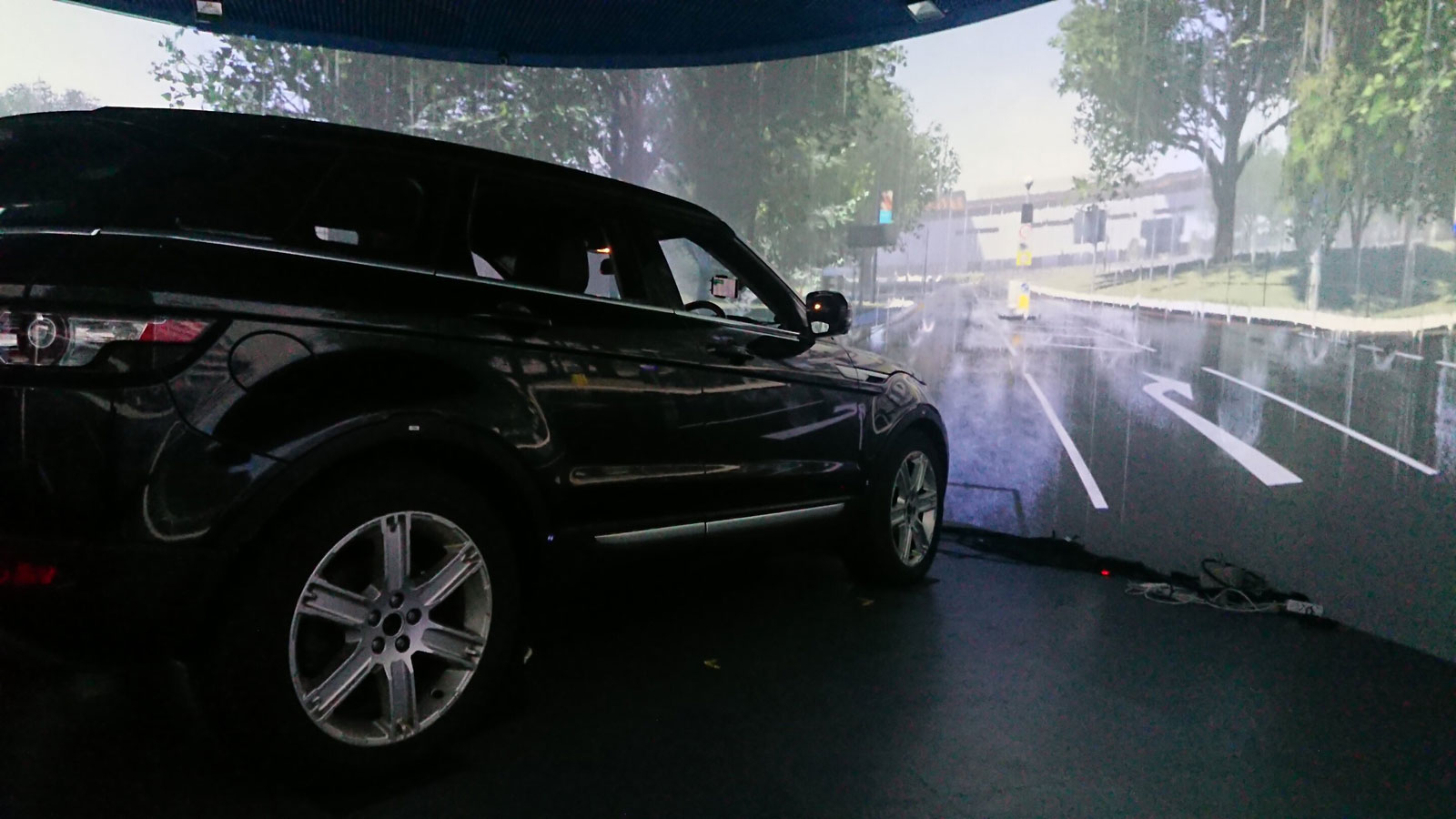
Researchers from the University of Warwick (WMG) are testing how lidar sensors on vehicles perform in the rain. Using a WMG 3xD simulator (explanatory video here) the team tested an autonomous vehicle’s lidar sensors in different intensities of rain, driving around a simulation of real roads in and around Coventry, England.
One of the issues with lidar sensors is performance degradation in rain. Lidar works by emitting numerous narrow beams of near-infrared light with circular/elliptical cross sections that reflect off objects in their trajectories and return to the detector of the lidar sensor. If a lidar beam intersects with a raindrop close to the transmitter, the raindrop can reflect the beam back to the receiver, which will falsely detect the raindrop as an object. The droplets also can also absorb and refract some of the emitted light, degrading the sensors’ effective range.
Researchers, using different rain models, made it rain in the simulator and measured the lidar sensor’s responses, making a record of false positive and false negative detections. As the rain intensity increased, it became more difficult for the sensors to detect objects. At ranges up to 50 m, several rain drops were erroneously detected. At 50 to 100 metres’ range, this decreased, but as rainfall increased up to 5 cm per hour, the sensors’ detection of objects decreased and effective range was shortened.
“The developed real-time sensor and noise models will help to further investigate these aspects, and may also inform autonomous vehicles manufacturers’ design choices, as more than one type of sensor will be needed to ensure the vehicle can detect objects in heavy rain.” said Valentina Donzella from the University of Warwick. The team’s research has been published in the journal IEEE Sensors.


