By Daniel Stern, DVN Chief Editor
Nothing to do but wait on ADB in the USA—even if NHTSA will eventually react favourably to industry and analysts’ strong consensus against their proposal, it won’t happen till sometime after the US Government resumes functioning. At the DVN US Workshop last week, a show-of-hands survey found most attendees don’t think ADB will be legal in the states in the next two years; maybe in the next five or ten. So in this issue of retroreflections, we’ll take a look at some history of how Americans react to new headlamp technology.
Over seventeen years’ time, a lot of technical innovation and technological progress can happen. Can, that is, but not necessarily will, and when something comes kicking stalled evolution in the pants, it can be difficult to adapt for those accustomed to the way things were. That’s what happened in 1957-’58 in the United States.
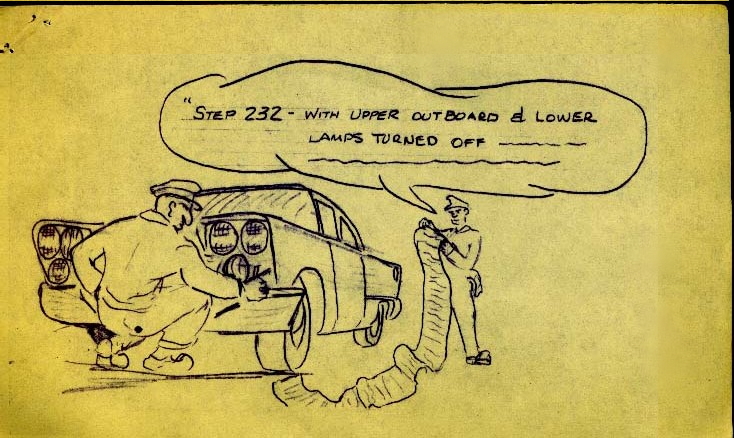
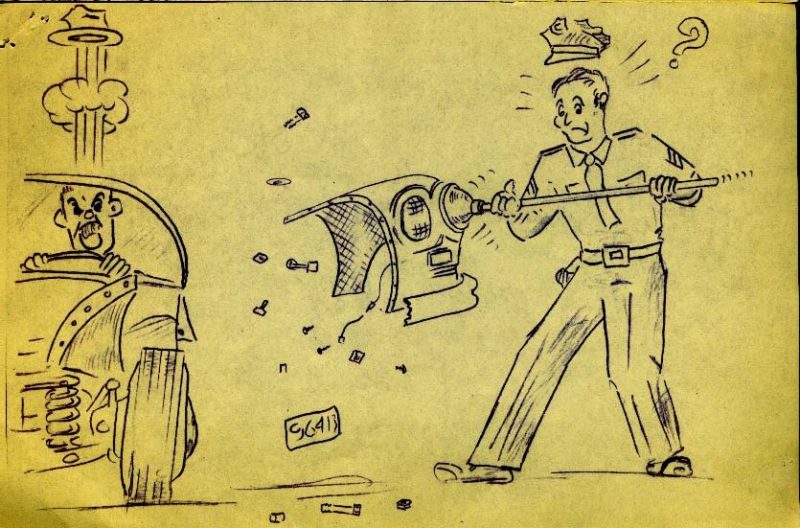
The four-headlamp system was okeh by every state for ’58, but that didn’t mean everything was fine. There was disruption and upset in the service sector, as illustrated by these four comic panels from that time, shared by renowned American headlamp optical engineering rock star Larry Rice, who started out in the sealed-beam era, and now he’s making LEDs walk, talk, dance, and sing (and light your way along at night).
All 1940- to 1956-model vehicles on American roads had two 7-inch round sealed-beam headlamps, one on each side. They evolved every now and then—the filaments were upgraded in wattage and output a couple of times, an anti-backdazzle filament shield was added, the reflector and lens optics were improved, and aiming pads were added—but they were still 7-inch round sealed beams, one per side.
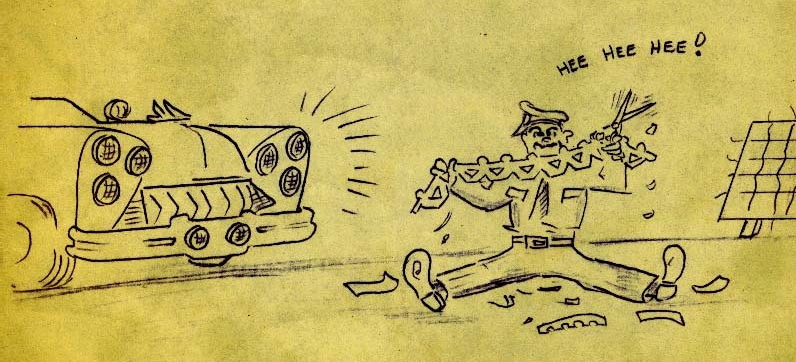
And then some 1957 cars come with a new system of four 5¾” lamps, two per side, in states that allowed it. National vehicle technical regulations were still about a decade in the future; lamps had to be type-approved by every state, and some states weren’t yet onside. Others were, but hadn’t amended their laws in time for the ’57s.
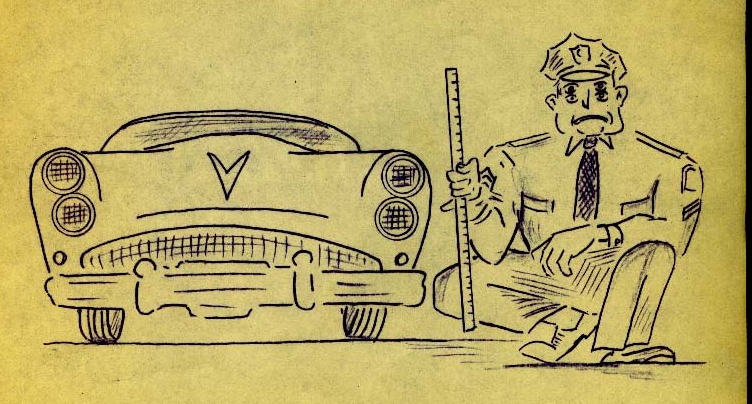
For these cartoons to make any sense, one must understand the very different laws, customs, and culture of the foreign country they’re from; i.e., the past: in most states each vehicle had to pass an annual roadworthiness inspection by state policemen or other inspectors probably wearing neckties. The inspection included checking the headlights for type approval and proper installation and operation and colour and aim (too bad this is no longer the norm). As this 1967 article describes, faulty lights were a frequent find.
An element of the inspection that had been routine and uniform for all cars, no longer was. It wasn’t just double the number of lamps; there were other things to mind, as well: the upper or outboard lamps produced the lower beam, while the lower or inboard lamps produced the upper beam. Fine, but here comes a car with the lamps arranged slantwise: the inboard lamps are also the upper lamps; the outboard lamps are also the lower lamps. Now what…? Confusion, frustration, and these cartoons.
Most of three decades later, the 1984 Lincoln Mark VII was the first American-market car since 1939 to come with composite, replaceable-bulb headlamps rather than sealed beams. Technically they shared little with the lamps used for years in Europe: plastic lenses instead of glass, transverse unshielded filaments instead of axial ones with a low beam shield, a plastic-base bulb with an O-ring trying to create a hermetic seal rather than a metal-base bulb with open breathing (it’s worth noting the British had tried hermetically-sealed replaceable-bulb headlamps a decade earlier and found the concept irretrievably problematic. By and by the Americans came to the same conclusion). The technical merits and drawbacks of the new system didn’t seem to matter much; many Americans—including writers who knew better, or should have—called them “Euro lights” and didn’t care if that was wrong. Performance? Nobody cared! What seemed to matter most was the cosmetics: an aerodynamic lens, flush with the front curvature of the body, rather than an upright round or rectangular sealed beam. This period video shows the prevailing priorities of that time: appearance, aerodynamics, and cost.
Ten years on, performance was beginning to seep into the conversation. This 1994 advertisement for a new Infiniti model comes right out and says the car has projector headlamps that work better than the regular kind.
So what kinds of conversations will we see and hear about ADB lighting systems when (if) they finally come to American roads? It’s tempting to hope they’ll amount to “Finally!”, but time will tell.


