Targeting applications such as adaptive lighting and light pattern projection for automotive applications, Samsung have developed various lighting module concepts they demonstrated at Electronica. The Matrix Beam Module is based on a regular surface-mount LED assembly, creating a 6 × 16 array of white LEDs together with switch ICs and a driver module.
| Conventional lamp |
 Matrix beam |
 Pixel lighting |
Another implementation consisted of a single 4.8 × 19.2 mm LED die forming an array of 192 (6 × 32) individual pixels sized at 550 × 690 µm, each embedded into a silicon recess forming reflector walls. The large LEDs are built on Samsung’s 8-inch wafers, and the individual pixels are obtained through a cavity-filling phosphor deposition process.
Here the reflective silicon walls allow for a higher contrast ratio compared to conventional µLED arrays—up to 500:1—with an extremely narrow dark-spacing: only 20 µm of space between adjacent pixels. The silicon walls act as micro-collimators and remove the need for one of the most sophisticated parts in adaptive headlamp design. Collimators are expensive to manufacture and require precision assembly; here the silicon walls control the beam shape at the source.
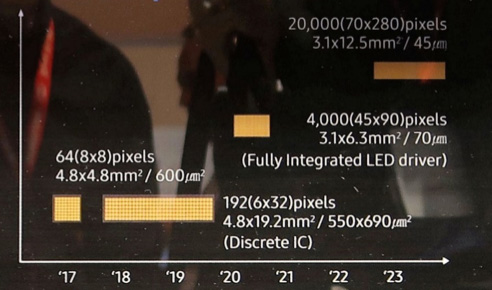 Depending on customer demand, the aspect ratio of the die could be specified differently for mass production, and with integrated drivers if needed. The 4.8 × 19.2 mm die would have a luminous flux of 3800 Lm at 1.6 A, drawing 54 W.
Samsung hope to have pixel lighting modules in volume production on the market by 2019 or ’20. Their roadmap anticipates 20-kilopixel LED chips in 70 × 280 arrays measuring just 3.1 × 12.5 mm (with an individual pixel size of 45 × 45µm) by 2023.


