By Professor Yandan Lin, Conference Chair
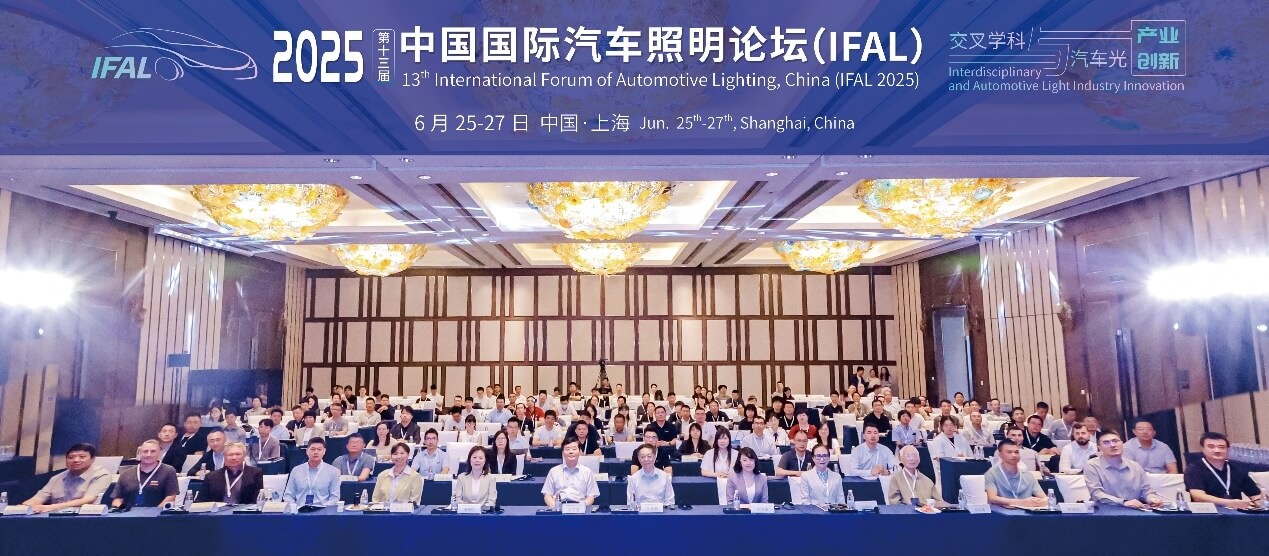
From 25 to 27 June, 2025, the 13th International Forum of Automotive Lighting (IFAL 2025) was grandly held in Shanghai. Hosted jointly by the Institute for Electric Light Sources of the Intelligent Robotics and Advanced Manufacturing Innovation College of Fudan University, the Intelligent Transportation Lighting Committee of CIES, Shanghai Motor Vehicle Inspection Certification & Tech Innovation Center, Fudan Lin-gang Industrialization Innovation Platform, and Shanghai IFAL Vision Technology, and co-organized by the Human Factors Engineering and Industrial Innovation Professional Committee of the China Creative Studies Institute, the forum was supported by the Department of International Cooperation and Exchange of the Ministry of Education and Fudan University.
With the theme of “Interdisciplinary and Automotive Light Industry Innovation”, the forum focused on the R&D application and market trends of AI technology in automotive lighting, attracting over 300 offline representatives from multiple countries, domestic universities, research institutions, and leading enterprises, as well as dozens of overseas guests participating online.
In the keynote session, several internationally renowned experts delivered insightful presentations:

- Dr. Wolfgang Huhn, President of GTB and DVN senior advisor, presented “The Glare Discussion in the UN GRE GTB: Status Update,” analysing global regulatory trends for smart headlamps and ADB technologies
- Wei Wang, Deputy Director of the General Components Test and Research Laboratory at Shanghai Motor Vehicle Inspection Certification & Tech Innovation Center Co., Ltd., discussed “The Transformation of Automotive Optical Measurement in the Era of Intelligent Driving: From Technological Breakthroughs to Standard Reconfiguration.”
- Professor Shijie Xu from Fudan University’s Future Information Innovation College shared his research on “Ultrathin Phosphor-glass Composites (PGC) for High-efficiency Far-red Luminescence.”
- Associate Professor Chunhui Jing from Southwest Jiaotong University explored “Design and Evaluation of Lighting Environment in Urban Rail Transit Cabins for Visual Comfort.”
- Professor Fei Tang from Jiangsu Normal University reported on “Controlled Preparation and Luminescent Properties of Ultrathin Phosphor-glass Composites.”
- Dr. Korbinian Kunst from Darmstadt University of Technology, Germany, compared “Headlight Safety Performance Rating (HSPR) and China NCAP’s Vehicle Lighting Performance Score (VLPS).”
The forum featured seven thematic tracks covering Automotive Optical Measurement and Standardization, Optical Design and Light Environment Experience, Multimodal Perception and Intelligent Driving, Emerging Display Technologies, Driving Safety and Riding Experience, Intelligent Headlight Systems, and Optical Materials and Control Technologies, with a total of 34 technical presentations organized.
Participants included representatives from universities such as Fudan University, Darmstadt University of Technology, Vrije Universiteit Brussel, Shanghai Jiao Tong University, Shanghai University, University of Shanghai for Science and Technology, Southwest Jiaotong University, Shanghai Ocean University, and Chongqing Vocational College of Architectural Engineering, as well as leading enterprises including Hasco Vision, ams Osram, Changzhou Xingyu Automotive Lighting Systems, Appotronics, Everfine, Synopsys, Lumileds, Texas Instruments, Jiaxing Hella, Rayben Technologies, Shanghai Fulllight Intelligent Technology, Shanghai Motor Vehicle Inspection Certification & Tech Innovation Center, Dominant Opto Technologies, Shanghai JingHe Photoelectric Technology, Huizhou Voir Science & Technology, Yejia Optical Technology, Chengdu Convenient Power Semiconductor, Buguang Technology, and Instrument Systems (Germany IS Photometry).
Furthermore, several industry experts including expert Xiangbing Li from the Research and Development Institute of Dongfeng Motor Corporation, engineer Xiaoxi Cheng from SAIC Volkswagen, and engineer Shuman Jia from Hasco Vision delivered in-depth technical sharing on topics such as vehicle lighting energy management, ambient lighting design, smart lighting development, driver takeover performance prediction, and MR interface perception measurement.
During the IFAL forum, an inspection tour of the automotive ecosystem industry chain was organized, featuring experts from leading national automotive enterprises and foreign scholars. The first of the delegation was Hasco Vision Technology, where they visited the exhibition hall and new testing laboratories to learn about cutting-edge technologies such as intelligent headlights, laser lighting, and LED matrices. This visit fully demonstrated Hasco’s strengths in optical design and electronic control, providing the delegation with a direct insight into the development level and future trends of China’s vehicle lighting industry.


Subsequently, the delegation proceeded to the Shanghai Motor Vehicle Inspection Certification & Tech Innovation Center and visited the Anting Test Ground in Anting Town. Covering an area of approximately 1.44 square kilometres, this test ground is China’s first comprehensive passenger vehicle test facility meeting international standards, equipped with various professional test tracks to fully verify vehicle performance and safety. The delegation also toured laboratories including EMC, Lighting Tunnel, Crash Test Center, and NVH, gaining an in-depth understanding of the vehicle testing process.
This inspection showcased China’s technical capabilities in automotive testing and R&D, highlighted the role of technological innovation in driving industrial upgrading, and promoted domestic and international industrial exchanges and cooperation.


