Today’s Retroreflections feature looks at something other than lighting for the first time. Nowadays, radar-based automotive sensors for driver assistance and autonomous driving functionality are all but standard equipment. Most of us remember the first commercial systems: relatively primitive arrangements of radar sensors on the vehicle’s rear bumper bar; the driver would hear a series of beeps while reversing. The faster the beeping, the closer the nearest obstacle. But work on automotive radar sensing goes back much further than that. An article (annotations added) in the August 1972 issue of “Automotive Engineering”, the SAE magazine, says:
RCA [the now-defunct Radio Corporation of America] have demonstrated an experimental automobile radar system designed to prevent rear-end collisions by tracking cars ahead and sounding a warning when separation distance becomes unsafe. The compact radar (17 × 8 × 2 1/2 in, that is 432 × 203 x 50 mm) radar transmits a continuous signal which is received by a passive reflector on the rear of the vehicle ahead. RCA scientists believe that an operational system, including both the transmitting/receiving radar and special reflector can be mass produced within five years at a sticker price of $50-100 per car […in 1972 dollars, equivalent to $290–$580 today]. They also project that the system might be integrated into a car so that it would automatically release the throttle and apply the brakes when approaching another car or should the car run off the road. Smoother traffic flow is predicted since the number of automobiles passing a given point can be increased substantially through the constant speed and separation provided by the system.
Other advantages claimed are:
- The reflecting antenna tracks a compact car as easily as a large truck and radar echo cannot be “swamped” by one from a larger vehicle.
- Since the radar signal penetrates fog, rain and dust it could prevent multi-car pileups.
- The system could prevent cars from entering one-way streets or highway access lanes from the wrong direction by positioning a reflecting antenna at the end of the street.
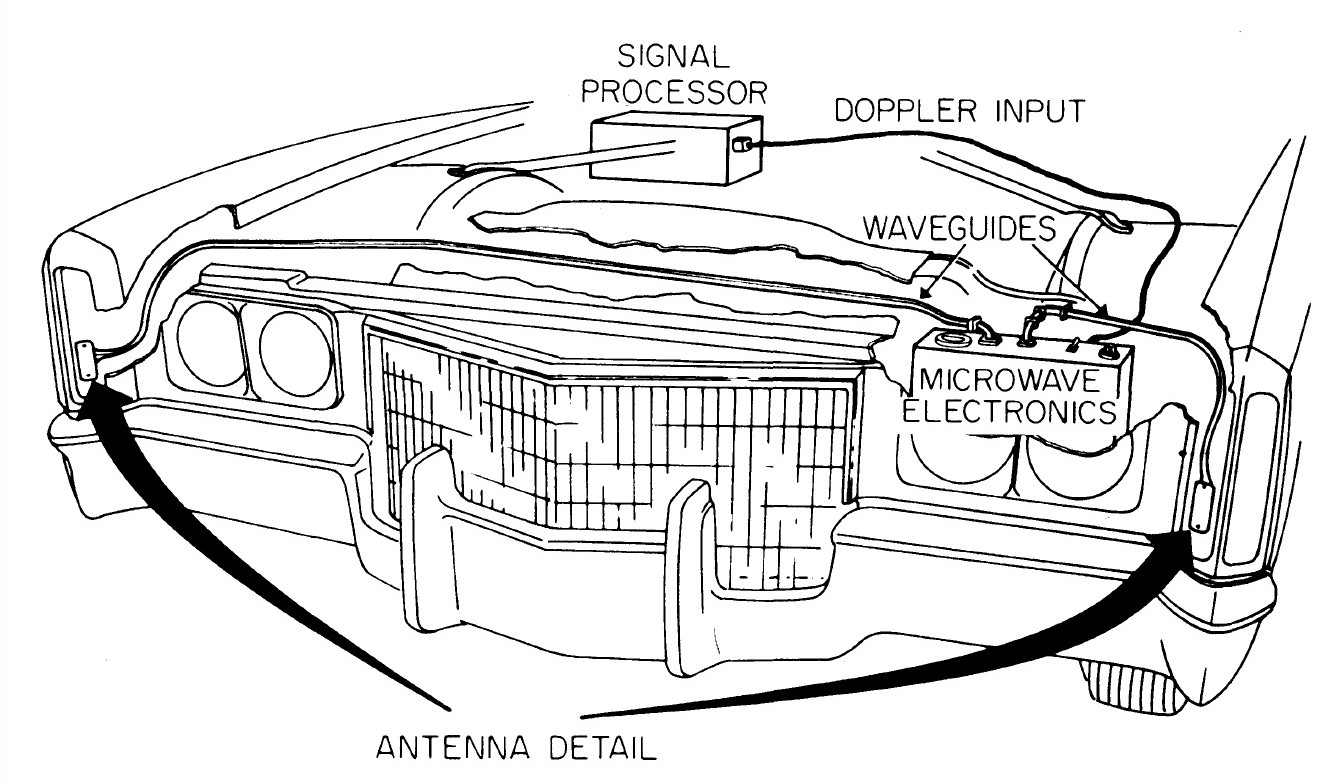
Elsewhere in the same issue of the magazine, there’s discussion of airbags and other passive restraints—a new topic very much on the auto industry’s mind as seatbelt usage rates were barely above zero in the United States at that time, and there was strong regulatory interest in safety restraints that required no driver action. One of the challenges: how to dependably sense a crash. Radar-based crash detection systems were one of the ideas being looked at (image); problems at that time included poor selectivity and short range. But take a look at the cost and size of that proposed 1972 system, in comparison to today’s tiny, affordable system-on-chip solutions!


