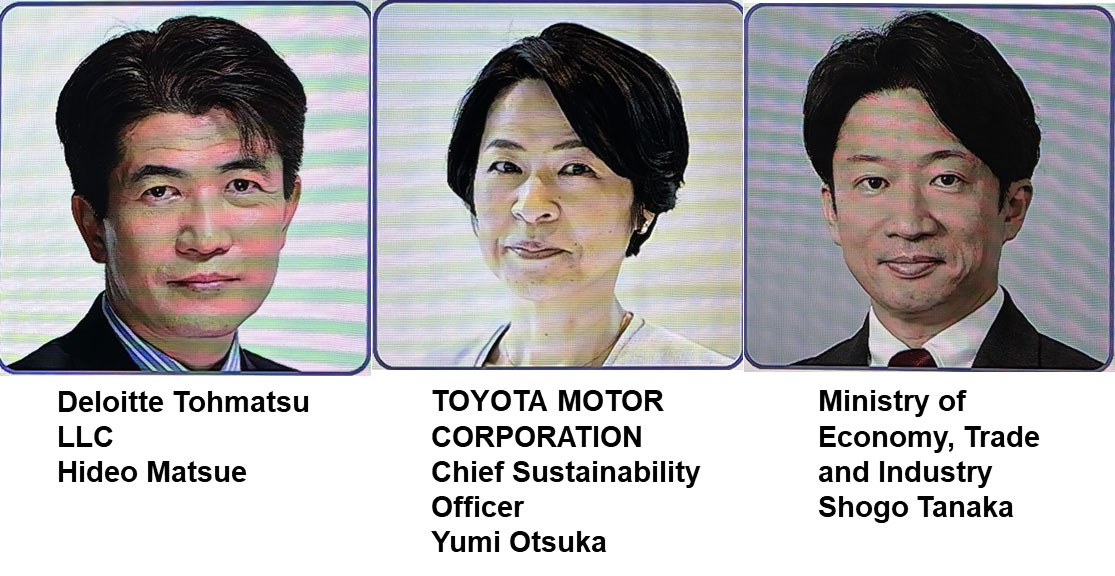
During Circular economy Expo in Japan, the Japanese Government strongly promoted resource circularity policies. Because Japan is a resource-poor country, circularity really matters. Shogo Tanaka, from the Ministry of Economy, Trade, and Industry, made points including:
- The movement towards commercialization is becoming very active, and we are working on policies to turn this into an opportunity for growth
- We also want to submit a bill to amend the Law for Promoting Effective Utilization of Resources.
- In order to expand the use of recycled materials, we will first designate strategic materials by government ordinance.
- In order to use these recycled materials, we will create a product top runner certification system for products that are themselves suitable for supplying recycled materials.
- We will amend the law so that collection will be possible if ministerial certification is received.
- We will establish a framework for providing guidance and recommendations to promote the healthy growth of the aftermarket industry.
- We are creating a framework for sufficient financial support that covers not only the introduction of equipment but also the running costs.
- We are creating rules for investment support and subsidy support
Toyota Motor’s Chief Sustainability Officer Yumi Otsuka said his company aims to create a social system that can circulate resources: “In terms of the coexistence of humanity and the earth, we are working on the circular economy as an important issue. Based on the culture of the spirit of the Toyota Production System, the key is to eliminate waste. We are focusing on developing technology, building partnerships, and shifting business models to use fewer resources, produce less waste, and use them for a longer period of time. We are also considering designs that are easy to disassemble and disassemble.
“Currently, Toyota’s design recyclability rate is over 85 per cent, and we are working to achieve a recycled materials adoption rate of over 30 per cent by 2030. Considering the entire lifecycle of a car and the number of parts it has, it is very difficult to create an ecosystem, but we need to be able to steadily collect parts when the customer reaches the end of their use, and we design our cars with the assumption that both the software and hardware will be updated so that the cars can be used for a long time.
“From now on, we will transform into a mobility company, and as we provide mobility in all forms, we feel that it is necessary to create international rules for used cars that are also being sold overseas. After-sales is where we truly interact with our customers. We believe that increasing value as Toyota is very important and makes our customers happy. We are reviewing our designs, such as by removing adhesives and using other materials to make things easier to disassemble”.


