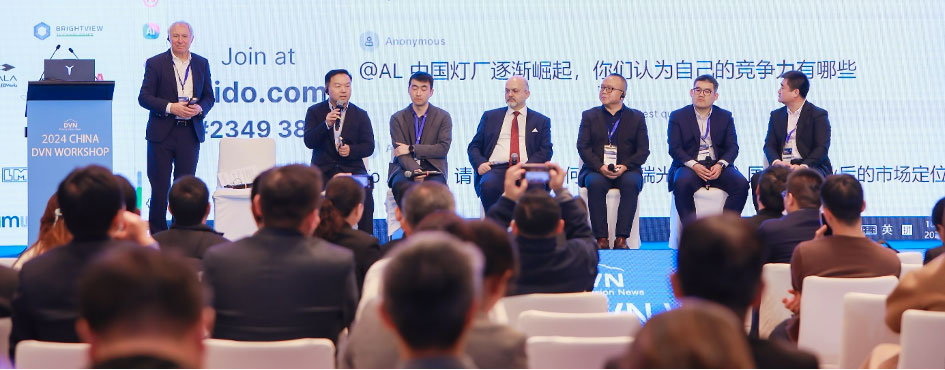
The third Leaders Round Table in the history of DVN, after Munich and Pune, was again a great success. DVN prepared a question for each of the VIPs at the table. The participants introduced themselves and their companies and answered the questions. After this opening, a discussion started, chaired by DVN’s Wolfgang Huhn. Panellists included:
- Mind Optoelectronic’s Hossein Nafari (Lighting Vice President)
- Marelli Automotive Lighting’s Peter Cao (General Manager APAC)
- Hasco Vision’s Ao Jinlong (Deputy General Manager & CTO)
- Xingyu’s Lin Shudong (Deputy General Manager, Research Laboratory Director)
- Liaowang’s Yang Kai (Deputy General Research Institute Manager)
- Anrui Lighting’s Eric Sun (General Manager)
All the executives gave brief and, of course, very positive descriptions of their companies. The Chinese market environment was unanimously seen as extremely challenging but promising for further high-tech solutions. International companies see many opportunities overseas, but also a high political risk due to unpredictable tax strategies.
A particular issue was the different pace of development of Chinese players compared to the rest of the world. Chinese automakers are seen as quick to make decisions and, on the whole, extremely impatient. They are prepared to take risks, such as very short testing times. The Chinese customer accepts that some functions in the car only work properly after several updates, so automakers can act in that way. All of this is the opposite of Europe and other developed markets, where customers expect a flawless car on delivery. Chinese engineers are used to working three shifts, 7 days a week if the project requires it; you rarely find that anywhere else in the world. Also, Chinese automakers’ specifications are short, containing only the minimum necessary items. This gives the tier-1s more flexibility.
The provocative question of whether light for safe night driving or light for fun is more important was clearly answered in the direction of safety. Fun functions are important, especially for young customers, and they bring in a lot of revenue. But safety is the basis of everything.
Sustainability is clearly still a minor factor in the Chinese automotive lighting market. European approaches to recycling and energy reduction haven’t yet reached China, but it is expected they will in a few years’ time. Today, strong cost pressure dominates the RFQs.

The second panel discussion focused on regulation. GTB Secretary Davide Puglisi presented the latest information from UN Regulations: acceptance of road projection including predicting trajectory, ongoing activity on signaling road projection and autonomous driving indicator lamps. Regulations allowing predicted-trajectory road marking should enter into force in Q4 2025. For signalling road projections, GTB will provide a new proposal for next GRE in April 2024 to get final confirmation. An AD indicator lamp proposal is under construction for both component and installation requirements. Pugliese also mentioned two other topics: the importance of glare, with a new task force at GRE level, and a discussion to clarify the definition of the apparent surface, under the umbrella of SLR.
FAW asked regulators to make more space for innovation, at least in some specific areas, especially about interactive light scenarios—and also faster regulation updates.
Xingyu discussed the latest update in the Chinese GB 5920 standard covering all light signalling device, applicable from July 2025 for new vehicle type (position, turn signal, width marker, daytime running, licence plate, rear fog, and slow-vehicle lamps, as well as light signal projections), July 2027 (stop and reversing lamps) and mandatory for all vehicle types starting July 2028. A small delay has been accepted for stop and reverse lamp application due to new requirements: minimum 15 cm2 lit area for stop lamps, and an enlarged photometric grid for reversing lamps.
CATARC’s He Yuntang described the latest update of GB 4599 (road illumination devices), applicable from July 2025 for new vehicle type (fog and cornering lamps), July 2027 (low and high beam) and mandatory for all vehicle types in July 2028. Similar to LSD, A small delay has been accepted for stop and reverse lamp application due to the same new requirements.
SMVIC’s Bu Weili gave some news about the update of installation requirements for vehicles (GB 4785, equivalent to UN R48). The first meeting will be in December 2024, first draft in 2025, and final draft in 2027. Topics to be addressed will include:
- ADB testing (similar to FMVSS 108)
- Clarification about light from parked vehicles and a new definition for a ‘non-running’ vehicle
- Clarification of the definition of apparent surface, including apparent surface symmetry and the 60-per-cent rule with quadrilateral shapes
- Integration of new AFS mode from GB 4599 into GB 4785
- Certification of the lit grille part of position lamp
- Sequential turn indicator sequence
- Automatic levelling as in UN R48-09
- Autonomous Driving Signaling lamp (need or no need)
The third panel talk gathered designers from Dongfeng, IM Motors, Lynk & Co, and Zeekr.

Compared to what I was used to in previous jobs, I noted the importance of function development, especially for new EV brands. Lighting function development expresses the otherwise hidden ‘intelligence’ and capabilities of the car. Examples include welcome and farewell sequences, show room modes, and selectable lighting signatures. The more fun you have from your lamp, the more intelligent the car seems to be. That is why ISD, road projection, signalling projection, and videos from lamps are so important in China. Interaction between driver and its vehicle has number one importance.

To shorten the development schedule and integrate innovation and functions into the lamp, a close relationship between design studio, R&D and set maker is needed, that was clearly explained by IM Motors’ exterior designer.


