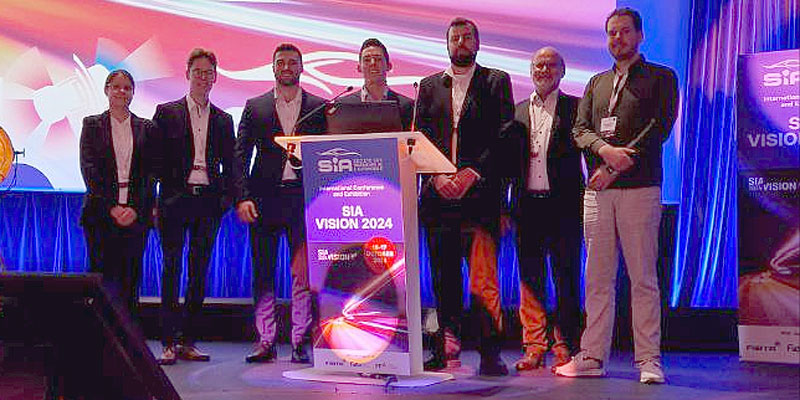
Six students from TU Darmstadt’s ALSVV team participated in the VISION Congress in Paris this year, and Dr. Michael Hamm talked with them about their experience.
Michael Hamm: Looking from the perspective of a researcher and scientist, what have been the most interesting fields in the conference and why?
Darmstadt students: From a research perspective, some of the most exciting areas discussed at the conference included innovative approaches to exploiting the capabilities of HD modules to improve driver visibility. In particular, we were interested in the development of adaptive and situational light distribution systems that optimize illumination on the road and its surrounding in different driving conditions. Our colleagues from various universities presented relevant studies in this area, demonstrating the potential for improved safety and driving experience.
Also, the latest developments from tier-1 and -2 suppliers were particularly interesting as they broadened our understanding of emerging technologies and trends. These discussions opened up new paths for future research and collaboration, highlighting the continuing evolution of lighting technologies in the automotive sector.
Michael Hamm: Which topics do you see as innovative challenges?
Darmstadt students: Our primary goal is to develop lighting technologies that improve object detection for drivers. This requires a camera system that delivers high-quality images with a good signal. Especially in low-light conditions, it is difficult to get a high-quality camera image, but it is necessary to be able to control the lighting intelligently. Vice Versa Lighting can be used to achieve better image quality, as both systems influence each other. Good camera quality is particularly important for automated driving at night. This synergy enables safer and more effective automated driving by enabling early object detection, which allows situationally adaptive light distribution controlled by HD modules. Achieving optimal sensor fusion between camera and lighting systems is fundamental to maximizing the performance and safety of these technologies.
As we explore innovative new light distributions, it becomes increasingly important to establish methods for evaluating the performance of these dynamic systems and to develop regulations that support their safe and effective implementation.
Another important topic in science is the role of vehicle lighting on other road users, such as the challenges involved in implementing projection systems.
Another challenging topic is sustainability. It’s a good idea to recycle the material used in headlights and rear lights. However, efficient processes are required to separate and recycle the different types of material properly.
Michael Hamm: Do you have ideas on how to contribute via research?
Darmstadt students: We believe our research can significantly contribute to addressing these challenges by exploring new methodologies and technologies that enhance the effectiveness of HD modules in various driving conditions. Additionally, collaborating with industry partners on practical applications of our findings can further bridge the gap between research and implementation.
Through scientific studies it is possible to demonstrate the benefits of new systems and reduce prejudices against their use. Furthermore, this research addresses fundamental questions in lighting science essential for effective lighting functions, enhancing our understanding of human vision, and providing valuable guidelines for future regulations.
Michael Hamm: VISION 2024 covered lighting and ADAS topics. What is your opinion on that?
Darmstadt students: We found the coverage of lighting and ADAS topics to be particularly valuable. The conference opened the opportunity to engage with experts in the ADAS realm and fostered discussions on how effective lighting can support other ADAS systems. It was productive to discuss how high-quality lighting, as rated by HSPR, could be integrated into rating systems such as EURO NCAP. We also appreciate that glare is discussed anew, which points out the importance of ADAS. Especially interesting is the discussion about the headlamp not only supporting the human driver, but also the camera for ADAS and for new generations of autonomous vehicles.
Michael Hamm: What are your recommendations for ISAL 2025, based on your experience at VISION this year?
Darmstadt students: We aim to find a good balance between industry and research talks to ensure a diverse range of perspectives. It would be beneficial to organize high-quality invited talks that appeal to both industry professionals and researchers.
The discussion topics primarily centred on current regulations and previously approved measures. Exploring and investigating features that are currently not permitted could open up opportunities for even more exciting and forward-looking discussions, potentially leading to conversations about adjustments to the regulations.
The Automotive Lighting Team (TU Darmstadt – ALSVV) and their research:
Elisabeth Kemmler: My research focuses on the investigation of discomfort glare caused by LED light in road traffic. Therefore, I am conducting laboratory and field studies in which psychophysical methods are applied. The aim is to derive a new model that predicts the perceived discomfort glare of different road users.
Tom Weidemann: Tom will consolidate all research and develop adaptive situational headlights using microLED modules, implementing and testing them in a real car under real-life conditions.
Korbinian Kunst: I am currently conducting perception psychological studies on optimal object visibility in virtual and real environments. These studies will be the fundamental research defining what good visibility is. To use this information during driving, I will design a computer vision algorithm which estimates visibility for the driver. With this, adaptive situational light functions by HD modules can be effectively designed.
Nikolai Kreß: I am working on front lighting topics, specifically on evaluating and developing new and improved light intensity distributions. This includes a wide range of subjects, and my current emphasis is on human object detection, which I presented in my VISION talk while additionally covering HSPR. My work is guided by the overarching idea that in the future, light distributions will become increasingly dynamic and adapt to situational requirements, especially in complex environments like urban traffic.
Markus Peier: My research topics are the adaptive control of signalling devices such as brake lights, taillights, turn indicators, and daytime running lights, as well as the communication of autonomous vehicles with non-autonomous road users. In studies with test subjects, we determine the optimum luminous intensities for the signalling lights so that optimum visibility and minimum energy consumption are ensured without disturbing other road users.
David Hoffmann: My research focuses on the requirements and interactions between a vehicle’s front-facing camera and its headlamps in nighttime traffic environments. The nighttime traffic environment is particularly challenging due to factors such as glare, motion blur, and low signal levels. For this purpose, we characterize camera systems in our laboratory as well as in the real world. Using this data, I perform experiments to assess the influence of harsh lighting conditions on the performance of convolutional neural networks.
Julian Lerch: My research focuses on the development and advancement of adaptively controlled headlight systems (future ADB). The emphasis is on simulating computer vision solutions that enable optimization for AI-based control systems, as well as the automated calibration, levelling, and aiming of pixel headlights.


