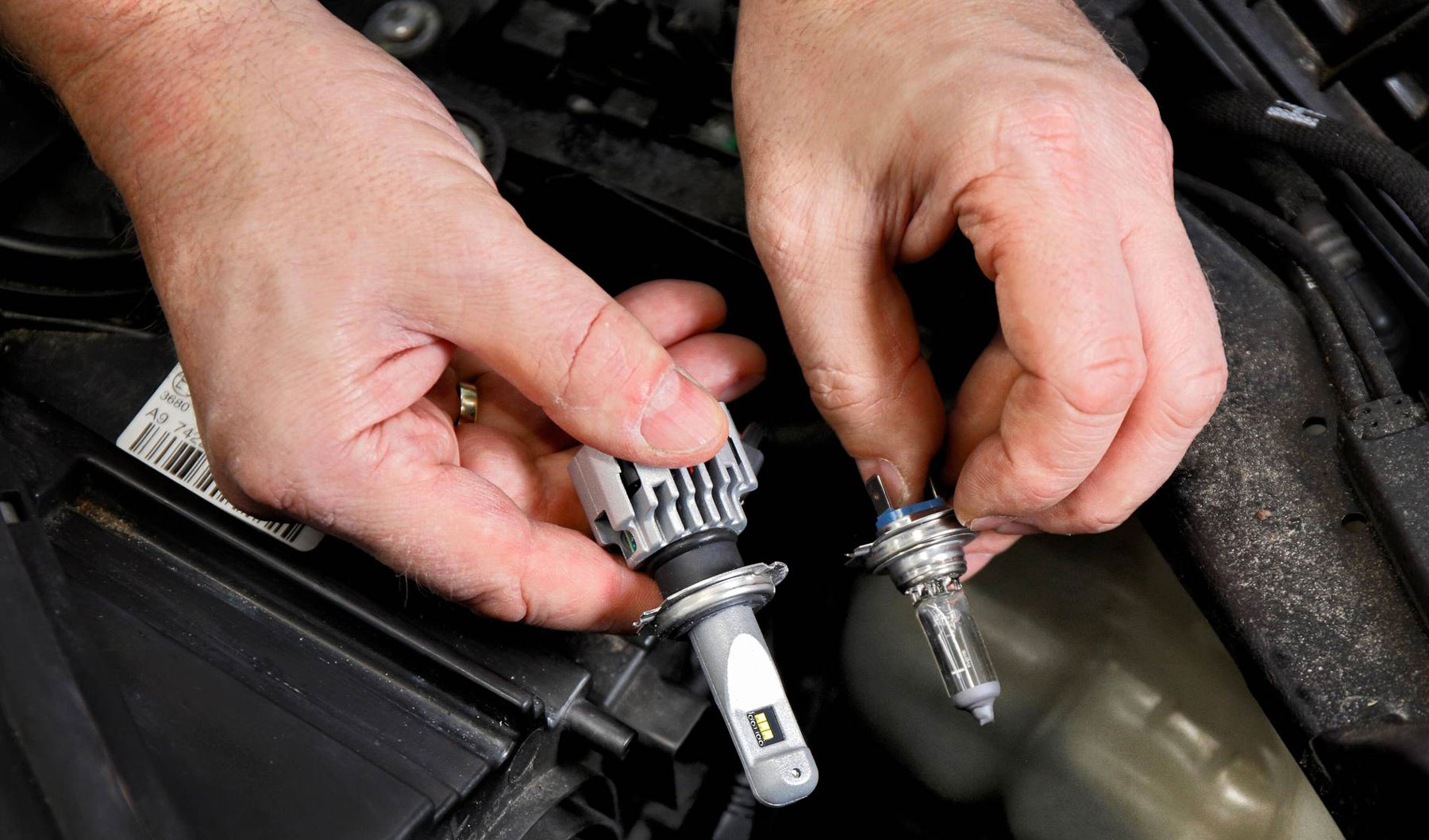
ADAC, the German automobile club, is advocating the installation of LED bulbs in halogen headlamps. A wide variety of LED bulbs are available from legitimate makers (aside from a mountain of them with little or no engineering in them, from less reputable outfits). Some of the legitimate-brand ones are approved in certain individual European countries for use in specific headlamps on specific vehicles. These approvals are not comparable to the ECE or DOT markings on a regular headlight bulb, indicating it will work safely, effectively, and legally in any lamp designed to take that kind of bulb. Rather, the LED bulb approvals are the result of specific countries testing specific bulbs in specific lamps. If a combination meets the testing country’s minimum standards for headlight performance, it is added to that country’s OK-list.
Germany, France, and Switzerland head up the small list of countries engaging in testing and approval of this kind, and the combined list of approvals comprises more than 900 car, motorhome, and motorcycle models. LED bulbs are also sold for fog lamps, parking lights, and numerous other vehicle applications—with and without safety approvals.
ADAC is appropriately emphasizing that it is important to use only approved LED bulb/headlamp/vehicle combinations. Legitimate makers provide approved-compatibility lists on their websites. The management of vehicles in service in Europe—periodic technical roadworthiness inspections strongly linked to the validity of the vehicle’s traffic authorization and insurance—make this approach feasible. Under it, an unapproved LED bulb/headlamp/vehicle combination can subject the owner to fines, the car can flunk its periodic inspection, and its insurance and/or operating licence can be suspended. Without a structure like this (for example, in North America), an approved-combinations strategy like this is not possible.
LED replacement bulbs for halogen lamps are gradually evolving toward universal drop-in applicability, but there are significant challenges to be overcome. For example, the rotative position (“clocking”) of a single-filament halogen bulb exerts relatively minor effects on the beam pattern; engineers have long used bulb clocking to fine-tune the photometric performance of the lamp—for example, to move an internal filament support to a position where its reflections will not cause unwanted glare light. Bulb clocking is also widely used to provide clearance for the physical fit of the bulb, especially for bulbs with 90-degree bases.
But the 2-sided/back-to-back structure of an LED bulb is a significant departure from the cylindrical-filament light source in a halogen bulb, optically speaking. LED bulbs are designed with the assumption that they will be installed with straight-up clocking: the two LED chipsets facing 9:00 and 3:00. But in many headlamps, that’s not how the bulb sits, which makes a universal drop-in LED bulb difficult. Also, the PWM feed applied to headlamps either for DRL-dimming or for regular low- and high-beam voltage regulation is invisible with glowing-filament light sources, but it can cause noticeable, distracting flicker with instant-on/off LEDs. Too, there is the question of what to do when a halogen headlamp’s inbuilt self-thawing system is taken away by a cold LED bulb replacing a hot halogen one.
Work is actively under way in GRE and SAE to build toward a future LED retrofit bulbs are more widely applicable. In 2023, UN Regulation № 37 was amended to provide a structure for future type-approvals of LED bulbs, and that regulation will soon contain specifications for LED H11s.


