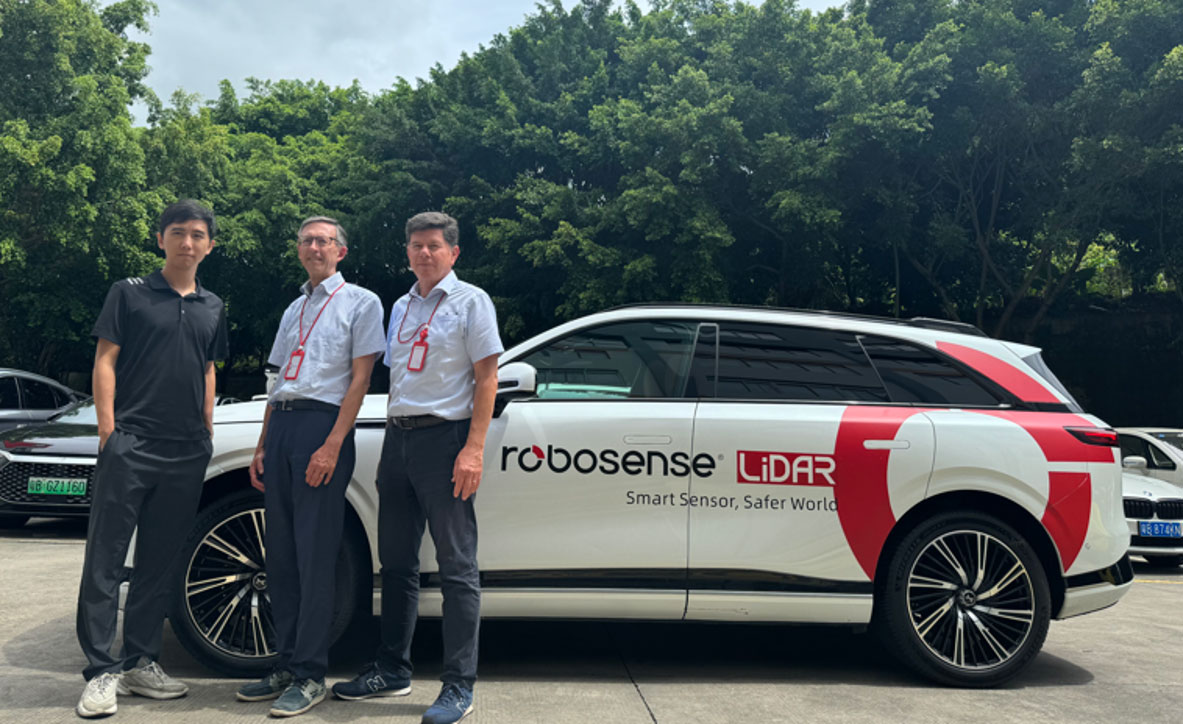
DVN had the pleasure to visit RoboSense’s facility in Shenzen, including labs and manufacturing lines. We met with Senior Product Director Sean Wang; Strategic Planning Manager Anna Zhang; Marketing Deputy Director Jasmine Gao, and Overseas Marketing Specialist Gloria He.
The DVN team included DVN-Lidar General Editor and lidar sensor expert Eric Amiot, and ADAS & AD Systems Expert Luc Bourgeois. The main purpose of the visit was to better understand the reasons why vehicular lidar is expanding much faster in China than in Europe. The agenda included discussion about market trends and technology; demo-car presentation, and a factory visit. Here are some of the questions and answers:
DVN-L: What passenger cars are equipped with lidar today?
Robosense: Today you can find lidar applications on cars with a price above $30,000. Based on the current cost reduction curve, we can expect to see lidar on cars cheaper than $30,000 in the next three years.
DVN-L: What is your expectation for the robotaxi market?
Robosense: 99 per cent of the robotaxis operating in China are still in the testing phase. Some have safety drivers, some have a remote monitoring system in case something happens. The deployment is limited to some big cities, and we do not expect any ramp-up before 2026-27.
DVN-L: Why is lidar so popular in China?
Robosense: There are several reasons adding up to make the lidar more and more popular in China.
- Lidar improves safety. Huawei is one of the OEMs using lidar to improve the AEB function and claims a significant improvement of the max AEB speed with lidar.
- Driver peace of mind: The driver is responsible for L2 – L2+ functions like NOA, the end user also knows the current systems are not 100 per cent reliable (Tesla ‘Autopilot’ issues are infamous). He needs a robust system and lidar makes the system safer, especially in urban areas.
- Object detection: Lidar is the high-resolution sensor which can measure exactly the dimensions and position of the target, including the moving direction / angle of the target, which is a great help in urban areas and to detect small objects lying on the road.
- SLAM: no HD map is required for the NOA function; this is the new trend. The map is created and memorized for the frequent travel route using lidar (e.g., home-office).
- Price Curve: lidar is getting cheaper and cheaper.
DVN comment
The driver expects the functional safety level at a similar level for L2+ and L3, the main difference between L2+ and L3 should be the redundancy. This was already the conclusion of the DVN report Tesla ‘Autopilot’, its Implication for the Growth of the Automotive Lidar Market, published at the end of 2022.
DVN-L: Are there already hands-off applications on the Chinese market for L2+?
Robosense: In China, hands-off systems are not allowed by the regulation and the driver clearly knows he is fully responsible. This means there is no pure hands-off application, and the driver is warned after a certain time if he doesn’t put hands on the steering wheel.
DVN-L: When do you see L3 applications coming in China?

Robosense: We have developed a new M3 sensor to support future L3 applications, with a 300-m range and a resolution of 0.05°, anticipating an active deployment from 2027, which means the lidar sensor should be SOP ready in S2-2026.
DVN-L: Do you see BSD applications for lidar coming?
Robosense: We have recently developed a new E1 sensor for BSD applications. This would also support L3 applications to get a better safety performance in cities for close cutting, and support remote parking / valet parking applications.

DVN-L: What is your competitive position on the market?
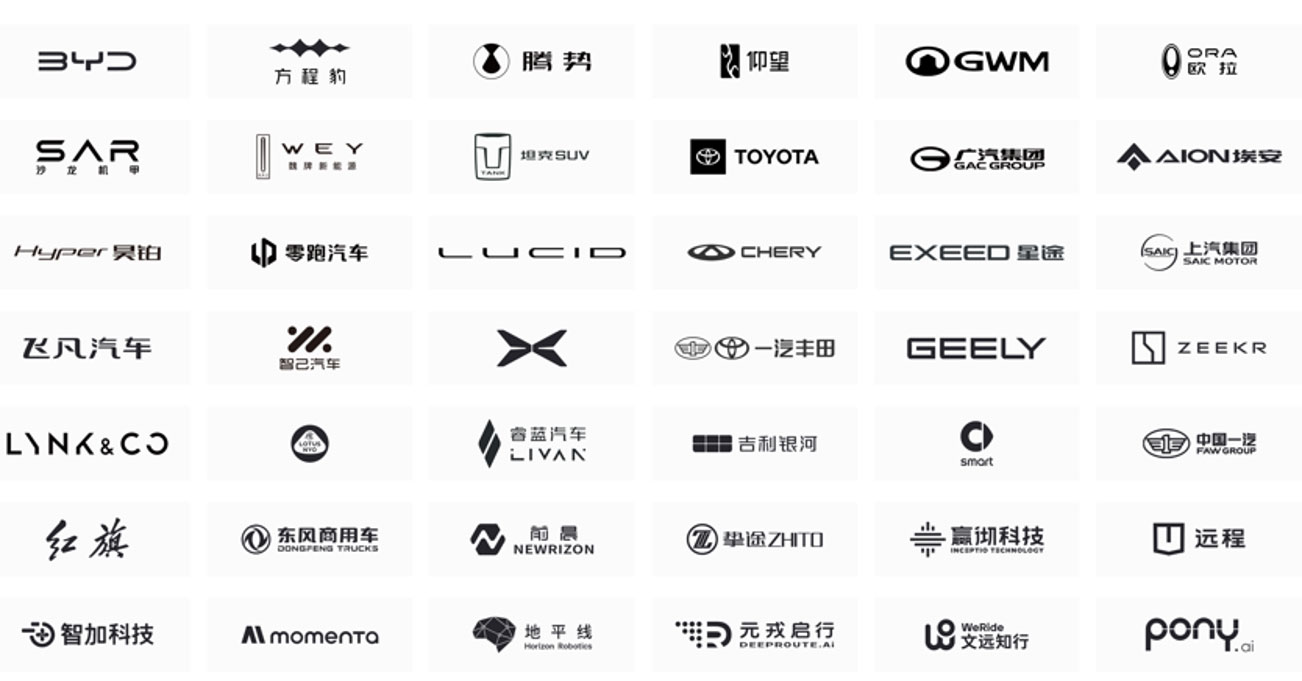
Robosense: Robosense is mostly focused on automotive applications, and has already equipped 25 car models with its lidar (>50 per cent of all car models on the market equipped with lidar – announcement at the Beijing Auto Motor Show 2024).
DVN-L: What is the cost reduction curve for lidar applications in China?
Robosense: We have developed a new MX sensor which will be much cheaper – starting early 2025, and the market expects a continuous price reduction over the next three years.
DVN comment
See DVN special report of the EAC lidar Tech 2024 expo in Suzhou; it is expected some suppliers will reach a $200 price range in 2025 thanks to the high volume effect, and C¥1,000 (USD $138 as of 1 July 2024) was mentioned as a target for the industry in the next three years.
DVN-L: What is your current business model? How big is the Robosense team?
Robosense: Robosense, which was created in 2014, has 1,300 employees currently focused on automotive applications. It sells lidar sensors sending point cloud data.
DVN-L: How many lines do you have in Shenzen?
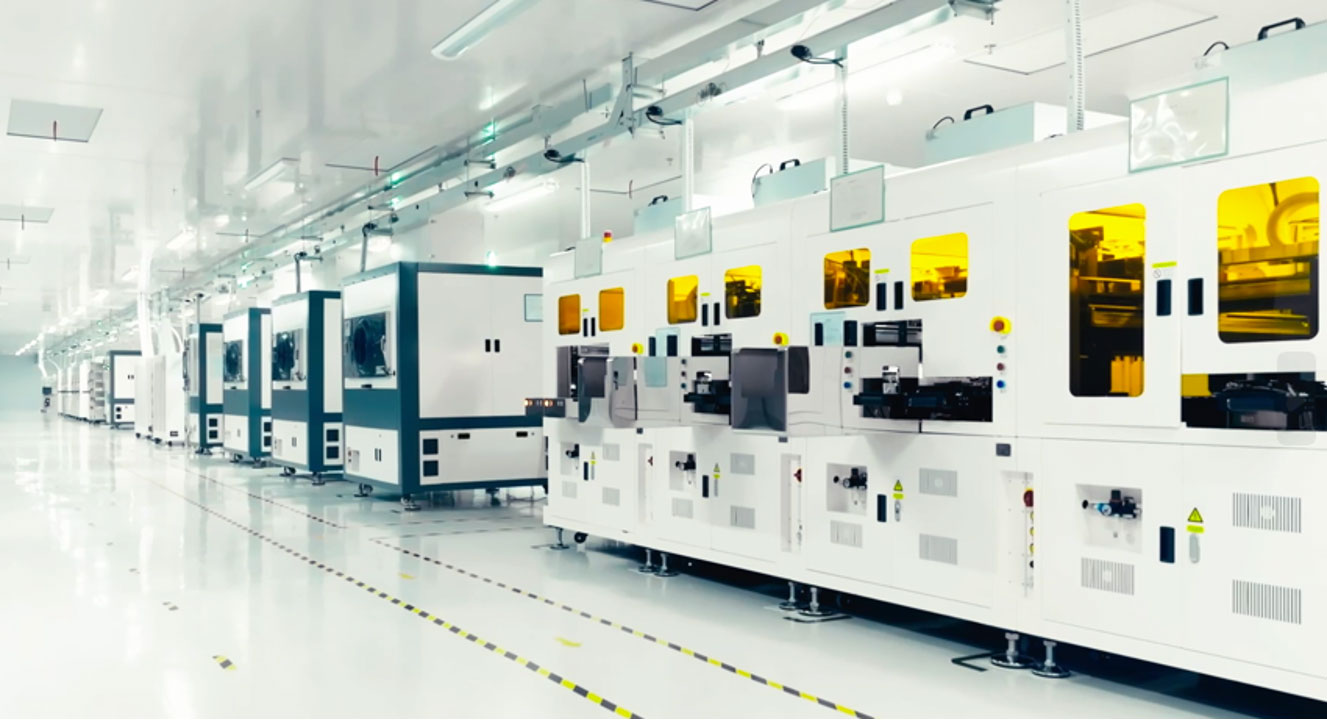
Robosense: We have four lines in the Shenzen plant for the M1 sensor. The manufacturing process is split in four lines: Scanning Module (MEMs) / Modules Prototypes production / Sensor Assembly / Sensor Calibration & Testing.
DVN comment
We noticed state-of-the-art scanning technology (2D MEMs); high-tech assembly processes to manage the complex architecture of the lidar; high automation levels and systematic quality verification (e.g., CCD cameras) at each station, and state-of-the-art quality organisation and quality tools (QRQC, San Gen Shugi…).
DVN-L: Many thanks to the Robosense team for hosting us at your facility in Shenzen!


