By Paul-Henri Matha, DVN COO and Lighting General Editor
Most vehicle lighting tier-1s participated at CES this year, and DVN took time to meet them, one by one, to see their latest technologies.
As a summary, all of them have been working on V2X communication for AD, supported by interactive social displays and signaling projection; ADAS sensor integration, and sustainability solutions to reach zero-CO2 emissions targets.
Koito + NAL (North American Lighting)

The Koito-NAL booth focused on three lighting topics: ADB with a very compact solution (ADB is quite new for US customers); V2X communication with turquoise AD light and signal projection, lidar and sensor integration from Cepton (long and short range lidar), including cleaning solutions.

Marelli
Marelli officialised partnership from the software sphere—Amazon Web Services (AWS), Qualcomm, BlackBerry QNX and DSP—who were also present at the booth. With a focus on design for affordability, for cost, for performance, for resiliency and for sustainability, the team addressed key needs of vehicle makers worldwide.

About lighting, the focus was on five items:
- Sustainability with Leanlight front and rear lamps. The headlamp has an optimised CO2 footprint with one low beam and one high beam module (height 20-24mm), new outer lens manufacturing process, MCU-free electronics architecture, and low power signaling functions, for a total weight around 2.5 kg per headlamp and 1.6 kg for signal lamp. The rear lamp boasts a 20 per cent weight and component count reduction, slim design, and optimised CO2 footprint.

- Display integration with miniLED technology for full tail photometry and dynamic communication and near field projection (DMD, MLA, gobo).

- Illuminated front grilleboards and rear panels, including illuminated logo with radar transparency, with innovative surface treatments possible like polyurethane coating, foil overmolding, and laser paint ablation.

- Lighting electronics including core computer, zone controller, and light domain controller. One remarkable thing is that Marelli can do the complete embedded software for lighting, from core computer to light domain controller and the lamp itself.
Forvia

Forvia said by 2045, their emissions will be zero and they are approaching two important milestones on that path: by 2025, they pledge to be carbon neutral in terms of their scope-1 and -2 emissions. And by 2030, they pledge to have reduced scope-3 emissions by 45 per cent.
To that end, Hella presented a sustainable headlamp concept using alternative materials and reusable components to increase the recycling rate while maintaining high standards of visibility and illumination. This concept has an optimised (i.e., reduced) component count, and incorporates lightweight, thin, highly efficient Fresnel optics as well as cover optics made from biopolymer. It weighs 2 kg versus 5 kg for a comparable traditional headlamp, without compromising performance.

Hella integrated lighting functions, based on their CLA concepts, in a front fascia with lens height 10 mm.

Signalling functions were based on their FlatLight µMX: a slim design, with maximum energy efficiency and superior homogeneity and performance. The technology is based on an innovative LED light guide concept with microöptics smaller than a grain of salt. This enables a module depth of just 5 millimetres, and completely new design options for the front and rear, as different lighting functions can be realised in just one lighting element. Another plus: it has up to 80 per cent lower energy consumption compared to conventional LED taillights. in 2024 it will go into series production as a rear combination lamp, and in 2025 front functions will be possible: daytime running light, front direction indicator (brighter than a rear one) and position light in only one light element as well.
ZKW
The LG Concept Car offered visitors an insight into the future of automotive entertainment. The microZ headlamp modules demonstrated how animated projections can be created in the future using intelligent front lighting. The projector function generates a 100-inch image that can be used to display a wide range of entertainment content based on OTT communication via the Internet (e.g. Netflix), transforming the car into a mobile cinema experience.
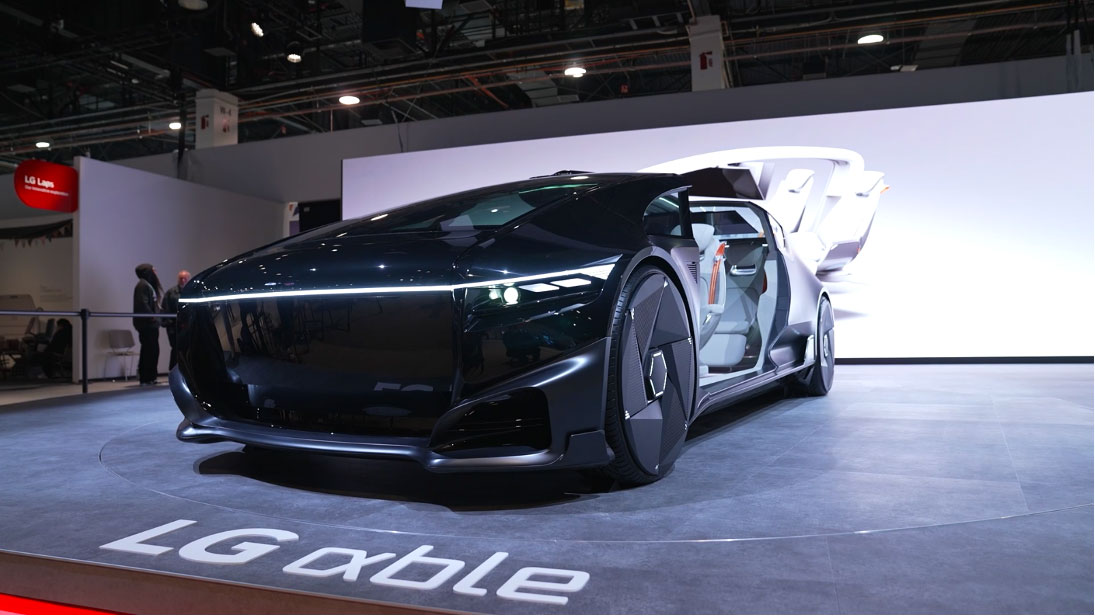
ZKW also showcased their latest product innovations, including an illuminated multicolour front grilleboard and, for the first time, an illuminated bumper developed in coöperation with Rehau Automotive.
Another new development, ZKW presented innovative rear light modules devised in coöperation with Osram, in which transparent LEDs are laminated onto a transparent carrier substrate. The result is an animated surface that can display taillights, indicators, brake lights, and illuminated logos.
They presented also the new Volvo EX90 headlamp with DLP technology and an ‘Ultimate Hammer’ feature combining the Volvo Thor’s-Hammer brandmark with mechatronic pop-up lamp technology.

The new headlamp for GM’s Chevrolet Silverado, which enables an illuminated animation of the charge indicator, was also on display.

ZKW aim to make their global production CO2-neutral by 2025, and all products by 2038. This goal is to be achieved by saving energy, avoiding waste, and switching to green electricity. At CES, they demonstrated how sustainable lighting can be achieved through optimised materials and processes. As part of their ‘SusMat4CarLight’ project, ZKW are working with partners to research recyclable materials for future lighting systems, including polymers based on renewable raw materials.
Valeo

Valeo, too, focussed on five main innovations in their grand showcase:
- Their CES Innovation Awardwinning Scala 3 lidar. Visitors had the opportunity to experience and learn more about Valeo’s AI-based perception software and how it helps classify objects identified by the lidar in its point cloud.
- Predict4Range was unveiled: a software solution to predict and drive the most efficient thermal management strategies of EVs for a driving range extended up to 24 per cent, fewer charging stops with faster charging operations, and extended battery life.
- Ineez Air Charging was presented for the first time. It is a wireless charging solution, the first and only one to use an ultra-low operating frequency, around 3 kHz, offering a lighter, simpler and safer charging experience.
- The latest Zeekr model was presented at Valeo’s booth. Equipped with a 15-mm-high Valeo ThinBiLite bifunction front lighting module and two digital panels comprising more than 1,700 LEDs, it offers users a unique, personalized, and interactive lighting experience.
- BMW’s Valeo-powered tele-operation was also on display at Valeo’s show stand.

During the CEO keynote, Valeo focused also on their ‘4 Rs’ sustainability principles. Valeo are committed to be carbon neutral in 2050 and to preserve natural resources by embracing circular economy principles. This starts at the product conception phase by making the right material, technology and design choices. In this spirit, Valeo presented their latest evolution of Purelight, a new headlamp concept designed with bio-sourced materials and additive manufacturing that allows repair and re-use of materials to minimise its weight and extend its life cycle.
Outside, on the proving ground, Valeo showed the Zeekr 007 headlamp, the Stargate concept. Equipped with a 15-mm-high Valeo ThinBiLite bifunction front lighting module and two digital panels comprising more than 1,700 LEDs, it offers users a unique, personalized and interactive lighting experience.


Mobis
Mobis’ Mobion concept showed off its 4 independent wheels. This concept was equipped with a variety of displays to interact with other road users: signal projections and front grilleboard and rear display.


Inside the booth, Mobis presented five technologies about lighting:
- HD microLED modulew with 25 kilopixels
- Lenticular grille lighting
- Prism slim module (combining both low beam and DRL, with lens size height from 12 to 25mm)
- 12mm ADB module with 12 segments
- On-road signal projections

Plastic Omnium (West Hall)

Plastic Omnium introduced three innovations resulting from partnerships with Sonatus, EyeLights and Paravision, aimed at breaking down the traditional boundaries of the automotive industry and laying the ground for tomorrow’s mobility.
1) Intelligent management of rear lights with Sonatus, a major player in the Software Defined Vehicle ecosystem.
Plastic Omnium and Sonatus together bring intelligence to enhance dynamic vehicle lighting. The solution developed with Sonatus enables monitoring and retrieving information from various onboard sensors in the car to interpret situations that may arise on the road. Using Sonatus Automator, vehicle sensors can automatically trigger animated informational or warning messages without driver action on Plastic Omnium mini-LED display in the rear light assembly of the vehicle.

2) Plastic Omnium and EyeLights team up to showcase high-brightness and high-resolution smart tailgate.
Plastic Omnium innovates with the EyeLights startup to offer a groundbreaking technology: a high definition, high brightness display capability at the rear of vehicles. The technology aims to better communicate with the vehicle surroundings, short and long distances and in any weather conditions. Whether during a sudden slowdown or to signal an object on the road, the technology developed with EyeLights, combined with the expertise of Plastic Omnium, will enhance safety for all road users.
3) Facial recognition built with Paravision Paravision’s facial recognition technology creates a template of vehicle owners’ faces, and will only allow registered and authorized persons to access the vehicle.
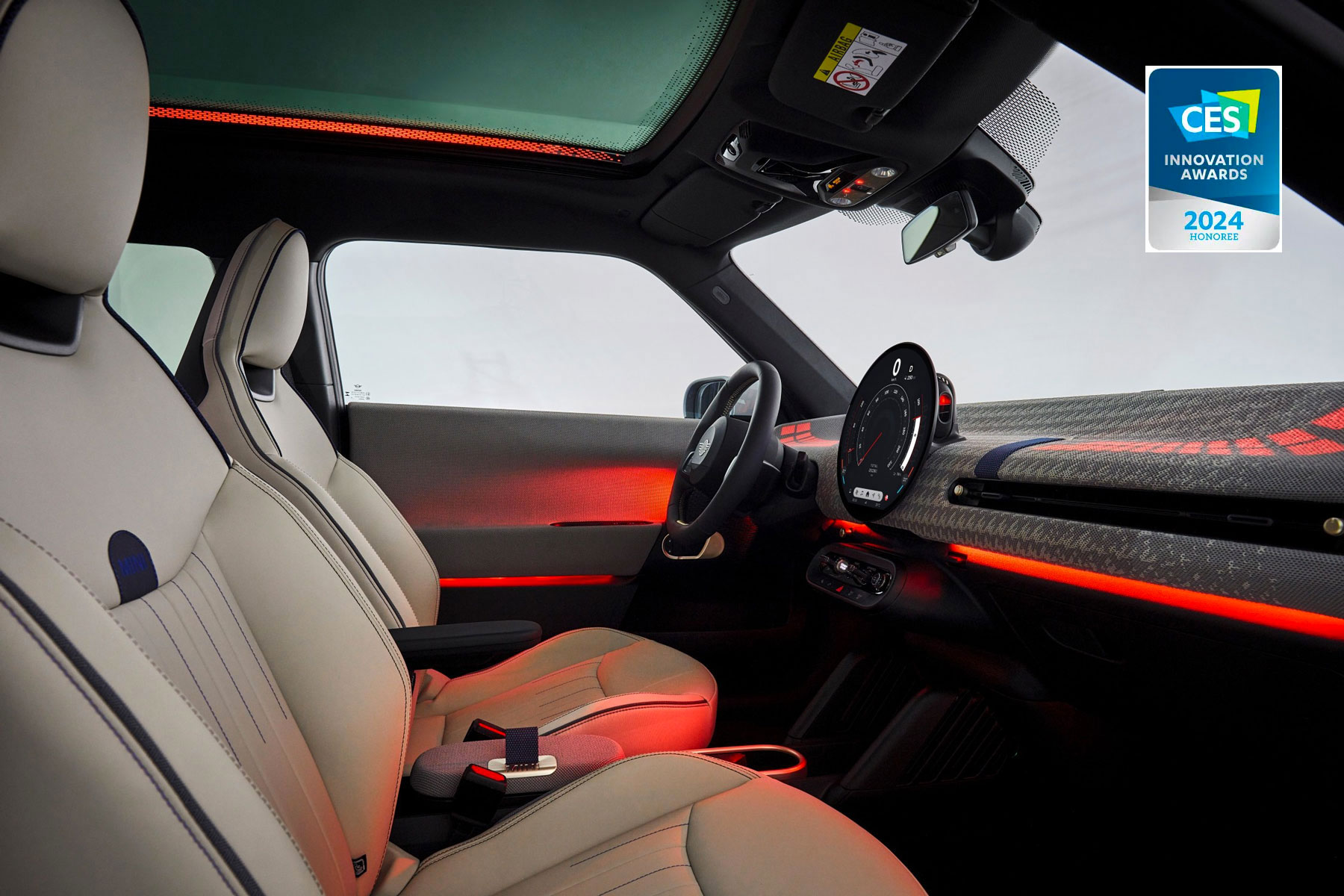
For the second consecutive year, Plastic Omnium won an CES Innovation Award, this time in the “In-Vehicle Entertainment” category for its dynamic interior dashboard projection system.
Plastic Omnium’s dynamic projection system illuminates the entire dashboard with colors and patterns to match the mood chosen by the driver. Already integrated into the interior of the new MINI Cooper Electric, it creates an immersive driving experience including lights, animations and projections.
More precisely, this module is composed by several microlens arrays (MLA), integrating different patterns. The light beam is generated by RGB LEDs (R-red, G-green and B-blue. Thanks to the combination of these three colors, all other colors are possible), and is then sent to the microlenses, which project the desired patterns onto the dashboard.
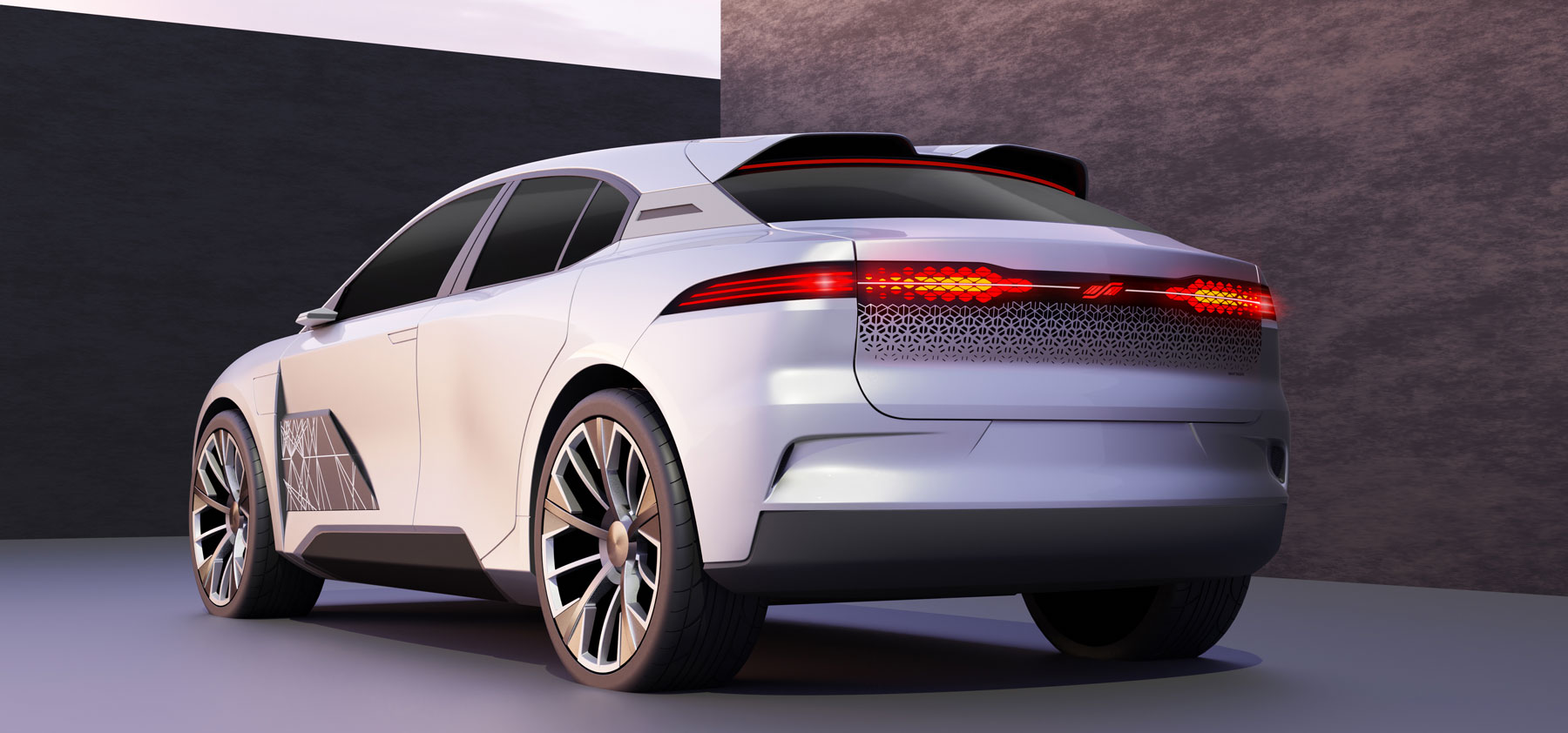
Another highly interesting innovation Plastic Omnium showcased in Vegas, is its Smart Tailgate – an innovative rear-end seamless module with a holistic approach, featuring new functionalities and onboard intelligence. The Smart Tailgate is a closure system integrating rear lighting behind a transparent outer panel with innovative decoration for seamless and daring design. It also features hidden sensors and antennas for advanced HMI (Human Machine Interface) functions and V2X (Vehicle-to-Everything) communication thanks to a display.
Magna
For CES, Magna decided to focus on the three main topics about electrification, ADAS, and connectivity. Nothing was shown about lighting.

HSL
In a private room, HSL—in collaboration with partners and TactoTek—showed off their newest innovations in grilleboards: fully integrated, illuminated and animated front panels made on final production tooling.

In parallel, in the generally-accessible North Hall booth of Mullen—a new startup from California—16mm-high HSL modules were shown on a car.


