By Paul-Henri Matha, DVN COO and Lighting General Editor
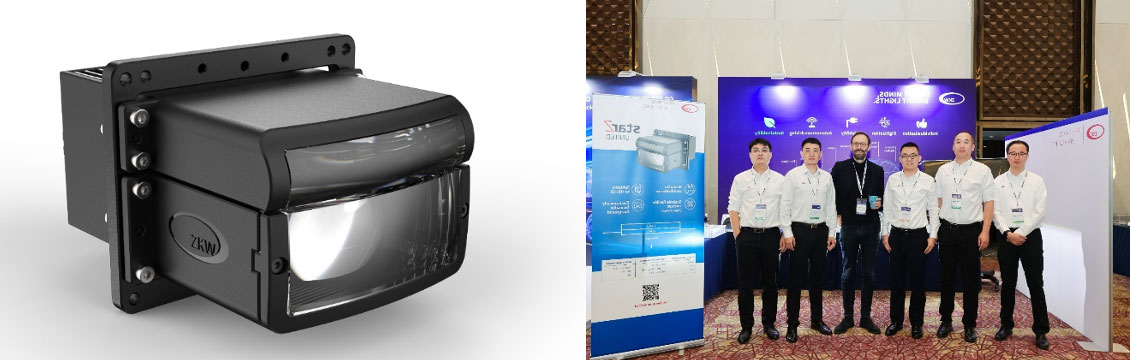
ZKW’s presentation at the Shanghai DVN Workshop centred on their new matrix and pixel technology, Starz United. The presentation was done by ZKW Dalian system engineer Song Hongrui.

The goal of this module is to offer a very compact solution, all in one, with high performance and affordable cost.
In the current ZKW module portfolio, and more generally in all vehicles currently in the field, a single-module approach is possible for BiLED (low /high beam) or BiMatrix (low beam + S-Matrix ADB, maximum 16 segments) systems.

The hardware configuration for an 84-pixel system has always involved two modules; an additional module was needed to provide the foreground width and fill light for the low beam.

The new Star United technology involves direct-imaging, and brings an impressive set of specifications and capabilities:
• Pixel count scalable from 30 to 3,000 (in partnership with Seoul Semiconductors)
• High Beam field of view: max 6° height, Imax 87,500 cd
• Low beam field of view: 38°
• Low beam bending: 8° with 1.5° resolution
• Lens size: 50 or 70 mm wide; 45 mm high

This is a very compact solution. Depth is 126 mm, down from the 170 mm of the PixelLite 84 as installed in the Polestar 2, Volvo XC40, and Opel Astra. Width is down, too, from 145 to 100 mm. The upper area of the module is dedicated to the near field of low beam, while the lower part is dedicated to the direct-imaged LED matrix.

After the Shanghai DVN Workshop, I discussed the technical concept with ZKW Austria’s general sales and technology relationship manager for advanced technology, Gerald Boehm:
DVN: What can you tell us about homogeneity? That’s been a challenge for direct-imaged LED headlamps.
Boehm: The homogeneity of a direct imaging system can be influenced in various ways. A well-designed microstructure in combination with a wisely-chosen sharpness of the imaging system as well as the ray characteristics of the emitter are parameters that influence the homogeneity of the system and need to be carefully adapted to the needs of the customer.
In general the field of tension spans between high homogeneity at blurry single pixels and sharper single pixels that clearly show a ‘garden fence’ effect. Both at the same time is extremely demanding, which is why a clear and early communication with the customer has to elaborate a good working point within this field.
DVN: Can the same module meet both the US and rest-of-world regulations? More to the point, can you design a lamp compliant with US-ADB and rest-of-world ECE ADB with the same hardware, and just adapt with software? What kind of pixel count is required?
Boehm: The development of the module strives for a maximum of functionality at a balanced size and cost. Thus, worldwide applicability and especially US ADB are one of the keys focuses for this module. It faces the same challenges regarding US ADB as any other module. While successors of current modules have to build on existing platforms, the development of a totally new module opens the freedom to fulfil certain requirements in a different way independent of former platforms. For ADB and AFS functionality a minimum of two rows of pixels seems reasonable. Combined with a meaningful high-beam field of view, a total number of 48 pixel seems to be a good starting point for the development. Further progress on the sector of light-sources and driver logic certainly promises for higher pixel counts in the future.


