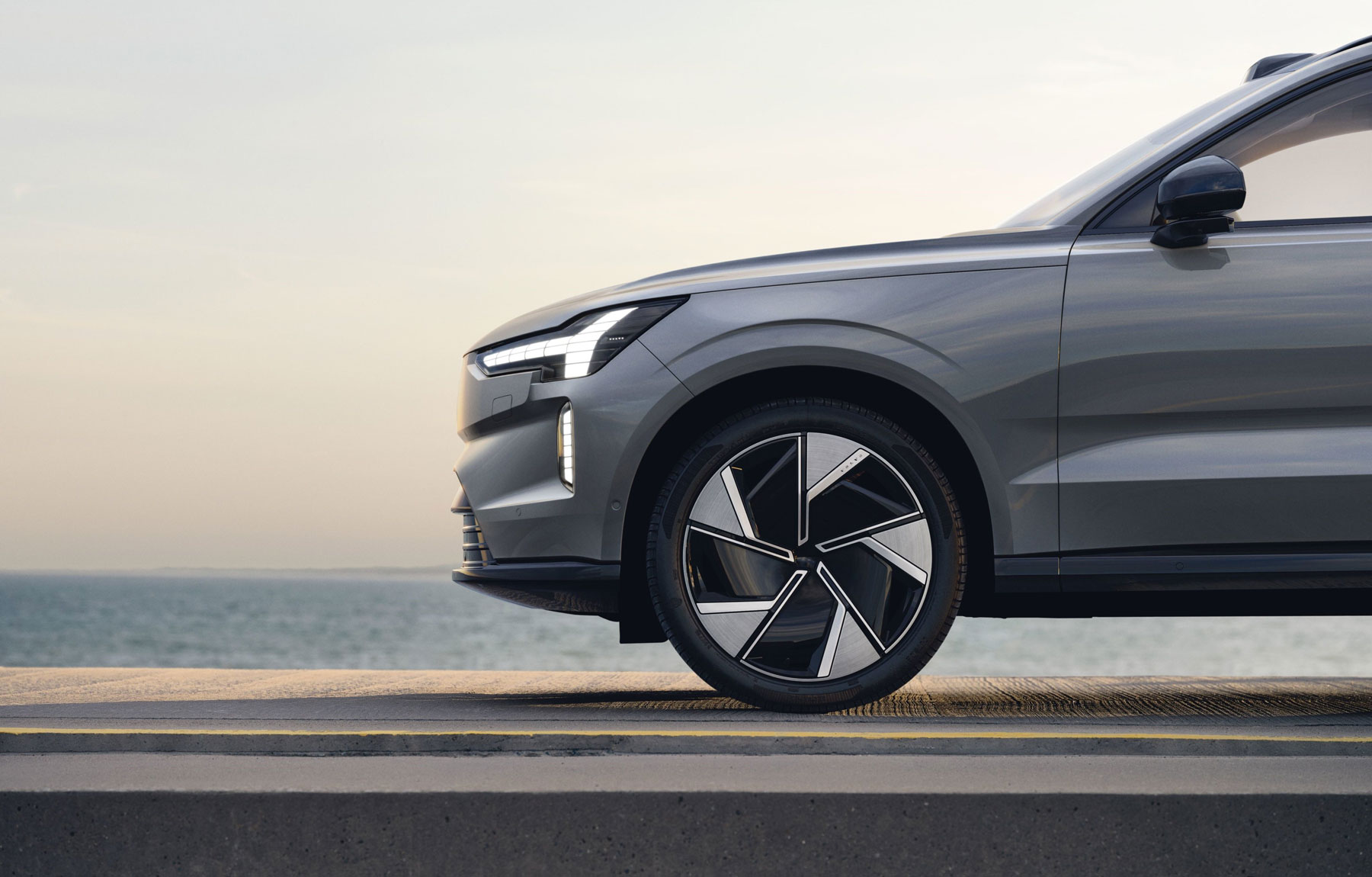
Volvo’s electric EX90 will go on sale in 2024 with all the hardware required for L4 self-driving. The system’s linchpin is the first rooftop-mounted lidar unit on an international-market passenger vehicle—Luminar’s Iris. It’s a semi-solid-state system, which scans using larger macro mirrors rather than the micromirrors found in a MEMS configuration. Its light source is a 1,550-nm fibre laser, the longer wavelength (vs. more typical 905-nm lasers) being harmless to the human eye. The lidar’s receiver uses indium gallium arsenide (InGaAs) microchip technology rather than silicon, and claimed resolution is greater than 300 points per square degree.
The Iris uses pulsed, time of flight target illumination that Luminar engineers claim delivers an exceptionally fast measurement rate, an immediate understanding of reflectance, and no speed-dependent range error. The lidar itself has a 120° field of view and a 26° dynamic vertical.
The Luminar Iris can detect and classify objects to a maximum range of 600m, even at night, and can spot a pedestrian or animal darting across the road at up to 250m. It can “see” an errant tire in the road, or other small objects, at up to 120m. And where the acuity of laser-based vision systems typically degrades in snow or rain, the Iris technology does so very gradually. “You might lose some light energy when lidar hits snowflakes, but you still get enough back to get a useful, fundamentally 3D image,” according to Luminar.
Based on their 50-year database of real-world accidents, Volvo say the lidar-based sensor suite will reduce serious-injury crashes by up to 20 per cent and cut overall crashes by 10 per cent.
The Iris lidar is elegantly integrated into the EX90’s front roofline, where it resembles a small hood scoop shielded by a transparent cover. The teardrop-shaped unit is sculpted to allow airflow to pass over and reattach to the roof, creating as little turbulence as possible. Water nozzles at the end of the EX90’s windshield wipers clean the lidar’s protective screen as they sweep near the roof. Two other nozzles clean side-facing fisheye cameras embedded in exterior mirrors to greatly expand views through road junctions.
“We see the lidar as a symbol of 21st century automotive safety, like our three-point seatbelt was in the 20th century,” said a Volvo spokesman. Volvo will integrate the roof-mounted sensor on other models built on its SPA2 platform, including the South Carolina-built Polestar 3 from Volvo’s new EV division. Luminar have progressively lowered automakers’ price for the Iris system to between USD $500 and $1,000.


