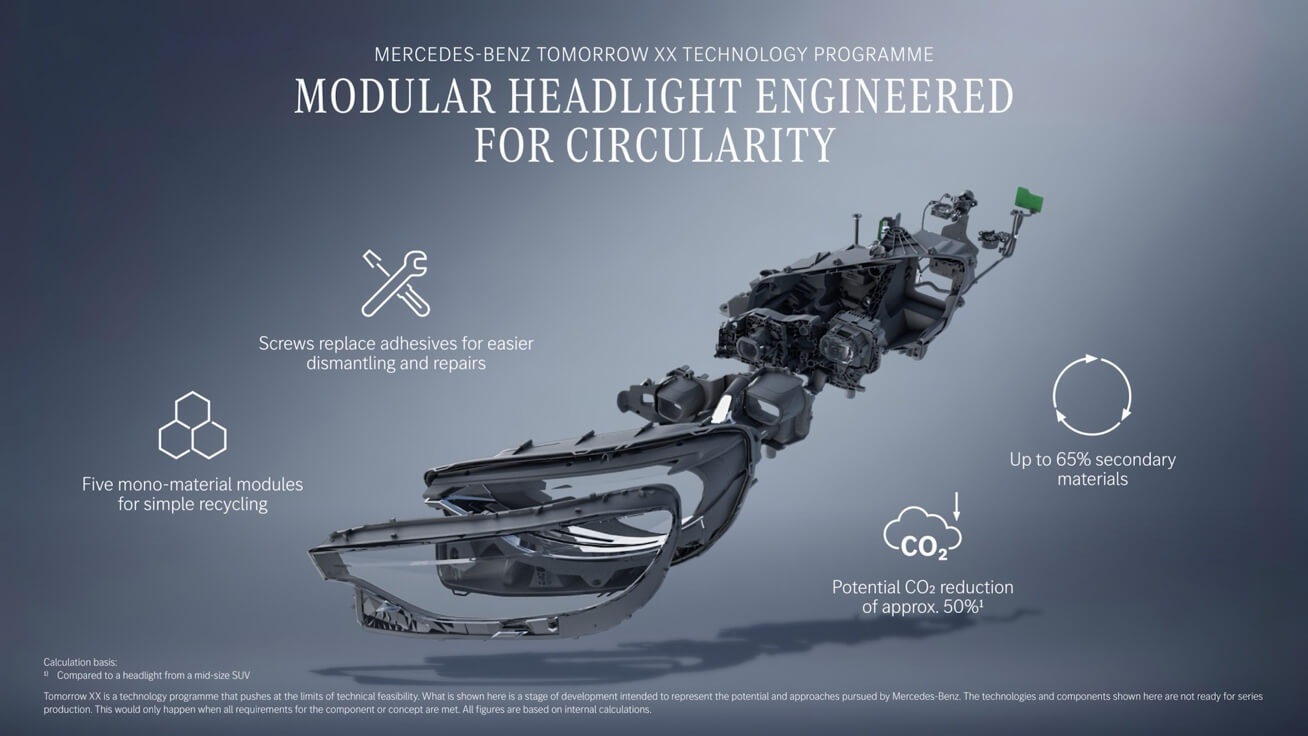
Virtually all LED headlamps are sealed, integral units without field-replaceable parts – no removable light source, no removable lens, no swappable driver. Is that changing? It very well might be. Last December, Mercedes-Benz unveiled their Tomorrow XX technology program as a driver of innovation for the company’s sustainability goals. One of the 40 items under this approach is the Modular Headlight concept.
During the Sustainability session at the DVN Munich event just recently, Lumileds presented interesting data about LED headlamp modularization: 10 years ago, when LED headlamps were new, everyone wanted to design their own modules – rectangular, octagonal, triangular, oval, slim, vertical – because they wanted to differentiate from the ~60mm round projectors or ~140mm reflectors more or less common to HID and halogen headlamps. Everything was project-specific, so development was expensive and took a long time. Off-the-shelf solution libraries did not exist yet.
Now, we see OEMs willing to standardize their modules – to modularize their headlamps. Why? To lower cost (with economy of scale), to shorten time to market, and to simplify lamp design for easier repair and recycling. I think this trend will not only continue for road-lighting functions and may well also extend to signalling functions.

Repairability and aftermarket lamp price has become an important topic, as we’ve previously reported. Lumileds shared during DVN Munich event other examples of headlamp prices in aftermarket.

Light source makers, supported by regulators, have been putting real effort toward modularization. We’ve reported on the field-replaceable “LED bulbs” specified in UN R128 and commercialized by companies like ams Osram (DVN articles here and here) and Toshiba (DVN article here). So far these have been for signalling applications and fog lamps, but there’s a GTB proposal on the docket for the next GRE meeting, to expand this concept to include types suitable for low and high beam applications. That could greatly facilitate and accelerate new possibilities for lamp design.
I’ve worked to summarize this proposal, with the help of regulatory experts at ams Osram and Lumileds. And you’ll also find, in this DVNewsletter, my conversation with ams Osram’s Jenny Raab about the replaceable LED module business.

And for the people who are not big fans of module standardization and regulation, feel free to read this week’s To Go Further piece – an outside-the-box exchange of thoughts about lighting!
Sincerely yours