
Dr. Gunnar Juergens is Senior VP of Product at Teradar. He is recognized for his expertise in leveraging cutting-edge microchip architectures to enable high-resolution, long-range imaging.
Prior to joining Teradar, Dr. Juergens held key leadership roles in the automotive sector, including serving as Vice President of Advanced Lidar Solutions at Continental. He holds a doctorate in engineering, and has authored technical publications on automotive safety functions, sensor system architecture, and vehicle-to-everything (V2X) communication.
DVN: Could you tell us a bit more about your startup and its history?
Gunnar Juergens: Teradar is a Boston-based startup pioneering the use of terahertz vision to launch an entirely new category of life-saving sensors for automotive, defense, and emerging industries. Founded in 2020 by Matthew Carey (CEO), Gregory Charvat (CTO & Co-founder), and Nicholas Saiz (Chief Architect & Co-founder).
DVN: What is the business model like?
G.J.: Teradar is a pioneer of terahertz imaging technology. We enter the market as a tier-2 technology supplier where automotive OEMs are our primary customers and tier-1 automotive suppliers are our partners for the development and manufacturing of the product. All of our technology is based on our proprietary Modular Terahertz Engine (MTE), with is an all-solid-state sensor architecture that can be customized to meet the needs of OEMs.
DVN: What are the advantages of imaging above 300 GHz compared to traditional millimeter-band radars?

G.J.: Above 300 GHz (low‑THz) the wavelength is shorter than 1 millimeter. Imaging at such high frequencies delivers much higher resolution and target separation as current radar technology.
DVN: How is the detection performance in harsh weather conditions?
G.J.: Terahertz imaging is the only automotive sensing technology capable of providing long-range, high-resolution vision in any weather condition (rain, fog, snow, sleet, dust, etc.). The reason for this is that we operate in the terahertz band, which sits in a sweet spot between traditional automotive radar and lidar. In this sweet spot terahertz imaging combines high native resolution with the weather robustness of radar.
DVN: What are the main use cases targeted?
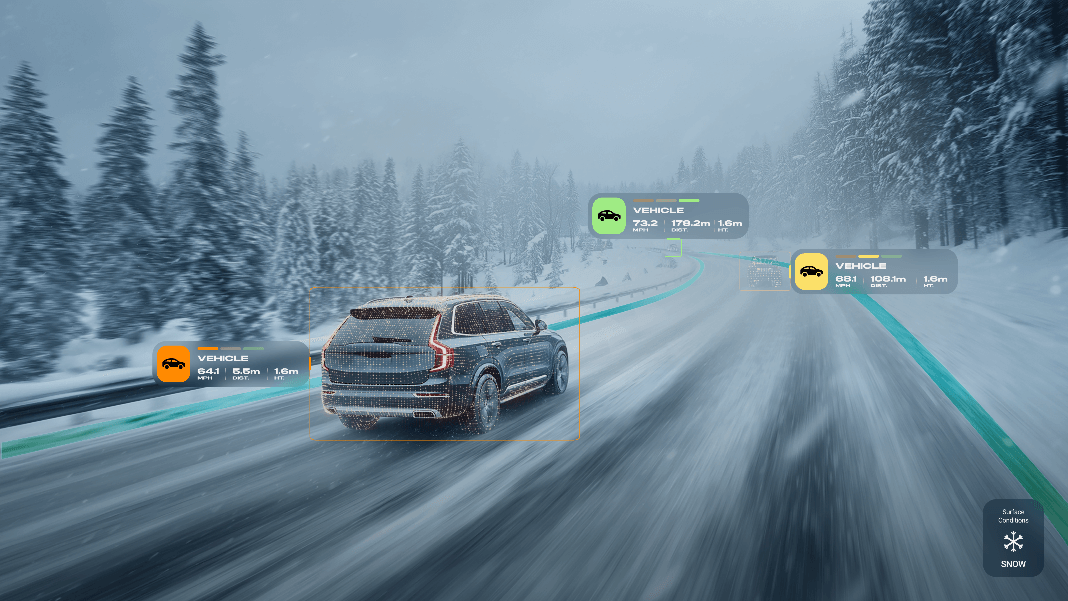
G.J.: We see a wide range of long-term applications for Teradar, but today we are laser-focused on the automotive market, with primary use in high‑volume ADAS programs (L2, L3) and as part of the sensor stack for advanced autonomous driving (L4, L5). It’s important to note that our technology is suitable for cars, trucks, and nearly every vehicle class thanks to the flexibility of our Modular Terahertz Engine (MTE) and the inherently scalable nature of our architecture, both of which are key to bringing Teradar to market at volume.
DVN: What hardware innovations make it possible to achieve such a frequency?
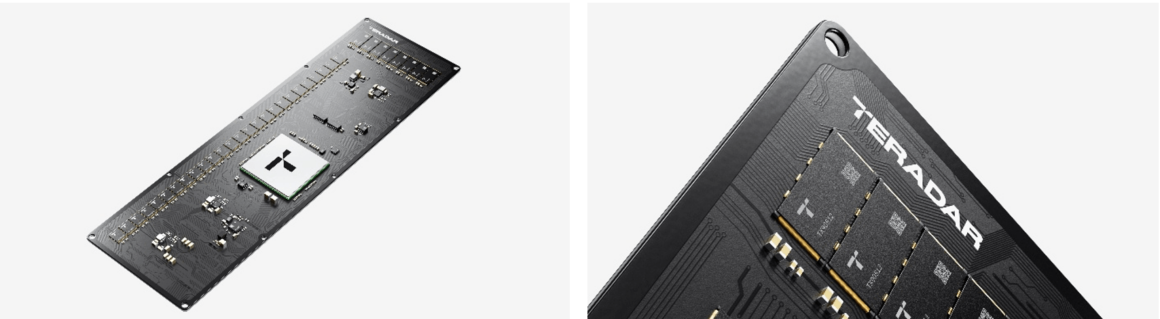
G.J.: Our core innovation is a chip design based on a novel high volume foundry process, enabling higher transmit power and higher receiver sensitivity at frequencies above 300 GHz.
DVN: How do you see the competition with corner radars or Imaging radars?
G.J.: Terahertz imaging will deliver up to 20 times higher resolution than imaging radar. We will enter the market as a high-performance, long-range sensor, and the costs of our chips will come down after reaching relevant market volumes. This will create opportunities to use terahertz imaging also in the corner and surround-view segment, e.g., to support urban autonomy or parking functions.
DVN: How does 300-GHz radar fit into vehicles?
G.J.: Teradar sensors can be integrated into vehicles similar to 77-79 GHz radar. Terahertz imaging can see through radome material and also through fascia material if required. Material is available that works for our frequencies. Cleaning will not be required.
DVN: What regulatory certifications or validations are involved for 300 GHz radars?
G.J.: Frequencies above 275 GHz are currently not regulated. Teradar is the first company who is developing terahertz imaging technology in such bands. Test licenses are already available with FCC for US and with BNetzA for Germany. Earlier this year an ETSI Reference Standard has been established for terahertz Imaging.
DVN: What is the roadmap for high frequency radars?
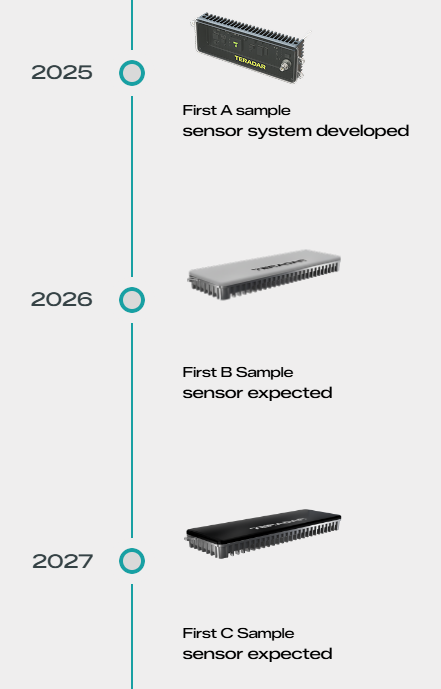
G.J.: We are currently working closely with five global OEMs based in Germany and the US, as well as with three leading automotive tier‑1 suppliers, and we’re on track to be in high‑volume production vehicles in 2028.
We expect the first production programs with premium OEMs in the US and Europe. Our tier‑1 partners are technology leaders in automotive radar.


