
Nils Dagas is Vice President of Research and Development at Gapwaves, a company active in the waveguide antennas increasingly used in automotive radars.
Dagas received his MSc in electrical engineering from Chalmers University of Technology in Sweden in 1995. He joined Ericsson Microwave Systems in 1996, working with digital receiver technology and AESA-based radar systems. In 2006 he joined Saab Surveillance, where he held several management positions within R&D, leading detailed design as well as system development and research. His latest role was deputy head of engineering in Saab’s Radar business unit, which develops radars systems for the ground, naval and air domains. In 2023 he joined Gapwaves, where he has the role of VP R&D. He oversees the scale-up of the company, bringing patented technology from years of research onto mass market applications for ADAS and AV.
DVN: What are Gapwaves’ main targeted markets and how do you see these markets evolving in the coming years?
Nils Dagas: Antennas for automotive radar sensors is our key market. Right now, a lot of focus is on the exterior sensors with front and corner radars. For handling future requirements, we see both requests for imaging radar antennas as well as antennas optimized for distributed arrays. While the volume markets are the first to move into waveguide technology there are also special requirements coming from commercial vehicles and the off-road segments. We also see interest in waveguide antennas for the In-cabin segment. In addition to automotive, other applications include commercial satcom, telecom and surveillance, as well as defense applications.
DVN: What are the benefits of Gapwaves’ waveguide technology for antennas, compared to conventional structures?
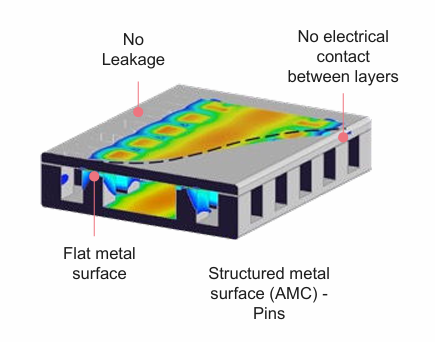
ND: Waveguide antennas offer higher performance and a low loss solution versus traditional PCB-based antennas for mm-wave applications. By design the gap waveguides relaxes mechanical tolerances enabling a simpler and more cost-effective manufacturing. The technology also enables signal routing that can be tighter than in a conventional waveguide enabling routing in fewer layers. Even without this the thickness is just a fraction of a traditional waveguide enabling better vehicle integration.
DVN: How is Gapwaves advancing radar technology for autonomous vehicles and driver assistance systems? What key benefits do radars using waveguide antennas over conventional types?
ND: The low loss in the antennas gives increased range. The better controlled and wider field of view gives a more optimized coverage. The wide bandwidth gives better range resolution and the ability to use the same sensor on different markets that has different frequency allocations.
DVN: How does Gapwaves address the challenges of manufacturing and performing mmWave antennas in a compact form factor?
ND: We have a pilot-line production facility by our headquarters where we have assembly for both injection moulded and metal multi-layer waveguides. Here we run smaller volumes and the ramp-up phase for automotive customers. This setup is then automated and transferred to partners in the customers target region of choice, creating an efficient supply chain. The design of the gap waveguide allows for an automatic EOL testing of each individual antenna, guaranteeing a 100% yield to the customer.
DVN: Can you give us examples of ongoing collaborations or strategic partnerships that have been particularly fruitful for Gapwaves with automotive OEMs and Tier1s?
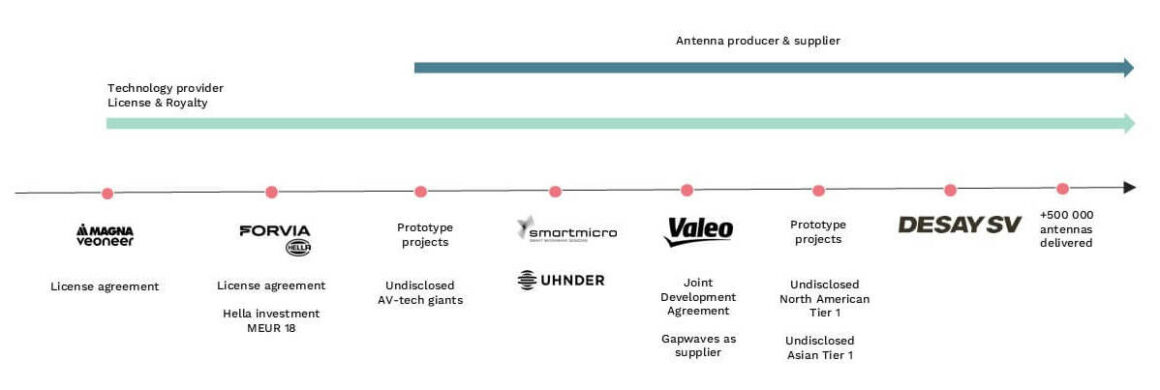
ND: We have several strategic partnerships and are trusted by leading partners in the global automotive industry. A long-term partner is Forvia HELLA, with whom we have been collaborating since 2021. We have integrated our antenna technology into their new generation radar sensor and is now in high-volume production. They are also a significant shareholder in the company. Since early 2023, we have been working with Valeo on their next-generation automotive radar. Our antenna technology for this radar sensor entered production this summer. We recently started a collaboration with Desay SV, a leading Chinese Automotive Tier 1, to co-develop next-generation high-performance mmWave radars.
Another important field of collaboration are the radar MMIC suppliers where we have a mutual interest of ensuring compatibility between the radar chip and antenna. We have official partner status with all the major chip suppliers.
DVN: How does Gapwaves see the market for HD radar in the automotive space evolving in the next 5 years? Will HD Radar replace LiDAR, particularly in the China market?
ND: There are three major factors driving the shift from Lidar to HD Radar, as we see it. The radar is more cost-effective, it has all weather capability, and it is easier to integrate on a vehicle. As multi-channel and distributed radar evolve it is likely that the above advantages will make HD Radar be the preferred solution over Lidar.
DVN: What are the main certifications and quality standards that Gapwaves has obtained for its products?
ND: At Gapwaves we work according to APQP (Advanced Product Quality Planning) to secure the quality for new products so that they will pass PPAP (Production Part Approval Process). The production partners we use are certified according to IATF16949, a standard which we are currently implementing. We are certified according to ISO 9001 and ISO 14001.
DVN: What are the main challenges that Gapwaves is currently facing and how does the company plan to overcome them?
ND: We have a solid product offering and have a proven track-record with several global automotive Tier 1, our main focus right now is to continue the volume ramp-up of production that we have started. Just this year we have gone from 160 000 antennas delivered in the beginning of the year, to reaching 500 000 earlier this autumn. This ramp-up will continue over the coming years with the help of our partners where we automate our current production line.
DVN: How does Gapwaves integrate continuous innovation into its product development and research processes?
ND: Gapwaves was founded from research at Chalmers University of Technology and innovation lies in the core of our business strategy. We have strong ties to the university world with several research programs as well as students doing their PhDs in Gapwaves. Our research and innovation are followed by in-house processes development and industrialization to be able to implement them in a cost-effective and robust way.


