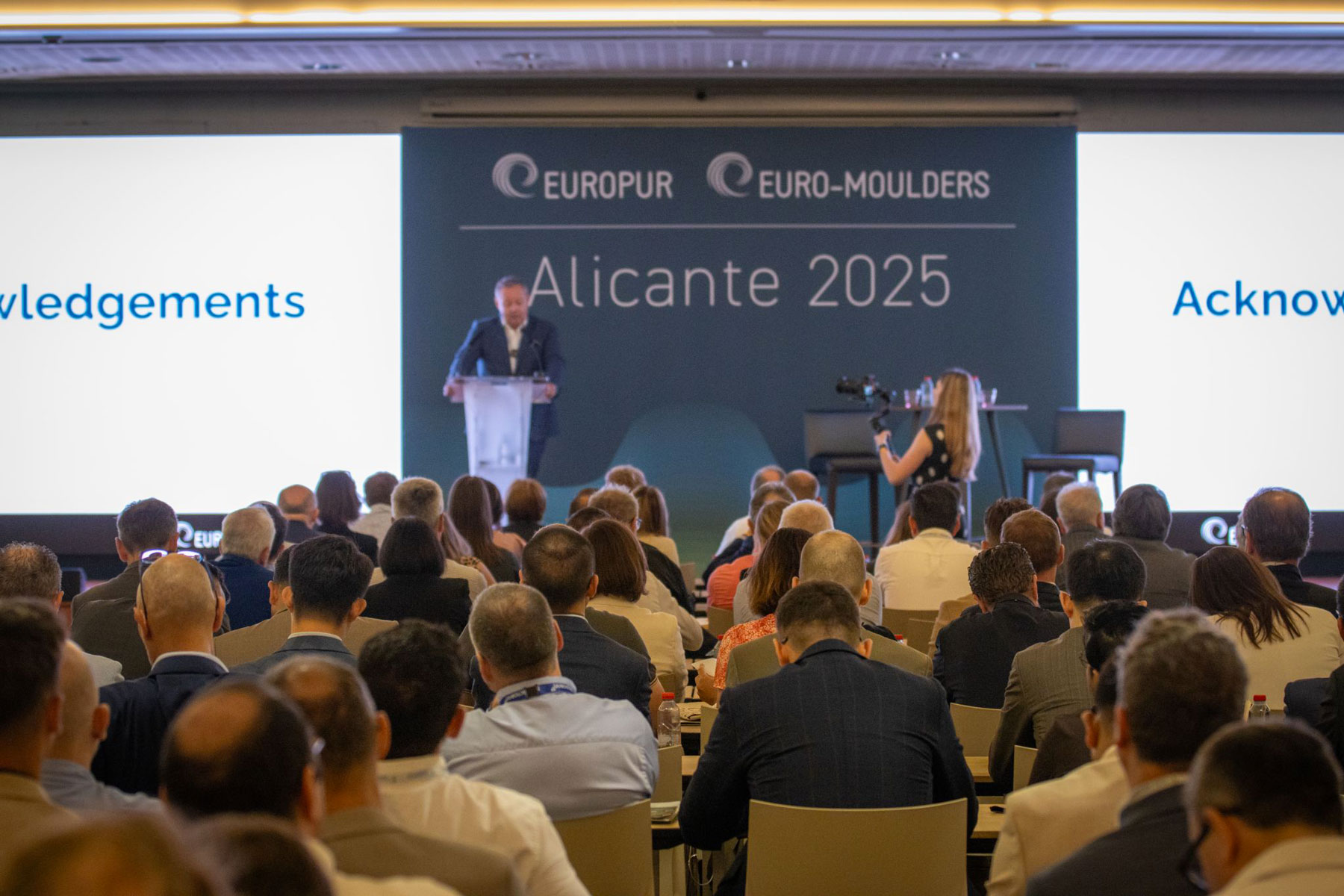
DVN Interior attended the Euromoulders Annual Conference in Benidorm, Alicante, Spain, with 550 participants representing the automotive, bedding & furniture, building, and chemistry industries.
At the conference, experts presented significant developments shaping the global PU (polyurethane) industry — particularly within automotive.
China’s Expanding Influence
China has firmly positioned itself as a dominant force in the global PU ecosystem. Backed by large-scale industrial policies, aggressive investment in R&D, and import of international expertise, China now leads 37 of 44 critical technologies worldwide. The county’s talent pipeline is now self-sufficient, and producing the next generation of top scientists, reinforcing China’s long-term leadership in key material technologies.
Automotive PU Trends
A downward trend in PU usage per vehicle is emerging, driven by evolving auto interior design:
• Simplified geometries and minimal laminations
• Dashboards with full-width screens
• Advanced seat design complexity
• Wider use of PET mono-materials in flooring
This trend encourages substitution with lighter, more modular materials, reducing overall PU consumption.
Circular Economy & Recyclability Challenges
Recyclability is a growing priority, influenced by new EU directives such as ESPR (Ecodesign for Sustainable Products) and ELV (End-of-Life Vehicles). PU recycling is technically viable and increasingly economically feasible but still faces a major obstacle: as an example, material contamination from complex multi-material components in vehicles. Improved dismantling techniques are critical to scaling recycling efforts profitably.
R-Polyol Adoption Progress
Chemists confirm R- (for ‘recycled’) polyol integration in automotive MDI and TDI applications at 40 to 50 per cent, with companies like Evonik and Huntsman pushing toward 85 to 95 per cent in their labs while maintaining mechanical properties.
Achieving 50 per cent R-polyol via depolymerization, up from the current 20 per cent, is feasible but contingent on better foam separation during dismantling.
Quantified Market Opportunity
In 2022, about 56,000 tons of PU foam were recovered from 4.7 million ELVs, highlighting a large-scale resource pool that remains underutilized.
Strategic Outlook
As highlighted at DVN Interior Workshop this past April by Dow, in a joint project with JLR-Adient using the Renuva material (up to 50 per cent R-polyol content), they have developed a recycled PU seat foam and are moving from compliance-driven topics to value-added product strategies.
In a post-chip-crisis context, securing alternative raw materials through smarter dismantling and recycling offers real supply chain resilience.
Conclusion
The conference underscored the urgency and opportunity in aligning industrial design, sustainability, and recycling practices to strengthen the economic case for PU in automotive applications. DVN continues to showcase this evolution and provide expert analysis across the mobility industry.


