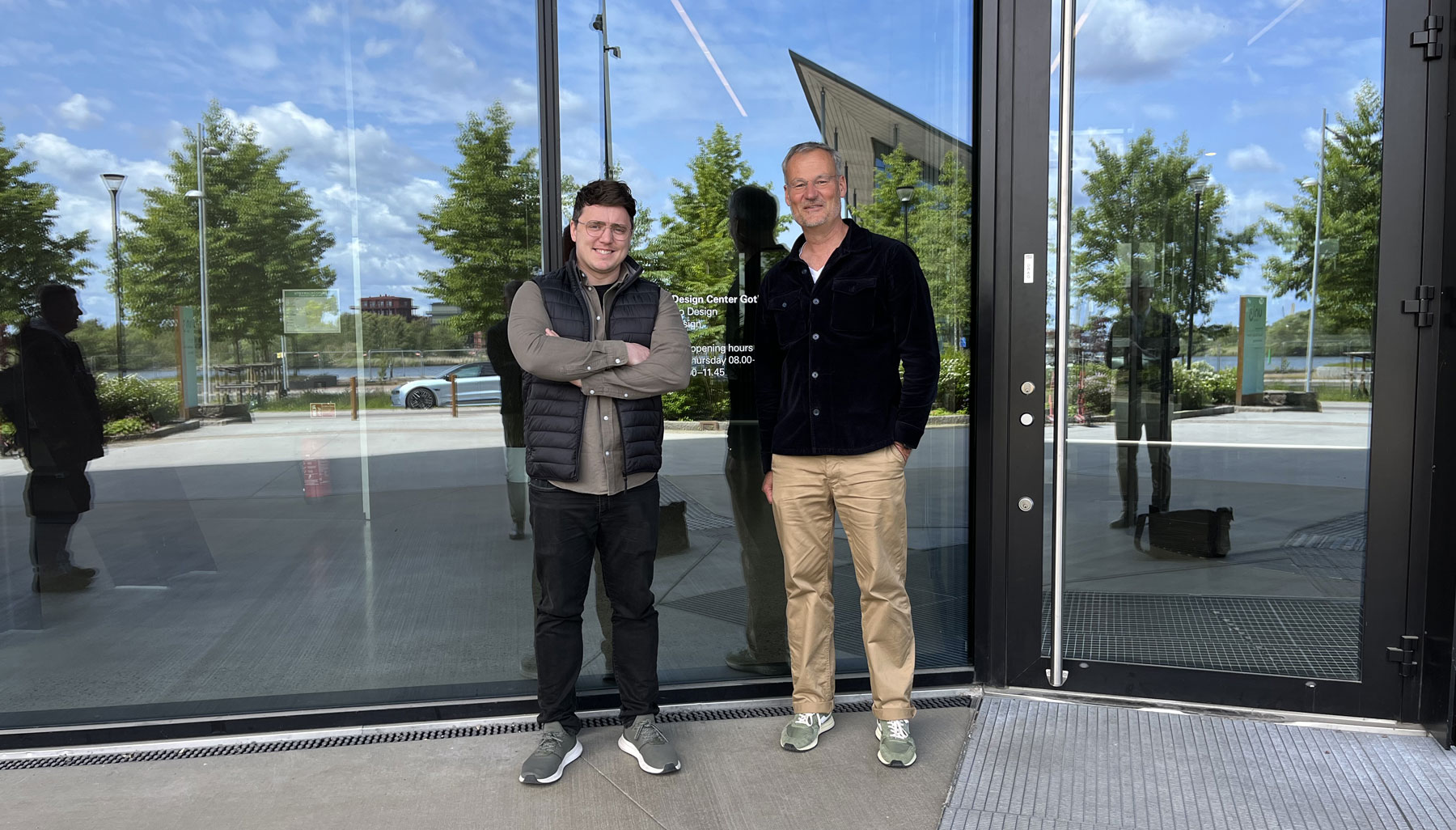
DVN Interior: Hello Daniel, Can you give us a short background and your professional history?
Daniel Hoffrock: Absolutely. I graduated in 2012 from Coventry University. I moved to Austria for a while because I did a sponsored project for my thesis with a company called Qoros, which was a Chinese company, which is now defunct unfortunately.
I moved to the UK and Ford. I was there for two and a half years. I did the FMAX truck. And I did the exterior facelift of the new big Transit, that came out in 2018.
Then I got an opportunity in Gothenburg with Geely Design In 2016. So, I moved over here. Back then it was only Geely Design, Zeekr and Lynk & Co hadn’t been launched then.
So, I was working with interiors on the Lynk & Co 01, 02 and 03, which is the first vehicles. Then I got the lead position on the 05. I was a lead designer for the 05 Interior and took that through to production, which was the 01 but with a sort of coupé back.
That interior was appreciated so much, that we actually put that interior into the facelift version of the 01 and then that became the 01 that came to Europe.
And then I worked on the Zeekr CM1E project, which is the Waymo collab with Zeekr.
And then I worked on the CM2E, which is basically the more private vehicle based on the MMA platform and is now called Zeekr Mix. These are the main projects.
DVN-I: That’s fantastic. And your role on the Zeekr Mix was chief designer?

DH: Yes, I was the chief interior designer. It was my job to coordinate the whole interior together to get the right direction. Sergio Loureiro da Silva is the head of interior, and he has the overview of the entire Zeekr brand interiors. I have the overview of the specific project.
DVN-I: And how long did that project take?
DH: The crazy thing is, we did the main bulk of it in less than a year. Which is incredibly breathtaking speed! It was something like we started in the spring of one year and finished in the spring one year later, it was very short.
DVN-I: What three details or features would you highlight from that project that you are very pleased with?
DH: Oh…It’s a difficult one, I mean, there are many interesting things. The rotating seats, for instance, are fantastic, the fact that we managed to get this moving floor console with the table setup. That was quite complicated to be able to make this sort of functional space, so it actually works because there’s been so many concepts out there that had rotating seats and tables and things, but they’ve been just show cars.

To make a production vehicle that has this is something fantastic. And when you see it now you have the seats rotate, you have the table in place, you really feel like a cool place to be.
I’m quite proud of the doors, because they’re sliding doors, they must be very flat for clearance to the body work. The fact that we were able to still get this luxury feeling, but without having too much 3D shape, that was quite a challenge. But I think we ended up doing it quite nicely.
DVN-I: And what was the trick in then doing so?
DH: I think we kept quite a simplicity in the shapes that we used, so everything was a little bit sort of squircular. We kept it very friendly, very soft, but also with a nice use of materials.
We have this really nice, embossed microfiber that covers the whole door. We also have this little lamp, a removable lamp, which has this kind of ‘furnituresque’ feeling, it looks like it could be on a coffee table somewhere.
And I think taking that home feeling and using architectural elements rather than necessarily typically aggressive automotive elements gave it that new fresh feeling, but also made it feel quite premium.
DVN-I: That was only one favorite, and it was the doors, do you have two more?
DH: The asymmetric IP was interesting as well. Because we put the airbag in in the roof instead of on the cross-car beam.
DVN-I: Ah, finally.
DH: We actually got it into the header, so that meant that we could free up the whole passenger side and push the IP away. And then, of course, that also comes with a tricky connection to the A-pillar that we had to deal with.
But I think it turned out very, very well. So, we’re having completely different interface to the doors on each side, whereas normally you do it once and then you copy it over.
The third one then…I think the floor console was quite cool.
It has a refrigerator in it and a very simple kind of pill shape form. But the fact that we managed to get all the attachments in. We have this modular attachment for like cup holders and various different things, it ended up being very cool.
DVN-I: At our recent DVN workshop in Cologne, we looked at how the Chinese are starting to use the vehicles as part of their daily routines where it becomes an extension of their living room; is that something you have noticed?

DH: That was basically the exact brief for the Mix. It was always intended to be this, expanding your home space. So, it’s a home away from home.
Originally there was an idea that you could use it as a shop if you wanted to, you could use it as a camper, you could use it as a living room or as a meeting space. All of that was taking into account.
That’s why we ended up with such a flexible space because we started off with that point in mind.
DVN-I: How do you foresee the cockpit layout of the future?
DH: If I was in charge, I feel like I personally would like to see more physical controls.
I understand the appeal of screens and you know, it really does give this kind of high tech feeling, especially when you see these panoramic HUDs. From a usability point of view, it has a potential, I suppose, because you can have information on the whole thing.
Maybe the panoramic HUD becomes more useful in autonomous situations. Could be so because, say, for instance, if it’s driving in level three or even at level four, the car can then communicate to you with the panoramic HUD what it’s seeing, what it’s doing and can give you a sense of security, knowing that it has seen the things that you think you’ve seen.
But for me, I would like to see less use of large screens in vehicles.
DVN-I: I totally agree, that’s also a recent market trend, isn’it?
DH: Because as an interior designer, as an industrial designer a big square piece of plastic that’s just in front of you, it takes away all the sculpture and all the interesting things that you can do because this screen has to be in the position that it’s reachable and it means that you can’t do anything with the sculpture behind. And if you do, you can’t see it anyway because the screen’s blocking it.
I would very, very much like to go back to a more sculptural interior with more physical controls to give back that sort of premium tactility you get, which you don’t have with the screen. You don’t have any tactility with the screen at all.
I think in general, we need more physical controls, more sculpture.


