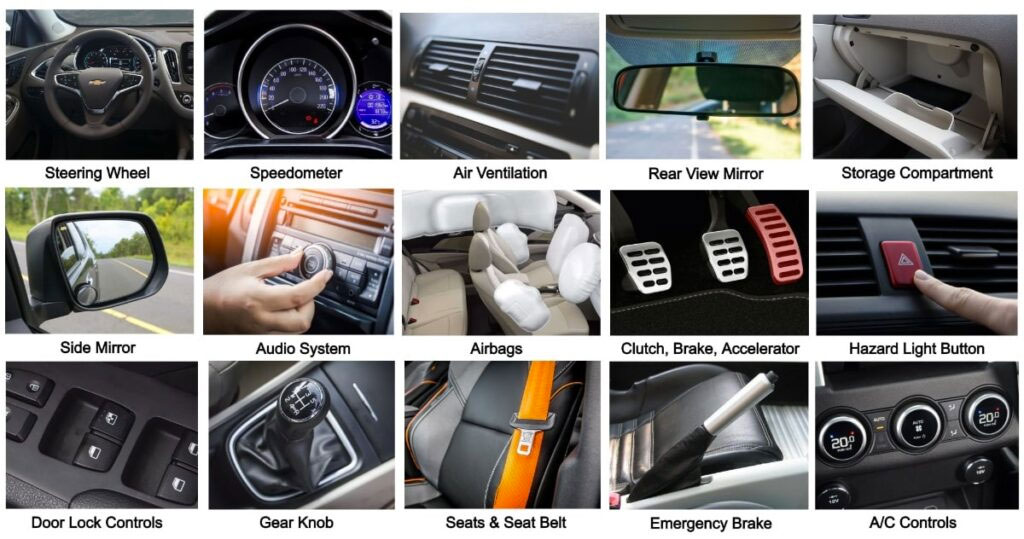
The automotive interior components market is experiencing steady growth, driven mostly by comfort and entertainment features, but also by regulations, including safety and vehicle end-of-life. A sustainability trend is also ongoing, reflected in the introduction of bio-based materials, recycled materials and lightweight materials.
Overall electrification is influencing interior materials and technologies with the goal of improving car autonomy and making the interior look-and-feel consistent with a new age of cars. As stated weekly in your DVN Interior Newsletter, there is a major rise in smart(phone) functions built into in-vehicle infotainment systems.
Market Growth

According to market research, the automotive interior market is estimated to be worth around USD $180bn in 2025, and is projected to reach $220bn to $270bn by 2032, at a CAGR of 2 to 5 per cent over the same period. These figures should include seats, dashboards, door panels, headliners, carpets, and trims, and also display, HUD, instrument cluster, rear seat entertainment, interior lighting, and the like. These use a wide array of materials of almost every category — metals, leathers, textiles, vinyls, plastics, woods, GF or CF composites…
Within this total interior market, seating represents about $50bn to $60bn, with a CAGR of 1 to 2 per cent. Displays and cockpit electronics are worth about $20bn with a CAGR of 3 to 4 per cent.
Market Share
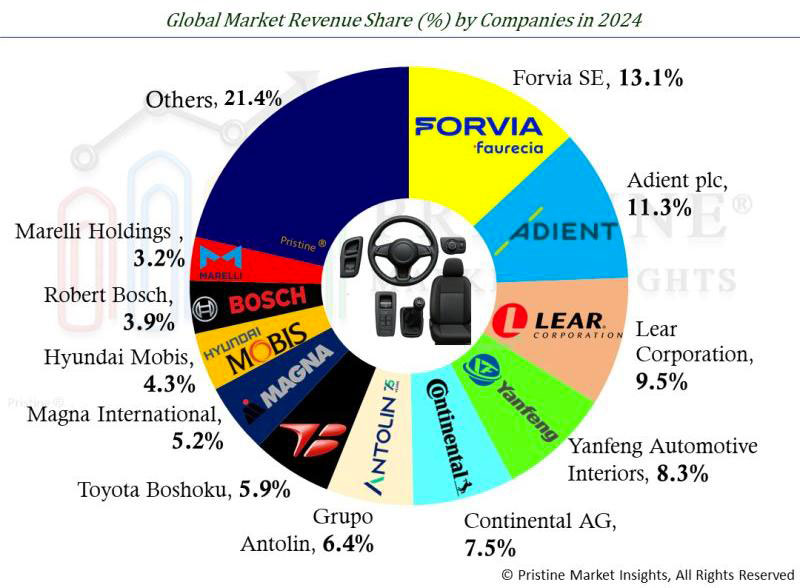
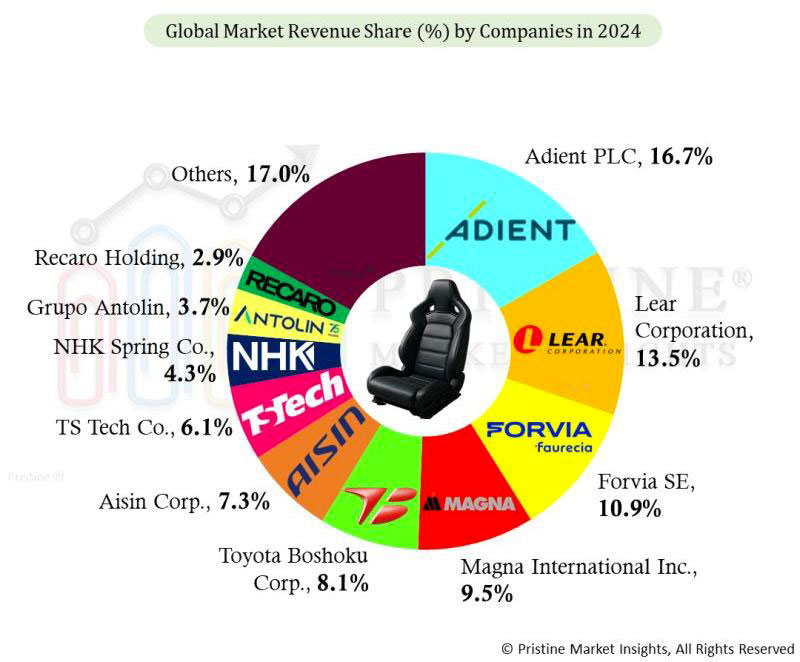
Pristine Market Insights has published this market share chart. The three biggest seat suppliers are Lear, Adient, and Forvia, and seats are a major chunk of the interior business, with a market much more concentrated than the rest of the interior. And, within seats surface materials represent a high percentage, mainly because of leather costs.
This review doesn’t cover the overall market volume forecast, especially nowadays with high level of uncertainty. However, our purpose is much more to anticipate which type of features and technologies could be expected for car interiors.
Key influencing factors
The three major influencing factors are:
- Need for more affordable vehicles, reflecting also cost reductions
- Integration of digital technologies, also named ‘smartification’ or ‘smartphone-on-wheels’
- Lightweighting and car length reduction to support energy efficiency and city/traffic compatibility
Of course, these aren’t the only factors. There’s electrification, safety, and everything around sustainability and environmental regulations.
Interior Trends
- Gesture and touchscreen controls are replacing physical dashboard buttons.
- AR displays are being integrated into ‘smart’ dashboards.
- ‘Smart’ surfaces with haptic feedback, replacing traditional controls or displays.
- Driver monitoring with camera, to be extended to mood monitoring
- Entertainment anywhere, anytime; especially when recharging
- Sustainable and recycled interior materials.
- Natural, recyclable, and biomaterials
- Vegan materials, no leather? And leather alternatives
- Interior lighting systems
- Lightweight composite materials are reducing overall vehicle interior weight.
- NVH control is more important, in EVs with less powertrain sound.
- Comfort features, like seat massage
- Cabin hygiene and safety (child), such as COV reduction, air purifier, antimicrobial surface coatings etc.
Seating
Seating Trends
- Lightweight seat structures, or at least with several components with light metals (Al), composites.
- Power seats with memory function
- Sensors integrated to monitor occupant posture (self-adjusting seats), safety, and mood.
- Ergonomic designs enhancing comfort and driver health support.
- Massage features
- Ventilated and heated and climate seats
- Audio systems, per seat
- Sustainable, eco-friendly materials for seats, emphasis on PU Polyurethane alternatives
- Modular seating systems allow flexible interior configurations, thanks to new use cases in automated scenarios (180° swivel?, full flat comfort for nap?).
- Rear-seat enhancements focus on entertainment and passenger experience
- Longevity of seats will be crucial as car sharing becomes more popular.
What does it mean for Interiors?
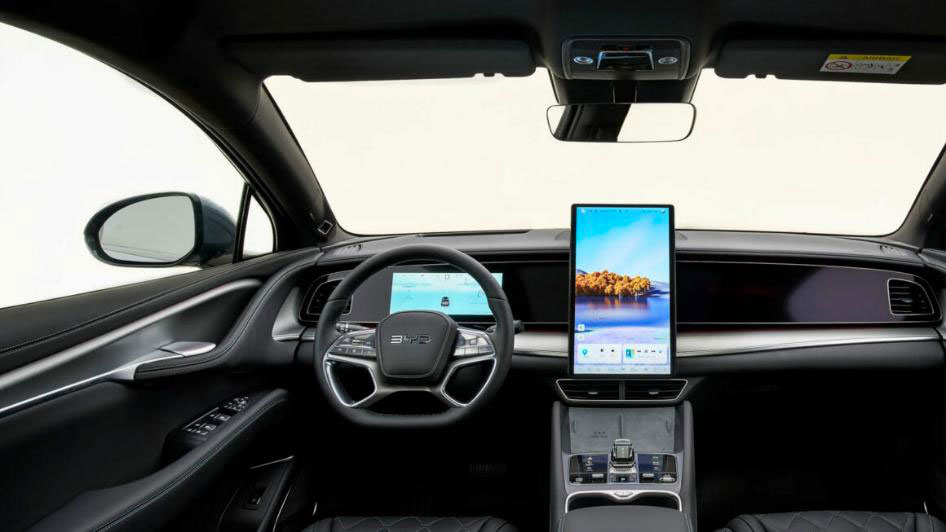
Lightweighting boosts demand for interiors made from composites and polymers that reduce overall vehicle weight without compromising durability or aesthetics. Seating is the most impacted system
Affordability also means development in materials and electrical components to reduce production costs, and features such as basic infotainment systems, Bluetooth connectivity, and user-friendly interfaces – enhancing value without compromising price sensitivity.
Premium brands like BMW, Mercedes, Audi, and Volvo will continually invest in enhancing cabin aesthetics, comfort, and technological features to maintain brand value and customer loyalty? It goes with high-end interiors, coupled with the demand for noise insulation, advanced infotainment systems, and high-grade upholstery, and it will significantly contribute to market expansion.
The replacement of buttons with displays was the HMI revolution in vehicles. We’ve seen in many recent product plans that it is not that simple, and then a balance is necessary. Voice commands are coming up, and cars begin to learn from their drivers. HMI are designed to give drivers a variety of ways to interact with vehicle features. Manufacturers are now collaborating with the digital world to develop more innovative and disruptive HMI. Passengers will also be mentioned in HMIs. In-car infotainment systems will be able to provide everyone in the car with the activities they want while also connecting them to the outside world; continuity with home/office world is key.
Noise insulation has impact on headliners, cockpit modules, door panels, seats, and which must be specifically designed to provide comfort, grip, and to improve noise absorption.
Environment

Regulatory frameworks around sustainability and safety are accelerating innovations in automotive interiors. Stringent emission norms have pushed the industry to prioritize lightweight and eco-friendly materials, driving demand for bio-based fabrics, recycled plastics, and natural fibers.
Cities and local authorities are more and more trying to reduce the impact of vehicles, resulting in taxes and limitation on CO2 emissions.
Costs
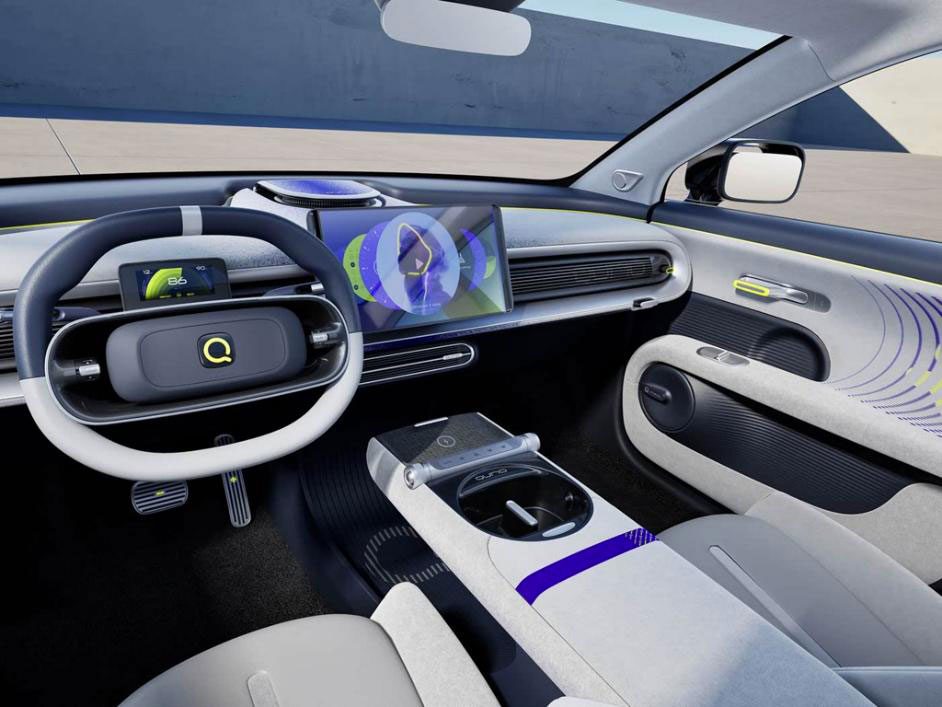
Although the prices of interior materials market are going up and down, reflecting petrol erratic fluctuation, impact of digital and electronic components remain significant. Share of a vehicle’s electronic system was only 1 to 2 per cent of the total vehicle cost, but due to the rising trend for UX, smartfication, and convenience features, the share of such systems has now increased to upwards of 12 per cent of the total cost. As a result of the high cost, high-tech solutions and features are currently only available in high-end luxury vehicles. For instance, Power front row seats 8-/10-way adjustable, middle row or rear captain seats with reclining function, big display, and infotainment system with cameras, gesture controls, dual-zone climate control, ventilated seats, and massaging seats, all represent major costs.
All these comfort and convenience features are pushing the car cost envelop far out what affordability means. Let see where we’ll land?
Conclusion – (Product Planning)
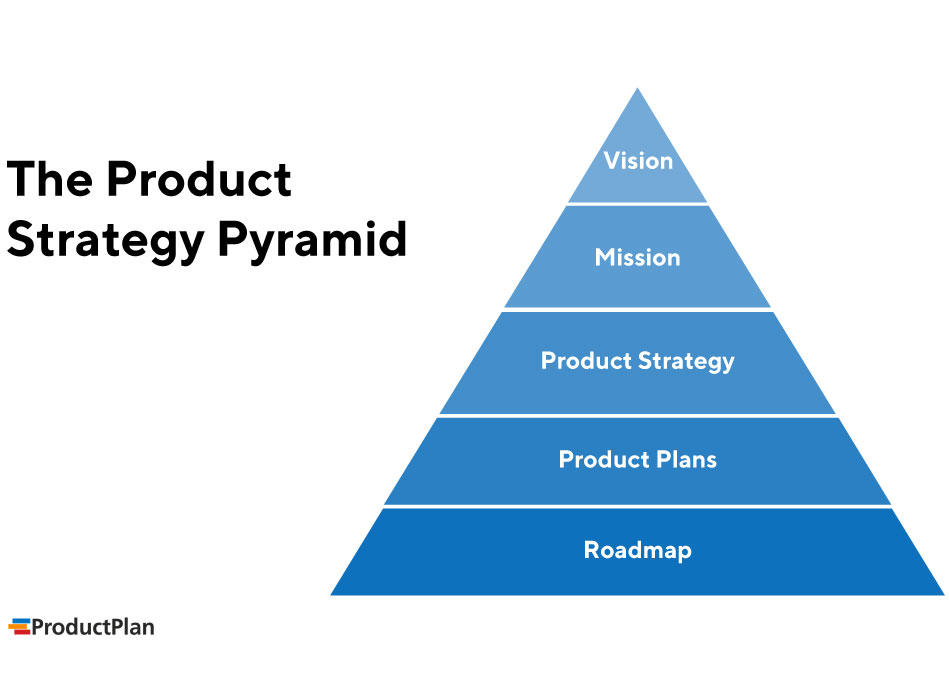
To ensure that the vehicle has the right features to succeed in the target markets, interior components must be developed 2-3 years ahead of SOS – start of sales. It a costly and time-consuming process, wherein product planners must be accurate enough to predict what should be done ahead of time. .
And if the feature (as an option) doesn’t sell, investment is not that expensive, and development of an alternative feature is not such a challenge, cost and time wise.
That is the whole story of the Chinese industry, named fast-fashion for the clothing industry or consumer electronics; their short development time drives high reactivity, and the ability to develop when needed, and not when planned within a hypothetic planning process.
Learn more:
https://www.mordorintelligence.com/industry-reports/automotive-interior-market
https://www.pristinemarketinsights.com/automotive-and-transportation-market-insights


