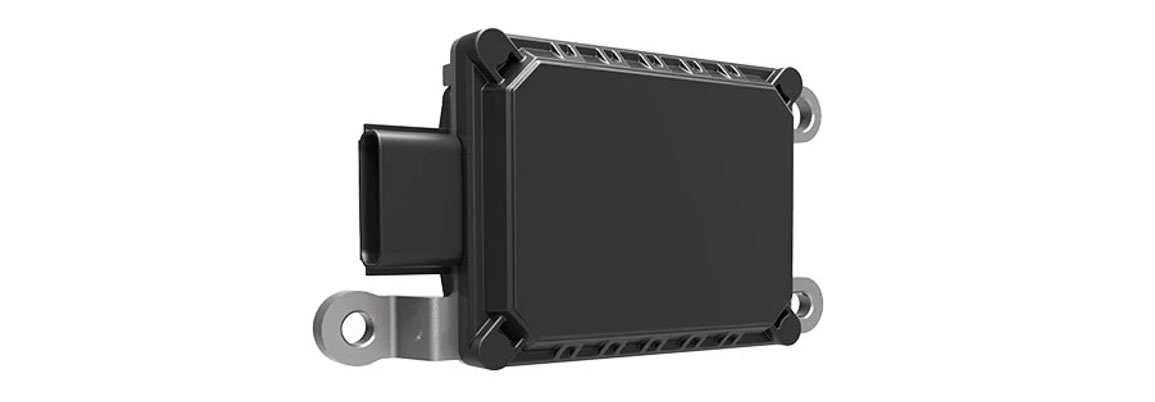
NXP unveils third-generation imaging radar processors

NXP Semiconductors has introduced its third-generation S32R47 imaging radar processor using 16nm FinFET technology, offering up to twice the processing performance in the radar MPU and a 38% smaller IC footprint than the previous generation. It includes AI/ML support for features such as enhanced direction of arrival (DoA) processing and object classification.
Combined with NXP’s mmWave radar transceivers, power management, and in-vehicle networking solutions, the S32R47 family meets functional safety ASIL ISO 26262 ASIL B(D) requirements.
Imaging radar uses richer point cloud data for more detailed modelling of the environment, which is important for AI-based perception systems that support assisted and autonomous driving.
The S32R47 incorporates a high-performance multicore radar processing system, allowing denser point cloud output and improved algorithms for next-generation ADAS systems. This helps to better distinguish objects, enhance detection reliability, and accurately classify objects such as vulnerable road users or lost cargo.
According to Yole Intelligence’s Status of the Radar Industry 2024 report, by 2029, approximately 40% of vehicles on the road will be passenger cars with Level 2+ (L2+)/Level 3 (L3) driving automation, with an increasing number of vehicles reaching Level 4 (L4).
“The S32R47 can efficiently process three times or more antenna channels in real-time compared to current production solutions,” said Meindert van den Beld, senior vice president and general manager for radar and ADAS at NXP. “It enables improved imaging radar resolution, sensitivity, and dynamic range, which are essential for demanding autonomous driving use cases, while still meeting the stringent power and system cost targets set by OEMs for volume production.”
DVN comments
NXP provides a portfolio of integrated, secure product families of MMICs, processors and SoCs that address safety requirements and support autonomous driving levels 2+ and beyond. System designers require a scalable, streamlined and integrated processing platform that balances compute agility and power efficiency for radar sensor solutions.
At Auto Shanghai 2025 Multiple Popular Car Models with Calterah Radar Chips Inside for Safer and More Reliable ADAS
Some popular car models with ADAS, such as the BYD models with “God’s Eye C”, AITO models, NIO ET9, Deepal S09, Zeekr 001, etc., have Calterah mmWave SoCs inside their radar systems. Such chips and solutions from Calterah are helping automotive OEMs achieve safer and more reliable ADAS functions.

Advanced Driver Assistance Systems (ADAS) use sensors like radar, cameras, LiDAR, and algorithms to monitor the environment and improve driving safety and comfort. As cars become smarter, mmWave radar is becoming crucial in ADAS. Major Chinese car manufacturers have introduced their ADAS solutions: BYD’s God’s Eye and Changan’s Dubhe Plan 2.0 use 5 radars, while Geely’s G-Pilot and Chery’s Falcon systems use 3 to 5 radars, increasing demand for mmWave radar chips. By the end of Q3 2024, Calterah’s radar shipments surpassed 10 million units.
Calterah has innovated by integrating GaAs/SiGe MMICs and MCUs into a single SoC with Baseband Accelerator (BBA) for radar signal processing, reducing system complexity and costs. They have also produced the first 77 GHz and 60 GHz mmWave radar SoCs with Antenna in Package (AiP), decreasing size, power consumption, and costs. These advances expand applications for short-range radar in vehicles, including door radar, Automatic Parking Assist (APA) radar, and in-cabin radar.

Building on the results of disruptive innovations, Calterah has achieved technological upgrades and improved product performances via continuous innovations:
- Proprietary Radar Signal Processor (RSP) offers an upgraded architecture compared against the BBA, significantly enhancing the flexibility and processing performance of SoC systems;
- Innovative Flex-Cascading® technology, applied in the CAL77C844-AR device from Calterah’s Andes family of radar SoCs, achieves imaging radar via cascading two chips and simplifies the BOM, providing strong hardware support for advanced intelligent driving-assistance systems;
- Calterah’s leading-edge and most innovative Radiator on Package (RoP®) technology provides mmWave signal interfaces, namely the radiators, and enhances the ESD robustness, offering better solutions for connecting waveguide antennas. Calterah’s Alps-Pro SoC and Andes SoCs with RoP®, working waveguide antenna systems, can greatly improve radar detection performances and angular resolution.
With the global average number of mmWave radar per vehicle reaching 3, mmWave radar will continue to support automotive active safety by providing reliable environmental sensing for safe driving. Calterah’s mmWave radar SoC solutions offer performance and cost benefits, enabling large-scale applications of ADAS and delivering driving-assistance experiences to more users.
About Calterah:
Established in 2014, Calterah Semiconductor Technology Co., Ltd. (hereinafter referred to as “Calterah”) is a global leader in designing and developing CMOS single-chip millimeter-wave (mmWave) radar sensors.
Calterah in 2017 mass-produced the world’s first CMOS 77/79 GHz mmWave radar transceiver for automotive use, pioneering in breaking into the automotive OEM market.
In 2019, Calterah took the lead again to launch SoC products with radar signal processing baseband, fully innovating the development and implementation of mmWave radar sensors that are easier to use and more compact with strong performance. Furthermore, Calterah also mass-produced the world’s first 77 GHz and 60 GHz mmWave radar Antenna-in-Package (AiP) SoCs, accelerating the wide applications of mmWave radar in the automotive, industrial, and consumer electronics markets.
DVN comments
Since 2024, Calterah has also established its first overseas office in Munich, Germany, to provide localized support for European Tier-1 automotive customers and further expand into the European market.


