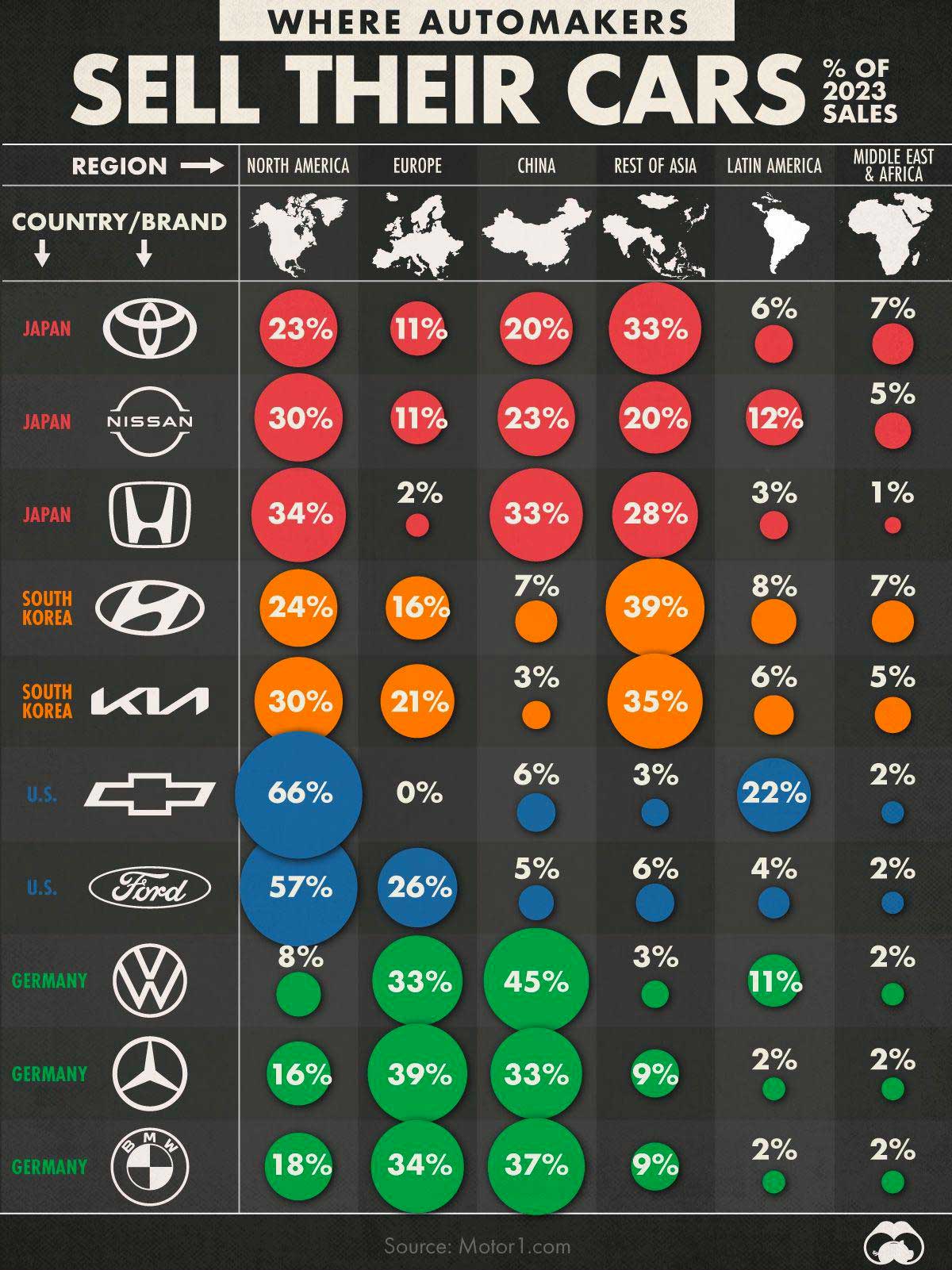
It’s a global automotive market, but which-all automakers are really global? It is interesting to understand where car brands are sold, and how the market is distributed by country. Looking at the 2023 numbers, before U.S. President Donald Trump started a trade war with destabilizing tariffs:
- Toyota is really the pan-Asian car company; 33 per cent of their sales came from the rest of Asia alone.
- Hyundai and Kia are really global, balancing between Asia, Europe, and the Americas. Kia sells more in Latin America (35 per cent) than in North America (20 per cent).
- Volkswagen sells more cars in China (45 per cent) than in all of Europe (33 per cent).
- Mercedes-Benz thrives in Europe (39 per cent) and China (34 per cent), with North America trailing behind.
- GM and Ford still rely heavily on the US; 66 per cent of GM’s sales are in North America. For Ford it’s 57 per cent in North America, and 26 per cent in Europe.
All in all: Japanese and Korean automakers have a diversified global footprint, German brands lean into China and Europe. and American makers are still playing mostly on home turf. These numbers do not reflect the growing presence of Chinese automakers, which are still very Chinese for China. That is changing, driven by electrification, and progressive global development of their manufacturing footprint.


