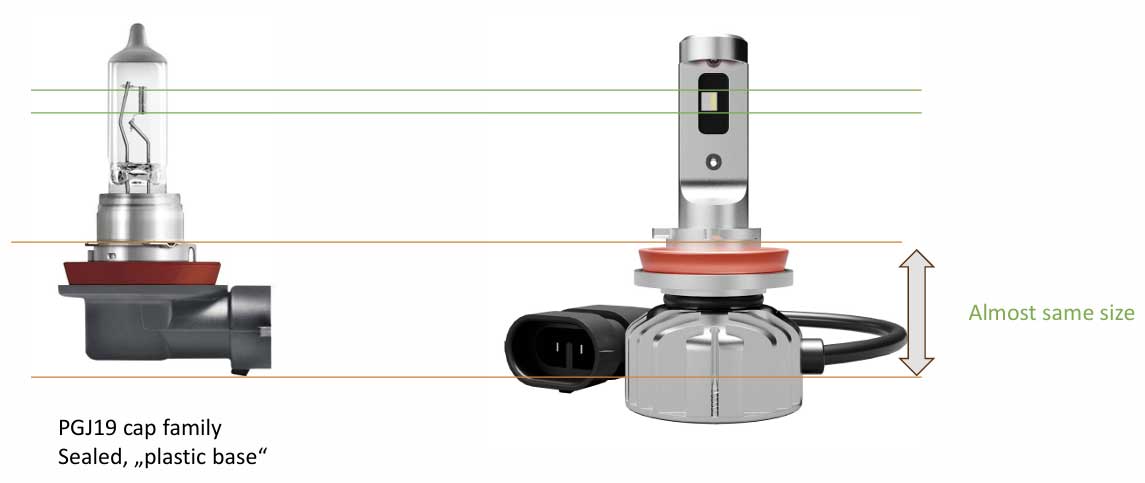
With ams OSRAM having announced the world’s first LED replacement bulbs (“LEDr”) type-approved under UN Regulation 37, vehicle owners will be able to remove halogen H11 bulbs, install the new LEDs, and drive off — no matter what kind of vehicle they have.
Up to now, the closest thing possible was for the vehicle owner to consult a list to see if a particular LED bulb was approved for their particular lamps in their particular vehicle in their particular country — since 2020, ams OSRAM have sold more than four million LED bulbs with specific-country, specific-lamp, specific-vehicle approval — so the universal approval under R37 of OSRAM’s new H11 Night Breaker Smart ECE is quite a breakthrough.
Yes-lists like this can grow quite cumbersome, and getting a bulb approved at the national level requires tests including validation of photometry, mechanical and electrical compatibility, including EMC, and solutions to address possible false triggering of bulb-outage indicators.
Now, with the R37-approved bulbs, a list of vehicles also exists, but it’s an easier one to manage and maintain, for it contains only those vehicles whereon specific installation instructions are necessary. Buyers of the R37-approved H11 LED bulbs will find the link on the package to a website with this information; if their vehicle is not on the list, it means no additional action is necessary — just drop them in, check the aim, and drive off.
The obligation to make this kind of information available on the internet is presented in R37 §.2.2.1:
Providing (a) website address(es) where the applicant shall publish up-to-date listing(s), for which the approval holder is responsible, of lighting and light signalling functions installed on vehicle models, specified by at least brand, type, model, and manufacturing period of the vehicle.
The H11 LEDr category specification in R37 allows for a slightly larger light source base and optional connector on a harness, which could affect mechanical compatibility. On OSRAM’s new H11 LEDr bulb, the bulb base is larger in diameter than that of a halogen H11, and the connector is at the end of a cable, not directly on the bulb. The purpose of looking at the installation-caveat list on the website is to check compatibility to make sure that the LED bulb will fit in the lamp and on the vehicle.
To avoid RFI-EMI, LED replacement bulbs must also fulfil UN Regulation 10 requirements incorporated by reference in §3.4.7.3 of R37:
The LED replacement light source shall comply with the technical requirements to an electrical/electronic sub-assembly (ESA) as specified by Regulation № 10 and its series of amendments in force at the time of application for type approval.


