Bentley was founded in 1919 and became legendary in motorsport during the 1920s, winning the prestigious 24 Hours of Le Mans five times between 1924 and 1930. The founding slogan, still valid, was:

The “Bentley Boys,” a group of wealthy and daring drivers, embodied the brand’s adventurous and competitive spirit. Bentley was acquired by Rolls-Royce in 1931 after the Great Depression, and shifted toward luxury vehicles. Models like the R-Type Continental of the 1950s showcased the brand’s ability to blend high performance with opulent design.


In 1998, Bentley was acquired by the Volkswagen Group, who revitalized the brand with significant investments in technology and production. Modern Bentleys, such as the Continental GT and Bentayga, fuse traditional craftsmanship and cutting-edge engineering.

Bentley have a long history of design, technology, and perfect execution. If you have a focus on lighting, a lot of details from previous cars can be seen in current vehicles. Bentley have always put a lot of effort into even very small details; this is a key difference between premium and luxury vehicles.

Bulb shields, headlamp cleaning systems, and light stalks are some beauties you could not really imagine.

To obtain this kind of result, Bentley’s R&D and design team have put a lot of effort into optical simulation. Their tools include TV displays with very high brightness (20,000 nits) to see all possible faults and simulate with accurate luminance. They hold a Speos licence including a VR lab to be fully immersed in interior cockpit to analyze colour-matching between interior lighting and surfaces (including woods and coatings, for example) and sun reflections on chrome and on displays.
Starting from A-class surfaces defined in studios, the Bentley team can get full immersive simulation within a month — that would be totally impossible with real physical mock-ups. Bentley’s Speos expert can adapt and change optical properties of materials and optical surfaces (e.g., graining) to improve homogeneity or reduce reflection, to speed up development loops between the studio, the lamp suppliers, and all the interior panel suppliers.


To do so, the Bentley team invested in HPC (high power computing) just for lighting to boost VR simulation, to use the tool at its maximum power capacity. They do these VR simulations with different mannequins, from 5th-percentile females to 95th-percentile males (different positions), for lighting as well as HUDs (head-up displays), regular displays, reading and stowage lighting, waterfall lighting, puddle lights, and visibility of red light outside the car — a regulated thing in R48, never easy to handle.
Bentley’s heritage is not just luxury, but also performance. I had the chance to drive the Continental GT with its 48-pixel ADB on archetypical British small curvy roads. The experience was really good. The ZKW headlamp provides 1,050 lumens on low beam and 2,400 lumens on high beam — an enormous amount of light on the road, which provides for perfect vision.

Bentley changed strategy on the new Continental GT. From a ±10° horizontal spread of high beam, with Imax of 139 kcd, they’ve increased the global flux to 2,400 lumen, meanwhile they increased the horizontal spread to ±20°, reducing the Imax to 97.5 kcd (that was enough for me). This provides a very comfortable panoramic vision.
The headlamp comprises three lighting units. On low beam, the three units are lit. One module provides the low beam foreground and high beam range, while the other two are 24-pixel modules for the cutoff and ADB high beam (see previous DVN article Design Award for ZKW Light Module).
What is interesting with this concept is the compliance of this module with SAE and ECE photometric requirements with software settings. There’s no need for different hardware, different headlamps, to meet different regulations. For a low-volume automaker like Bentley, it makes great sense to reduce proliferation of hardware variants.
We concluded the discussion with a higher view to see what challenges they have today. The Bentley team gave me five main items they are now focusing on:
- Close working with Style/ UX and Project, to define clear requirements and roadmaps
- Close working with the group to develop new functionalities for light, to increase communication by light (autonomous light, charging status show with grille and rear lamp, road projections…)
- Possibility of on-demand, OTA personalization of the videos and animations
- Increase interaction with Bentley apps
- To scout new suppliers and technologies, through supplier tech shows and visits to far-East suppliers
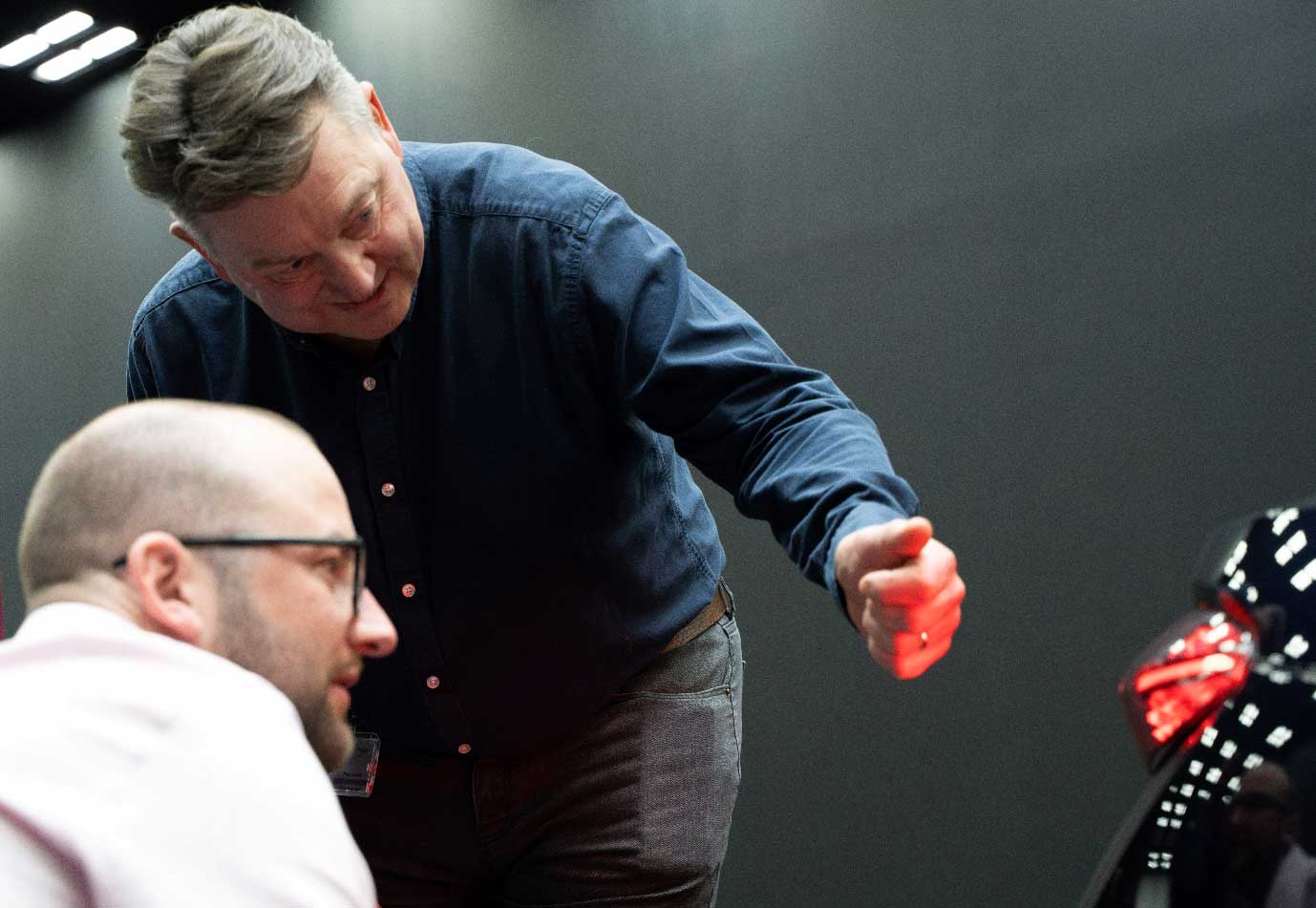
Great pictures of the team, taken by Raphael Rottmair:


