Aledia is a spinoff of CEA-LETI, in the Grenoble region of France, and they’ve already launched several major semiconductor companies. DVN’s Paul-Henri Matha and Jean-Paul Ravier talked with Aledia sales managers Frédéric Moutier and Félix Marchal, about their innovation in nanowire diodes.
Aledia’s 3D GaN nanowires are a technology delivering enhanced brightness and energy efficiency, along with superior pixel density and resolution. Their three-dimensional structure allows precise control of light emission, making displays more efficient and well suited for advanced applications such as augmented reality and other high-performance display solutions.
They have developed — after more than 10 years’ R&D efforts and 300 patents — three main types of nanowire LED:
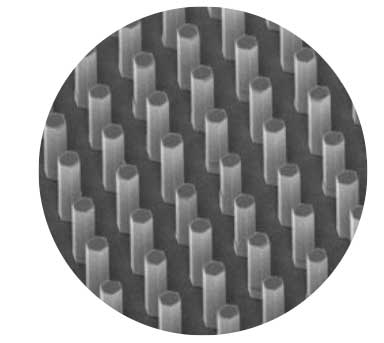
- Nova Blue MicroLED ALD-LD-000X for cost-competitive MicroLED mass production for small and mid-size displays (tablets, laptops). Their chip size, from 15 × 30to 3.5 × 3.5 µm2 achieves a record external quantum efficiency (EQE) of 40 per cent, and up to 1.1 billion chips can be produced per 8-inch wafer (scalable to 12-inch).

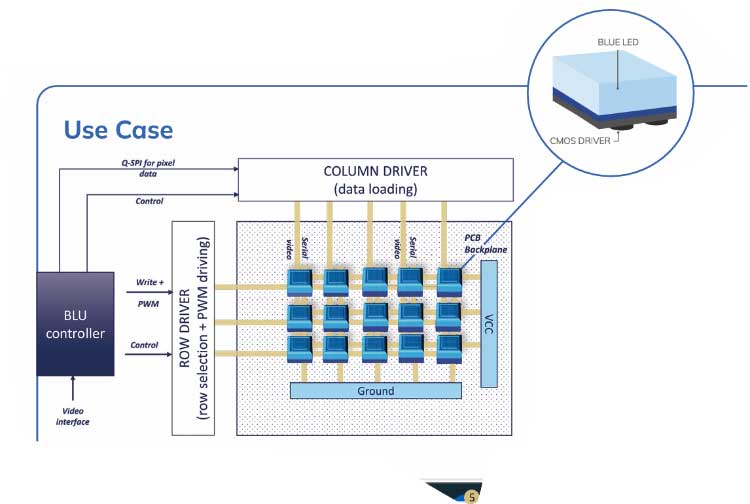
- Blue Digital LED (ALD-SP-0004) for high-performance display applications like virtual reality, automotive central information displays, HUDs, televisions, notebooks, gaming and professional monitors. These are a 2-in-1 component with the blue-emitting LED integrated with CMOS driving electronics equipped with on-chip 16-bit data memory and PWM current driving capability, and on-chip compensation for non-uniformity, and with a peak luminous intensity of 50 mcd per chip at 25 °C, allowing also reduced power consumption.
- Colour and RGB micro-displays (ALD-MD-2001, ALD-MD-2002, ALD-MD-2003, ALD-MD-2004) to optimize power efficiency and form factor for augmented-reality optical engines and AR glasses. These use gallium nitride nanowires grown on silicon substrates to display either single colours (red, green, blue) or all three. Their sub-pixel pitch can be as small as 2 µm sized for a 3 × 5 mm, supporting 720p and QHD resolutions. Thanks to nanowire technology, the light emission is optimized within a ±20° cone without the need for microlenses.
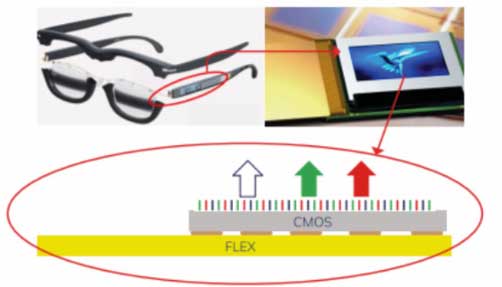
This allows a very good power consumption — from ⅙ to ½ that of traditional solutions — with good reliability and colour stability.
Aledia currently produce 5,000 silicon-based wafers per week, with mass-transfer operations being carried out by their customers, as well as colour conversion. The target markets are mainly the display and telecommunications sectors.
One of the important potential markets is virtual reality glasses.
For larger screens, only blue LEDs are available, and colours are possible by dint of quantum dots.
Aledia are ready for mass production, with a major start of production by their customers scheduled for 2027.


