RoboSense’s New 192-Beam Digital Automotive Customizable Lidar

RoboSense has launched the EMX, their new 192-beam high-performance automotive digital lidar. They describe it as setting a new industry benchmark, accelerating the mass adoption of digital lidar with unmatched performance, integration, and customization capabilities.
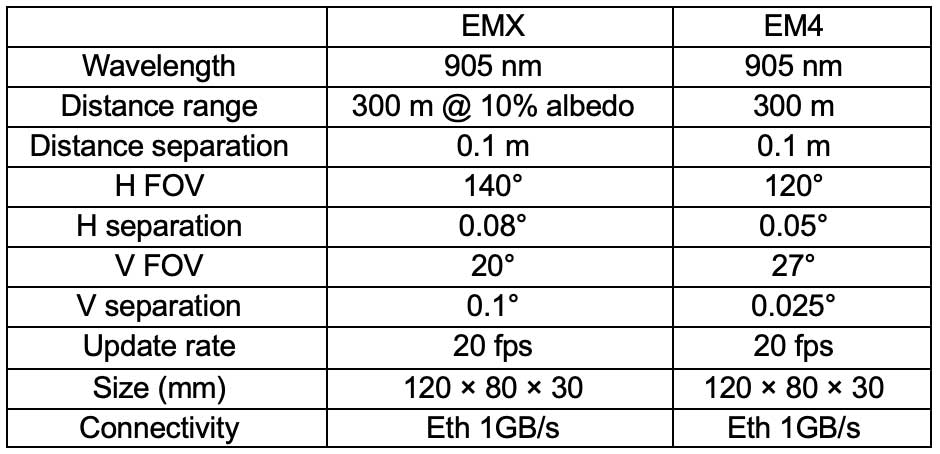
The compact EMX features an upgraded intelligent ‘gaze’ function, and supports extensive customization. With RoboSense’s EM platform digital advantages, the EMX delivers 192-beam high-density scans, producing 2.88 million points per second, with global angular resolution of 0.08° × 0.1°, and detection capabilities within 300 meters. It can detect objects such as black vehicles and traffic cones within 200 meters.
It integrates RoboSense’s proprietary scanning technology, combining control algorithms with scanner dynamics for scanning rates up to 20Hz — exceeding industry standards, and significantly cutting response latency to improve the equipped vehicle’s ability to react to pedestrians or execute fast lane changes safely. With up to a 140° FOV, the EMX can dynamically increase horizontal angular resolution up to six times.
It functions well under challenging environmental conditions, with features like anti-reflectivity interference, noise reduction for rain, fog, and dust, and resistance to contamination and water stains. It uses SPAD-SoC and VCSEL chips to provide high detection sensitivity and maintain data integrity, improving spatiotemporal synchronization and fusion perception outcomes. It measures 120 × 80 × 30 mm, making it one of the smallest digital automotive main lidar units.
The EMX product design has received industry recognition and earned design wins from multiple automotive OEMs upon launch. Production will start within the year.
RoboSense provides comprehensive lidar capabilities including emission, scanning, and data processing. Their digital lidar portfolio supports various automotive and robotic applications. This year, they introduced products such as E1R and Airy for robotics, and EM4 and EMX for automotive use.
For example, the ID.ERA, SAIC Volkswagen’s first range-extended full-size SUV concept car, debuted at Auto Shanghai 2025 with an EM4 Lidar. The model has a range of over 1,000 kilometers (CLTC) and includes an intelligent assisted driving system that covers high-speed, urban, and point-to-point navigation without requiring maps. The design features ‘German simplicity’ and ‘Eastern aesthetics’, integrating intelligent sensing components like lidar into the car body for a futuristic appearance. The production version of the ID.ERA is anticipated to launch in 2026.
These products establish industry standards and allow RoboSense to customize solutions quickly. For instance, the EMX has up to 384 beams for advanced driving, while the EM4 meets high-end needs with up to 2,160 beams, providing ultrahigh-definition options. The EMX launch expands RoboSense’s digital lidar portfolio, offering customizable solutions that support continuous innovation in automotive and robotics sectors.
EMX versus EM4
DVN comments
RoboSense’s market success stems from market-driven collaboration and ongoing innovation. By March 2025, RoboSense partnered with over 30 automakers and tier-1 suppliers like BYD, Zeekr, and IM, securing more than 100 vehicle models. In early 2025, RoboSense supported the launch of 15 models, including Toyota bZ3X, GAC Trumpchi S7, and Geely Galaxy E8. According to Yole Group’s report, RoboSense held a 26-per-cent global market share for passenger car lidar in 2024, ranking first in market share, annual ADAS lidar sales, and cumulative shipments from 2018 to 2024.
Hesai’s Infinity Eye Lidar For L2-4 AD Systems
Hesai’s Infinity Eye solution comes in three configurations: A for L4+ autonomous systems, B for L3 conditional autonomous driving, and C for L2 assisted driving.
Infinity Eye A: UltraHigh-Definition, Zero Blind Spot Perception for L4 Autonomous Driving

Infinity Eye A combines four ultrahigh-definition AT1440 lidars with four solid-state FTX lidars to offer full 360° coverage with zero blind spots. This configuration provides both long-range and short-range detection, ensuring comprehensive awareness for autonomous applications like robotaxis and robotrucks.
Infinity Eye B: Extended Range and Comprehensive Perception for L3 Autonomous Driving

Tailored for L3 conditional autonomous driving systems, it has a forward-facing, long-range ETX lidar and two FTX lidar for blind-spot detection. This multi-lidar configuration balances extended ranging capability with wide-angle field-of-view perception, essential for L3 driving tasks, where the vehicle self-drives in certain situations while allowing for human intervention.
Infinity Eye C: Compact and Powerful Lidar for L2 ADAS

Infinity Eye C is designed for L2 ADAS and includes the ATX lidar, with a 200-meter ranging capability at 10 per cent reflectivity, up to 256 channels, and an angular resolution of 0.1° × 0.1°, which allows for the detection of distant obstacles. The ATX uses Hesai’s Intelligent Point Cloud Engine (IPE) to filter out over 99.9 per cent of environmental noise, providing stable perception in all weather conditions. Its compact design and low power consumption enable flexible integration into the vehicle body or behind the windshield.
Alongside Infinity Eye, Hesai offers three additional automotive-grade lidar products:
AT1440 ultra-high definition lidar

This long-range lidar is the world’s highest-channel-count automotive-grade ultra-high-definition lidar. Powered by Hesai’s fourth-generation proprietary chip, it features 1,440 channels and a ranging capability of 300 meters @ 10% reflectivity. It uses cutting-edge high efficiency photodetection and parallel processing technology, increasing lidar channel count by 10 times compared to similar products on the market. With a point rate exceeding 34 million points per second, the AT1440 delivers over 45 times the point cloud density of mainstream automotive lidars. This enables highly precise perception of small objects on complex urban roads, as well as subtle surface changes like bumps and dips. The AT1440 will enter mass production in the second half of 2025, debuting on Kargobot’s first-ever future transport robot, and will also be deployed in Kargobot’s mass-produced L4 autonomous truck platooning solution, supporting the large-scale commercialization.
FTX solid-state blind spot lidar

The FTX is the world’s widest field-of-view fully solid-state lidar, featuring an ultra-wide 180° × 140° field of view. It delivers over twice the resolution of its predecessor, while reducing the exposed window area by 40 per cent. It effectively covers blind spots around the vehicle and accurately detects low-profile obstacles such as curbs, pets, and other small objects to enable precise automated parking. It can monitor fast-approaching vehicles from the rear and sides in real time, providing critical support for safe lane-change decisions.
ETX ultralong-range lidar

The ETX automotive lidar boasts the longest range for L3, with a 400-meter range at 10-per-cent reflectivity, thanks to Hesai’s Photon Vector Technology. It offers eight times the resolution of the AT128 lidar with 0.05°H × 0.05°V angular resolution. The ETX is compact, maintains Class 1 eye safety, and reduces size and power consumption. It has secured multi-year nominations from a leading European automaker, with mass production to start in 2026.

DVN comments
Hesai is leading in the fast-growing ADAS passenger vehicle market, especially in China. Since 2018, about 120 vehicle models have adopted lidar, with nearly 40 new models launched in the last two years. Lidar is moving beyond luxury vehicles to more affordable models, including C-segment cars around $25,000. This democratization resulted in a 68-per-cent growth in the ADAS passenger car lidar market year-on-year in 2024, a significant industry milestone.


