Touch-sensitive screen? Or interactive projection? Automakers are pursuing different concepts for displaying digital content in the car.
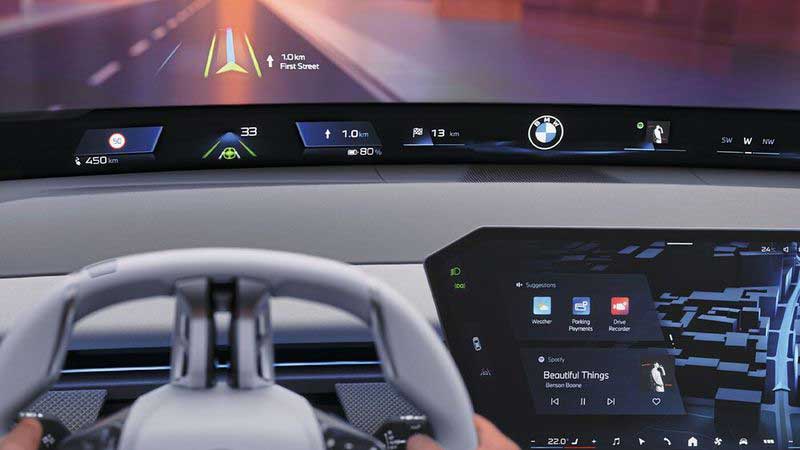
BMW uses both! They do not want to follow the trend of increasing display surfaces in the cockpit. Projections on the windshield will play a major role in the manufacturer’s upcoming vehicles. A projection provides the essential information for the driver and front passenger. This shifts all displays in the car upwards and thus more into the driver’s field of vision. The objects in the windshield are given a 3D effect and are no longer only visible from the driver’s seat. All occupants can see the projections on the head-up display.
The Panoramic Vision from BMW includes a projection surface in the lower area of the windshield. This surface has a black background so that content is clearly visible in all lighting conditions. The entire width from the left to right A-pillar is used for this purpose. A total of nine areas are available for information. Three elements behind the steering wheel inform the driver about their current speed, permitted speed, remaining range, time to destination and activated assistants. The remaining six areas can be freely assigned. You can choose from the “MyLife”, “MyCar” and “MyJourney” sections. These can be music tracks, weather forecast, direction or the visualization of the voice assistant. A round head with large eyes then appears on the projection screen. The selected content is dragged upwards from the central screen to the desired position using your finger.
For the first time, the voice assistant is visualized on the Panoramic-Vision surface. The occupants see the feedback on the implementation of the voice commands in Panoramic Vision, the head-up display or on the screen.
Even the “New Class” from BMW will not be completely screenless. The concept cars have a touch-sensitive screen (17.9”), which moves closer to the steering wheel. The sides are tilted 72.5° towards the driver, giving the impression of a parallelogram.
Mercedes-Benz has achieved a width of 141 cm (55.5″) with their MBUX Hyperscreen. Visually, it looks like one screen surface, but it comprises three OLED screens. The slightly-curved OLED screen delivers 5K resolution whose content is easy to see even in bright sunlight. This is ensured by a contrast ratio of two million to one. Driving information is displayed in the driver’s area, while the front passenger can select the content. In car mode, they are based on the time of day and location of the vehicle.
Hyundai Mobis presented a holographic projection at this year’s CES in Las Vegas. A 100-micrometer-thin film from Zeiss is applied to the screen to create a spatial effect for the viewer. The exhibit at the trade fair also showed the use of the lower area of the windshield. Information for the driver as well as the selection of media and other digital content is projected across the entire width.


