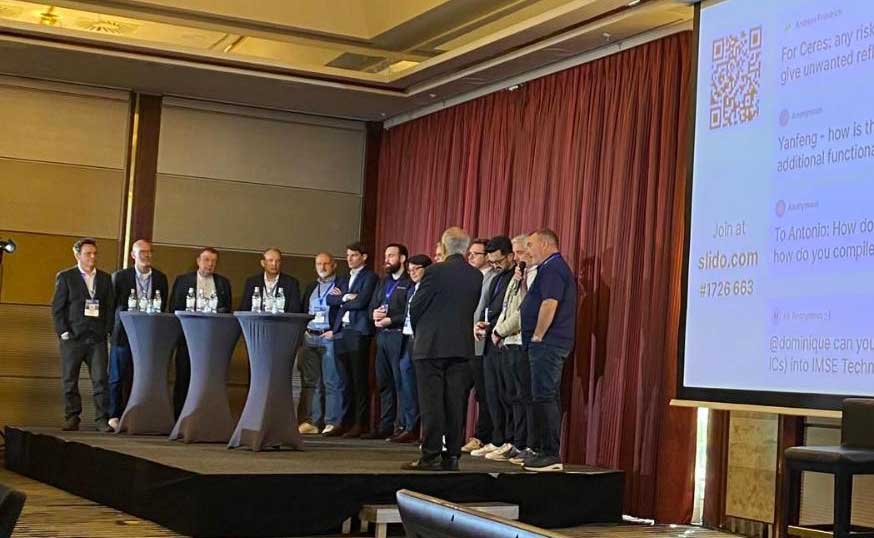
Cockpit trends as stated by Ceres and et al include:
- Windshield displays including HUDs, transparent displays, and panoramic type will coexist, with reduced focus on distracting touchscreens
- Critical status and feedback information will be displayed near the driver’s direct line of sight in a comfortable manner that is not cognitively overloading
- Tactile buttons and switches in easy reachable position, on any surface (including smart surfaces), usable without looking, will return to be a major part of automotive HMI
- Multifunction steering wheels (MFSW), with new software control platforms, will assist display of content in the optimal and least distracting way.
- Cluster display moving higher towards line of sight
UX Done the Polestar Way
(Antonio Cobaleda-Cordero, Polestar)

The Cockpit/HMI session started with Polestar Design UX Research Lead Antonio Cobaleda-Cordero, who shared some of the design values and principles behind Polestar’s approach to UX.
UX is paramount to build the story of the vehicle interior; it creates magical moments.

Like in a smart phone, visuals should participate, with meaningful support. Everything must be tested, like icons, colors, typography, etc. Design and design details are also reflecting the Polestar approach, where it should show, not tell!

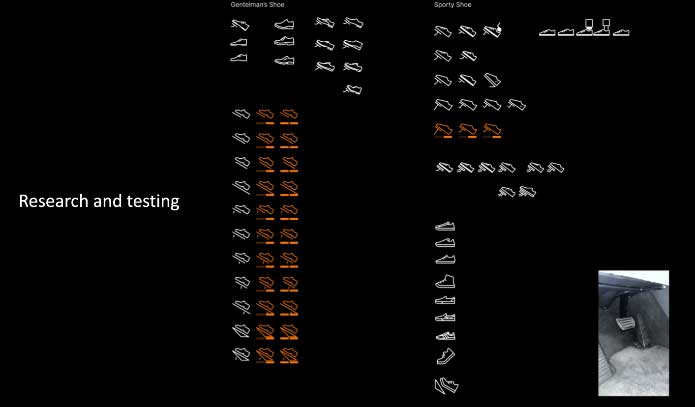
User Experience and Emotions
(Xavier Chalandon, Renault)


Xavier Chalandon, Renault’s HMI Master Expert, described how user experience is the appraisal and behavior induced by the interaction with a product, system or service; it is holistic, expressed by values which can be structured better in a honeycomb, not really in a pyramid (Maslow).
Experience comes through perceptions and sensations, mental models and representations, physical and psychological responses, behaviors, beliefs, emotions, preferences, and so on.
Chalandon gave the example of an instrument cluster appraisal, where both pragmatic vs hedonics appraisals elicit effects.

Experience goes beyond usability and look & feel. Experience is emotion + feeling. Emotions last only seconds, when feeling last hours; what is important is what we think after hours, and what we get when exiting the vehicle is the peak of feelings at the end! That’s what makes emotional more memorable than functional.
Connected Ecosystems & Seamless Interiors
(Hugo Mestre, Novares)

Hugo Mestre, Novares’ Innovation Director, presented the company’s partnership with TG0 for active plastic with smart shape for HMI solutions. This set of solutions has fewer parts and components, and uses less material.

We enter a new era for plastics—’plastronics’—to address industry needs for design freedom, affordable costs, and sustainability. This solution bridges the gap between controls and smart surfaces, it adds a brick to the display.
HoloFlekt Windshield, Safer Driving and New Display UX
(Andy Travers, Ceres)

Andy Travers, CEO of Ceres Holographics, described his company’s HoloFlekt windshield. He stated that automakers must prioritize safety over glitz when it comes to how drivers interoperate with information. This does not mean HMIs can’t be sexy and cool, as the latest transparent display HUDs and AI voice activation features demonstrate; but they must keep cognitive distractions to a minimum. Travers said research demonstrates that physical buttons outperform touchscreens; we need more controls for less distraction!
Ceres and their ecosystem have a configurable and scalable holographic-enabled laminated windshield solution, developed with Eastman Saflex and Vanceva, and Covestro. It is production-proven, automotive-certified, and far along in evaluation stages at several automakers around the world.
SDV, From Cloud to Cockpit
(Frank Uhlig, Elektrobit)
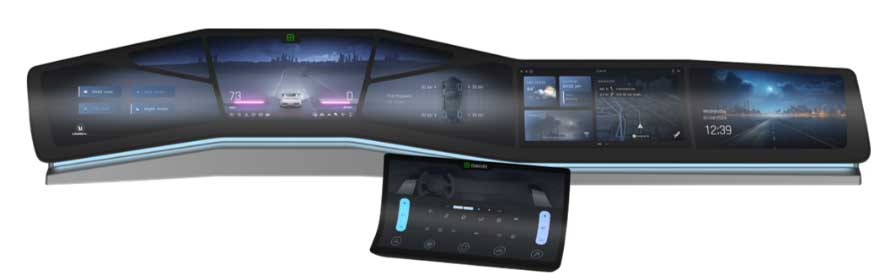
Considering it’s a struggle for engineers to implement the correct styling from the design. It’s also time-consuming for designers to check if engineers have implemented the right color, font, and spacing during internal QA sessions. Design will always be subject to sudden changes of heart; designers want to see different colors or fonts, which is a big pain for the developers.
Starting from these HMI pain points, decoupling UX/UI, using design tokens, central and tiny pieces of UI information to store design related information such as colors, fonts, spaces, animations, and so on.Their benefits are that they can be transformed and formatted to meet the needs of any platform
Elektrobit has developed a set of processes and tools called Theming Engine. It minimizes friction between design to code processes and supports easy skinning of the HMI.
Elektrobit currently develops a cloud-based solution for infotainment systems, which allows for flexible development without being tied to specific hardware.
Plastic Based Touchscreen Panels and Displaylike Switches for Auto HMI
Dr. Wolfgang Clemens (PolyIC)


There is large potential for plastic-based display and touchscreen panels, with molded plastic panels, integrated / embedded touch screen sensors, optical aspects (e.g. anti reflection), and special features (e.g. hidden display decoration, static display). He reminds us of the process technology used, IMD (in-mold decoration), which has great potential to substitute glass panels in many applications. These plastic-based display panels with IMD decoration have good optical parameters (close to glass), high design freedom (form, outline, decoration, premium look), easy combination with backlighting / switches, and typically lower cost than glass panels. The talk concluded with application examples, with Datamodul for Hidden Display, with AMS Osram for miniLEDs integrated to decorated plastic panels (Aliyos), and interactive luminous soft textile surface with touch sensors (Mento’s Rainbow-Textile).
Sunrise
(Demetrio Galindez, Antolin)

Demetrio Galindez is Antolin’s Global HMI Product Development Manager. He presented Sunrise, a cockpit concept engineered for seamless transition between manual and autonomous driving, developed with the support of VIA Optronics. They provide optical bonding, glass lens, displays, touch technology, and camera solutions. Antolin leads integration of HMI, display, lighting, and electronics.
Key features of the concept are adaptative UX (manual and autonomous; driver and passengers), smart surfaces (technology and control available on-demand), and immersive experience (dynamic ambient lighting that extends display content throughout the cockpit, enhancing air vents and design lines), digital backlighting effects with matrix light and miniLED, and overall using eco-friendly materials (PersiSkin, Seaqual). Immersive experience is phygital!
The Mighty Touch
(Prof. Dr. Wolfgang Weinhold, Innowep)

Prof. Dr. Wolfgang Weinhold, from Innowep, spoke about “The Mighty Touch”, and Haptic and Durability as an HMI Function. Based on his work as an academic teacher for IPSA (Institute for Surface and Product Analysis), he reminds us what is haptics: the sense of touch, perception with the hand as an interactive organ in different phases of use (contact, grasping, palpation). He separates touch haptics (tactile) and motoric haptics (kinesthetics), with motion sensitivity. Touch is our primal sense, and each time we touch (a screen), it triggers that natural instinct, that fundamental feeling. The example of bank notes haptics analogy was very informative.
Consumer research, through panels, shows correlation of subjective ratings withobjective machine measurements; Signy is this translator, measuring haptic, dependent on the test, its geometry, material properties, micro- and macro topography, effective contact area, and applied load and speed. Signy supports quality assurance in R&D, to differentiate ‘expensive’ and ‘cheap’ material, to feel criteria vs. measurement parameter , and overall to identify trends.
Series-Ready IMSE for Smarter Cost-Effective Interiors
(Dominique Heilborn, Tactotek)

Tactotek Automotive Director Dominique Heilborn described how after years of development, with participation by their full ecosystem, IMSE is ready to go into production. Its development reflects patience and perseverance.
Tactotek does not manufacture, they create technology, which they then license. Now, it is serial production ready, tested and released, scalable for mass production.
Applications include surface light, light channel, smart surface, with its complete eco-system (design rules, role of partners – component, material, equipment, scientific, service, film, injection, …), training, knowledge, tools, etc.
SDV to Experience Defined Vehicles
(Pierre Sigrist & Olivier Cros, Epicnpoc)
The name of the company comes from ‘epic’ intention of UX designers plus POC for proof of concept, a kind of prototype for software developers. Epicnpoc develops digital prototypes from customer intentions with their Bowl software for fast prototyping solutions. Since its beginning in 2018, Epicnpoc has delivered 25 major concept projects to the likes of Forvia, Novares, Renault, and Mercedes.
Bowl follows an E steps agile approach:
- Connect features to actual functions / services / hardware / tools
- Define GUI layouts
- Describe the Customer Journey (Features, GUI Contents, Interaction logic)
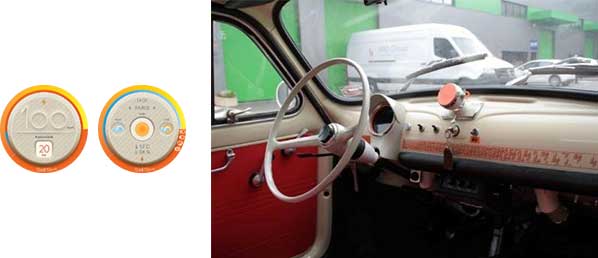
One example was a new cluster in a retrofitted Fiat 500, to transform the mechanic speedometer into a modern cluster. Another one is Forvia Horizon, their masterpiece at CES 2024.
Their offer includes ideation and specs definition, development (rush in 3-4 weeks), and experience on real prototype.
Laser Surface Treatment Tech for Innovation, Luxury, Sustainability
(Max Blackwell, Reichle)

The objective is to make boring interior parts interesting. Reichle Technologiezentrum is an 80-person, family-owned company developing laserwork technologies to enhance surfaces for look, haptics, and function. The company’s technology can generate 3D effects on a 2D surface.


