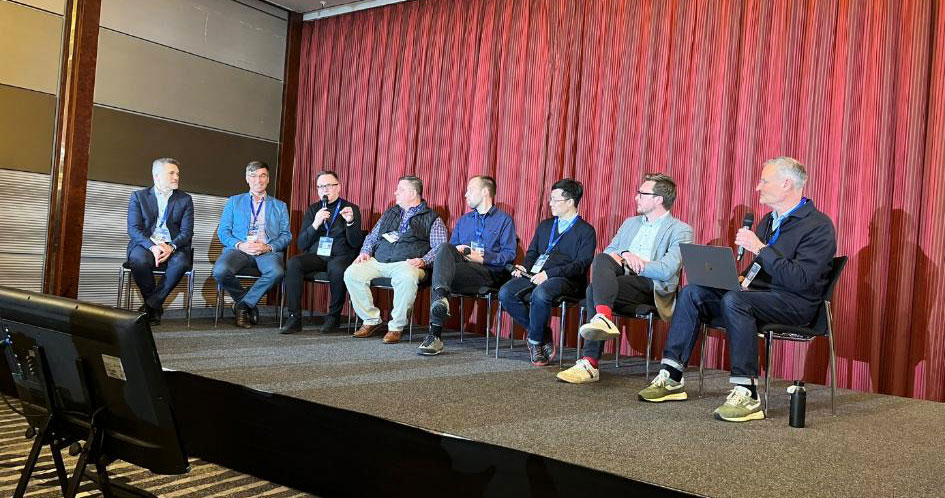
To close the Köln DVN Interior event we had a panel discussion with the theme ”Design” related to the topics (UX, second living room, cockpit, displays, interior lighting) shown during the event.
The following participants took part:
Davide Casini – Chief Technical Officer Italdesign Giugiaro
Mathias Rönnfeldt – Managing Director SP3
Thorsten Süss – Industrial Designer, Design Director NBHX Trim Group
Kevin Mulligan – Light specialist and studio engineer. GeelyDesign
Robert Striedieck – Interior Design & Lighting expert ex. ZEEKR
Guang Yang – UX/UI Designer. Advanced UX designer Diconium, a VW company
Frank Uhlig – UX/UI designer Head of UX/UI design Elektrobit
The panel was chaired by Andreas Friedrich, Senior Interior Design Expert, late of Polestar, Geely Design, Lynk & Co, Volvo. etc.
First Kevin Mulligan explained his role of Studio Engineer at the Geely Design studio, a common role at any design studio in the world but not known to everyone. A studio engineer is the bridge between engineering and design, with the specific task of boiling down all technical requirements to the bare minimum for the designers to do a proper job and vice versa, and to be the design advocate in discussions with engineering to get all creative ideas across and convince the engineers that it´s absolutely doable within the given constraints. A rather challenging but fun role sometimes.
Then we discussed the interiors of tomorrow and how they might look like.
We have seen pillar-to-pillar screens, driver screens becoming smaller and freestanding, CSD (center console screen) becoming bigger and freestanding, some automakers are merging the driver and CSD screens into one, and in all of this the HUD or ARHUD is trying to play an important role too. The participants believed we will be seeing more simplified layouts in the future, more minimalistic and physical interaction points will come back to cater for the new Euro NCAP requirements where you need to have certain functions with physical buttons to get 5 stars in their rating.
Guan Yang pointed out what he already mentioned earlier during the event that there is a huge difference in how Chinese people use their cars versus how we use them in the EU. It´s already more of a second living room and hence the needs are very different.
Robert Striedieck told us a bit about his graduation project from Umeå that was about how we can keep the fun part of driving a sportscar when cars become autonomous. You can read more about it here. So far, he hasn’ seen anything in that direction yet – it’s still too early.
We also discussed the need for personalization and if UX is one of the main differentiators when EVs become more similar in technical capabilities, range, battery size etc. How interior lighting could be one important player in this but more and more colors is maybe not always the right way to go. Polestar has curated themes with light that works well with the interior CMF so you always will have a great-looking interior, while others let the customer decide totally.
At the end we touched upon the fact that smart surfaces are basically plastic parts with electronics inside which often becomes a challenge for automakers and tier-1s when such part falls between the responsibility of different departments, typically interior trim department, CMF people, and electronic engineers, not always easy. At the design departments and certain tier-1s they were getting used to these new technologies and had their internal collaboration working fairly well.
So overall: many interesting aspects of design to discuss and always too little time, but all in all a good way to end the conference with this discussion.


