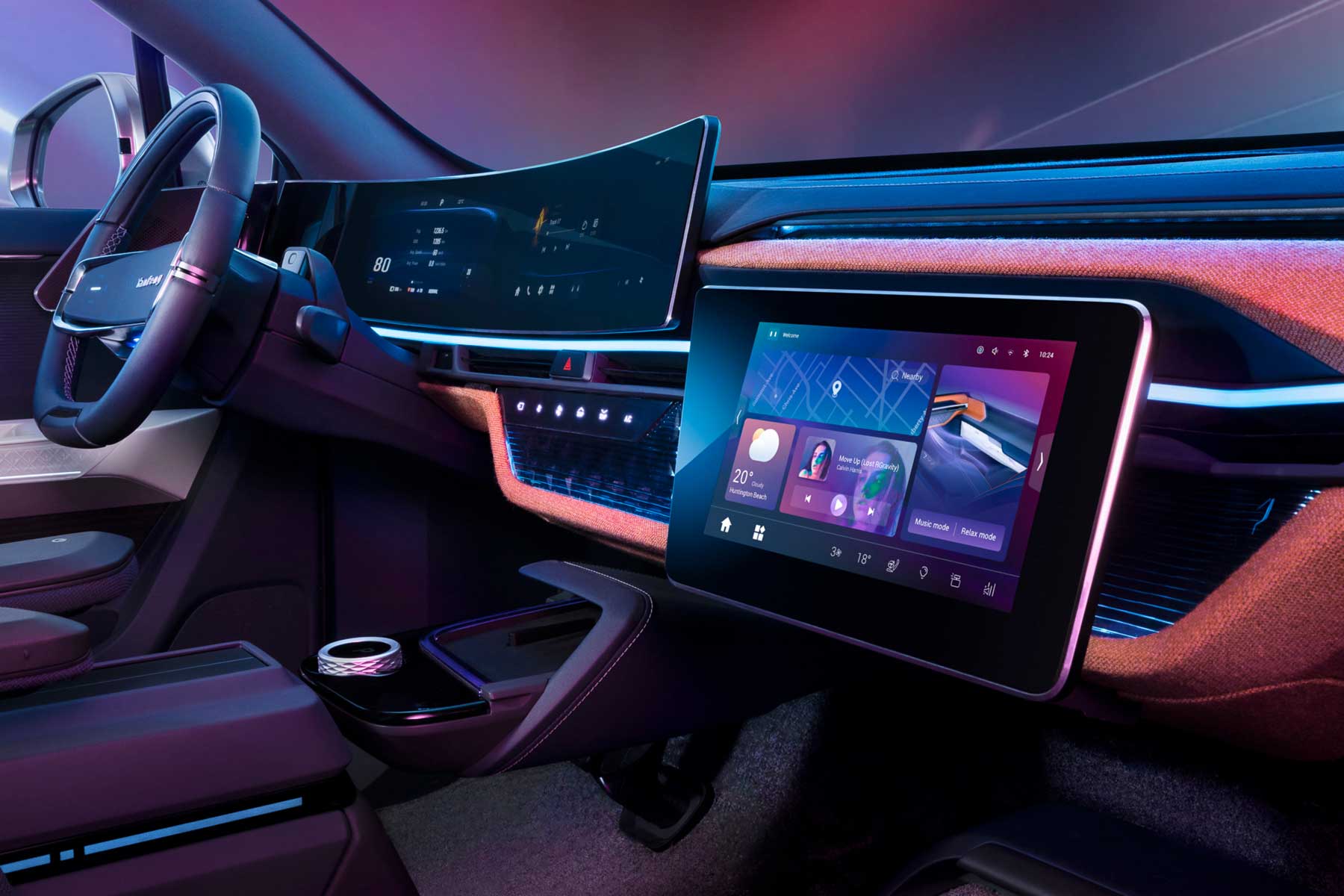

Yanfeng CTO Patrick Nebout gave a keynote presentation entitled, “Automotive Interior, China Perspective”.
He said the NEV market share in China will exceed 75 per cent by 2028, with rapid growth of PHEV & REEV (range-extended EV) segments.

The premium sector of the market keeps an upside momentum, with a lot of new NEV brands setting their sights on high-end buyers. These emerging companies are aggressively challenging traditional premium brands and defining new premium BEVs. Examples include Zeekr, Polestar, Nio, Li Auto, Aion, Aito, Xpeng, and more.
NOA (navigation on autopilot) is a key battleground for automakers; it is evolving from highway-only to urban NOA. In 2025, uptake of NOA at L2 and above will exceed 50 per cent.
From an in-cabin perspective, the following features lead innovative trends:
• Diversifying seat functions: sliding, rotating, health-monitoring, fatigue-warning, adaptive adjustment.
• ‘Smart’ surfaces for new HMI: touch controls integrated with decorative trim and lighting.
• New interior lighting modes: single-color ‘breathing’, music-sync, real-time variation.
• Exquisite craftsmanship, detail design, texture optimization.
• Artificial intelligence models enable multimodal interaction for new kinds of in-cabin HMI. Advances include more accurate, fluent language recognition; humanlike interaction, and simulated emotions.
• Multi-sensor integration.
• Multimodal interaction: visual, auditory, tactile, olfactory.
• Personalized entertainment recommendations and driving assistance
• Advances in climate control and health management, entertainment and vehicle information services.
All this means enhanced cockpit functions for personalized UX. In that respect, the vehicle is no longer a mobility space, but a living space.
Vehicle development is not driven anymore by vehicle configuration with a feature list as long as possible, but by use case scenarios. It goes from car-centric, to user-centric.
Mr. Nebout used three examples to illustrate these trends: the Aito M9, Stelato S9, and Yanfeng Smart Cabin.
Aito M9

Aito is the first brand under Huawei’s Harmony Intelligent Mobility Alliance (HIMA) collaboration model, in which Huawei leads the product design and development process and supplies key components such as the powertrain, ADAS, and vehicle software, to deliver a completed design for the automaker to manufacture. The name Aito stands for ‘Adding Intelligence to Auto’. Features include:
• Smart welcoming mode, UWB precise sensing, rich lighting effects
• MagLink Display System: a Huawei tablet can be attached to the seat backrest via MagLink, enabling multi-screen interaction
• Cinema mode, with dual zero-gravity seats and a 32″ retractable projection display
• Camping mode, with flat-lying 1st row to form a bed
• Outdoor KTV mode, with 100″ display for watching movies or doing karaoke, projecting lyrics, and selecting songs with your phone
Stellate S9

Stelato is a Chinese premium EV brand established in 2024. The brand operates also under HIMA, a collaboration between BAIC BluePark and Huawei. They lay claim to:
• First zero-gravity mode in sedans, including for rear passengers
• Motion sickness relief mode, using Huawei’s Xmotion intelligent vehicle body coordination control system to provide seamless acceleration and deceleration and stable posture
• Privacy mode, with seven opaque curtains; one click disables the in-car microphone and camera; there’s also a one-touch personal sound zone.
• Cinema mode uses a 32″ retractable projection display. The image remains stable at 80 km/h, even with all four windows open.
• The ‘Healthy Cabin’ has an automatic fresh air system, and the seats are covered with an organic antibacterial coating.
Yanfeng xBU smart cabin


The Yanfeng xBU smart cabin includes what the maker calls a ‘Smart Safety System’, integrating the seat belts and airbags along with SafeUnit®️ technology (see our previous coverage). The seating ECU is integral, and the smart cabin also has innovative switches, armrest display, heating, adaptive components, and sustainable construction.
There’s a narrow, square, foldaway ‘smart steering wheel’ enabled by drive-by-wire. Lighting is integrated with decoration, ambient effects, branding, mood support, and display functions.


